All posts by Dentbros

Obedience in your dog: is it worth it?

Obedience – why your dog will thank you for it

I’m such an old nag.  Always going on about practising this obedience with your dog, work on that with your dog.  Then they will be better behaved and your problems will be gone.  Really?  Or am I just saying that because I have ‘easy collies’?  Yeah, it’s probably that.

This week, I have had a few occasions to be grateful that my dogs are well behaved.  And a few times when I have found myself feeling sorry for a dog who has not been trained to behave nicely. This morning, for example, the girls and I encountered a lovely looking Labrador up in the woods.  He was on lead, and as my girls filed past at a safe distance, not making eye contact (miserable buggers I know!) he leapt across the path towards them in a joyous, exuberant way.  The woman holding him was hanging on for dear life (he was much stronger than her) and making placatory comments to him.

The lifestyle of your dog

I confess I felt really sad for that dog.  I considered the life of my 5 Border Collies:

  • An hour’s walk off lead every morning, in 5-6 different locations each week
  • Free access around the large house and garden for the rest of the day
  • At least one really mentally and physically challenging training session per week
  • Life in a pack of 5 dogs – with plenty of companionship, play and engagement with each other
  • Regular, daily training sessions with me, either on walk, at home or in class
  • Busy (and now Luna) also goes into school for 3 hours per week to work

What does your average single dog in a family home get, if he’s lucky?  A walk, on lead, along the same paths?  Cuddles and pats from family members?  Toys to play with?

It’s no wonder then, that this dog is absolutely beside himself to see 5 potential playmates go by.  You would be too, wouldn’t you?  But equally, if some large person came rushing into your face, you would not say “how lovely to meet you” would you? Training that dog would:

  • engage his brain
  • reinforce his relationship with his owner
  • allow him to actively engage with other dogs without being a pain in the arse!

Obedience and safety

Another reason for having dogs that understand obedience is when an emergency arises.  Of course if your dog is always on lead, they probably won’t run towards danger, but what if (like this morning’s Labrador) they are really strong and get away from you?  How would you cope if they were running off towards a road?  Do you remember Fenton?

Incidentally, I saw a muntjac out in the open up on the Heath this morning, searching for a drink.  So deer are a real issue.

Stop the dog

This is the training you need.  It’s not competition level obedience, just an ability to make your dog wait when you need it to.  Something like this:

Now I am not going to promise that if you teach a stop, you will be able to prevent your dog from ‘doing a Fenton’, but maybe you could stop them from chasing one deer?

Stay calm

I was happy to have some obedience in the puppy when she went into the lake earlier this week.  Due to the drought, the level of the water had dropped so much she struggled to get back out onto the bank.  As soon as I realised, I scrambled down the bank towards her.  It was my turn with the platitudes; it’s OK I’m coming to get you, wait there.  And do you know what?  She did!  Ounce waited calmly, until I got to her and hauled her out by the scruff of her neck.

A final video then, showing me messing around.  I saw someone being able to say their dog’s name and then give them an individual command.  I have tried this, but as you can see, when I say ‘down’ they all tend to go.  This is because I regularly put them all into a down at once.  So I decided to have a go at calling them out of line and then giving them a command.  Mixed results.  But a bit of fun in the sun. Play with your dog it might save their life?

Ask for help?

You are very welcome to CONTACT ME to ask for my advice.  I can help you with a variety of issues and problems around getting a dog and suggestions for tackling training issues.  Go to the What Dog? page for more information on my service.

Please let me know if you have found this post helpful?

Remember..

Please CONTACT ME if you want to know more about me and my dogs?  And feel free to COMMENT if you want to tell me what you think.  If you want to know more, why not FOLLOW ME?  Then you will receive an email when there is a new post.

NB: If you read my posts in an email, you may be missing out on the lovely pictures!  Please click through to my website to see the post in all its glory!


Childhood Dogs: great memories of past dogs

Childhood dogs – teaching us how to look after dogs

I regularly receive enquiries from people looking for Border Collie puppies; I am an Assured Breeder for Border Collie  after all.  Many people come to me because they are thinking of getting their first family dog or their first dog as an adult, having had dogs in childhood.

childhoodWhen I ask people if they have had dogs before, as part of my vetting process, people often say “yes, we had such and such dogs when I was growing up”.  Sometimes people even tell me they have previously owned dogs and it isn’t until I meet them and they talk about these dogs that I discover that the dogs actually belonged to their parents.

What’s the difference?

If your parents own a dog, then it’s yours too, right?  Well maybe.  If you grew up with a dog or dogs, can you answer the following questions:

  • how was your family dog chosen?
  • who chose its name?
  • where did your dog sleep?
  • who was responsible for feeding your dog?
  • who trained your dog?
  • did you walk it regularly?
  • who cleared up your dog’s poo/sick?
  • did you care for it when it was ill?
  • what health issues did your dog have?
  • how long did it live?

Taking responsibility

Living in the same house as a dog is not the same as owning one.  I’m sure plenty of people were able to answer some of these questions, but ultimately, it’s about making decisions.  Starting with what kind of dog to get.  Most children have a dream of owning a dog, but hopefully their parents are the ones making the choice, doing the research and buying the dog.

seaside childhoodVery often parents wait until their children are in their early teens before getting a dog.  This means that by the time the dog is old enough to need care and (often medical) attention, the children have left home.  They therefore miss most of the ‘owning an old dog’ stage.

Adulting – learning from childhood

Just because the dog wasn’t yours doesn’t mean you didn’t learn anything from the dog you owned in childhoood.  Hopefully you experienced the joy of dog ownership. You probably cuddled the dog when you were sad.  It is likely that you ran around with it in the garden from time to time.  I would definitely hope that your parents dragged you out on walks with your dog occasionally, although probably not every day.  You might remember some of the challenges – chewed shoes, accidents, fighting.

Look back on these experiences in childhood with a dog and understand what you learnt and what are the limitations?  Be realistic about the fact that it won’t feel like that to you, as an adult?  Read about 10 common mistakes made by new dog owners?

childhoodOne of my puppies went to a lovely young family where the husband had grown up with collies.  Sadly, the puppy developed epilepsy and they had an extremely challenging eight months before she was put to sleep.  Not what they signed up for.  Be prepared for the fact that it’s not all cuddles and carefree walks in the sunshine.  It is mostly that though.

Ask for help?

You are very welcome to CONTACT ME to ask for my advice.  I can help you with a variety of issues and problems around getting a dog and suggestions for tackling training issues.  Go to the What Dog? page for more information on my new service.

Remember..

Please CONTACT ME if you want to know more about me and my dogs?  And feel free to COMMENT if you want to tell me what you think.  If you want to know more, why not FOLLOW ME?  Then you will receive an email when there is a new post.

And if you receive my posts via email, remember to click through to the site to see the photos and lots more information.

Miniature Dachshund – interview with an owner

Miniature Dachshund: a pocket full of fun!

Today we are hearing from Nina, who is telling us all about Fudge.  The Dachshund is another dog in the Hound Group, but one in a different league altogether from the Greyhound!  Originating in Germany where he is known as the Teckel (badger dog) the Dachshund is still used for both tracking wounded game such as deer and for going to ground after badger or rabbits.  In the UK there are two sizes, with miniatures preferably weighing under 5 kilograms.

There are three coat types in each variety: the Smooth haired, the Long haired and the Wirehaired and the six varieties all share the same breed standard, divided by size and coat.

dachshund“I always knew I wanted a Miniature Dachshund from when I was very young. I just thought they were adorable and so I had my heart set on getting one.”

Stubbornness again!

Nina says they bought Fudge from a family who were unable to cope with him and who advised that he was not getting along with their female Dachshund at the time. [Note from a breeder: please return your puppy to the breeder if this happens?  Good breeders will ALWAYS take their pups back] Fudge was 4 months old when Nina got him.

Nina had researched Dachshunds heavily before deciding to get one.  All the information suggested that they are a very stubborn breed who are difficult to train! 

“Whilst his stubbornness does show through on occasion, he has been an absolute dream to train and is an incredibly fast learner! This does mean though that he is also very quick to pick up bad behaviour, so you need to be vigilant and consistent with any form of training.  This is tough and frustrating when you know he knows how to action the command, but he simply chooses not to!”

Nina says she has also had to train her partner, as he has not owned a dog previously.  He has had to be taught to remain consistent with his commands to Fudge!  Nina feels that Fudge learns more quickly than any of her family’s other dogs.

dachshundSeparation anxiety

When he first arrived, Fudge did exhibit some of the typical separation anxiety issues that had been talked about with his breed.  As Nina and her partner both work full time, this was hard to deal with at first.  Nina works close to home, so she went home at lunchtimes to feed him and keep him company.

“With some training, an Adaptil plugin, and some soothing “doggy sleep music” we managed over a matter of weeks to reassure him that we would be coming home and there was no need to bark and howl at the top of his voice whenever we left the room! This also worked well for bedtimes when Fudge was left downstairs to sleep. Since this, he now goes to bed on command without any fuss and doesn’t whine when we leave the house.”

Cuddle Monster

Fudge enjoys showing off and was a clear front runner in his puppy training class. He seemed to know instinctively what to do; where other dogs were still learning after 7 weeks Fudge had mastered it after a couple of examples in class.

A Miniature Dachshund is very lovable and loves to be around people.  Fudge gets on well with babies, toddlers and other animals and so is very friendly and not shy at all.dachshund


“It is true what they say about them having a big personality for a little dog.”

Unfortunately, Miniature Dachshunds are described as ‘Velcro dogs’ because they want to be around you ALL THE TIME.  This was true of Fudge initially as he was reluctant to use the garden for toileting unless Nina or her partner were out there with him!  With some tough training on his separation anxiety (including tough love when he was howling the place down at night), he quickly out-grew this phase.  However, it is very important not to pander to them when they do this as they are so quick to learn!

Because they crave attention, the Miniature Dachshund is hard to stop from doing something, because any action you take provides attention.  The best tactic is to ignore the undesirable behaviour and distract them away with something else.

Back problems

Breed health issues with the Miniature Dachshund can include eyesight (PRA- Progressive Retinal Atrophy) and also problems with their backs, due to their shape and size.

The back problem is IVDD (Intervertebral Disc Disease) which may result in future surgery. Because of the shape of the dog, it is best not to let them jump on and off of furniture and up and down stairs.  Nina says this is easier said than done!  She monitors Fudge’s weight closely, since this can put excess strain on their spines.  Delaying neutering can also help to reduce the likelihood of them suffering IVDD in future.

“Fudge has had a bit of dry flaky skin. We were recommended to use Yumega Oil, which is added to his breakfast.  After a matter of days, this has made him flake free.”

dachshundLittle legs, but plenty of exercise

At the moment Fudge doesn’t walk far as he is still young.  An adult Miniature Dachshund should have around 45-60 minutes of exercise a day (a mix of on lead and free running).  I regularly see one up in the woods and it can clearly cover the distance.  Nina says that Fudge prefers fields to built-up areas.

Nina has found that he needs regular, short training sessions to keep reminding him what he has learnt.

Cheeky habits

As the Miniature Dachshund was bred to hunt badgers, they can dig the garden, so watch out!  They can also slip under a hedge; be aware of this!

Nina says that Fudge does have something of a ‘doggy’ smell, so she has a daily spritz spray to keep his skin moisturised and to keep him smelling fresh.  He doesn’t like being groomed, but doesn’t need much as he has a short, sleek coat.

Overall, Nina highly recommends her breed.  She says he has converted even the least likely dog lovers in the family and beyond.  They suit just about any home due to their size and friendliness.   Thank you Nina for such a great insight xx

Ask for help?

I hope you have enjoyed my insight into owning a Miniature Dachshund?  Please comment and share your views and experiences?  What breed would you like to know about?  Or do you have a breed of dog and would like to share your views on living with your dog?  Please CONTACT ME to let me know?

You are very welcome to CONTACT ME to ask for my advice?  I can help you with a variety of issues and problems around getting a dog and suggestions for tackling training issues.  Go to the What Dog? page for more information on my new service.

Remember..

Please CONTACT ME if you want to know more about me and my dogs?  And feel free to COMMENT if you want to tell me what you think.  If you want to know more, why not FOLLOW ME?  Then you will receive an email when there is a new post.

NB: If you read my posts in an email, you may be missing out on the lovely pictures!  Please click through to my website to see the post in all its glory?

Charity: what can you do to raise money?

Charity: What is the best way to support a charity with your dog?

I am feeling guilty.  I had signed up to take part in the ‘Midnight Moo‘ tonight, walking 10 miles around MK city centre, starting at midnight.  This event is to raise money for the wonderful Willen Hospice.  I think hospices are great places and try to support my local one whenever I can.

However, I am not doing the walk tonight.  My reasons are:

  • Why would I go for a walk without my 5 dogs?
  • I don’t want to walk around the city streets when I could walk up and down the river, between our two beautiful lakes – Willen and Caldecotte?
  • Why would I walk around during the middle of the night, when it’s dark?
  • I have a dodgy knee, which gets painful when I walk

charityWhy do we do things for charity?

Shame on me.  But it’s made me reflect on charitable endeavours and why we do these.  I love to support and donate to charity and  will donate for other people.  I will give money at coffee mornings.  It is great that people run marathons, jump out of planes, climb mountains and cycle huge distances, raising money for charity while they’re at it.

Which comes first, the desire to do something extreme or the desire to raise money?  Why do the two have to go together?  If you want to do something anyway, to push yourself, then surely it’s OK to just do it?  If you want people to donate money to a particular charity, can you ‘just ask’?

Maybe it’s better if you’ve had to sweat.  Perhaps if I made myself stay up all night that would make people think I deserved to receive donations for the charity?  Walking 10 miles is not that hard for me – I walk 3-4 miles every single day, plus all the running around I do at training.

What I do for charity

I volunteer: I have been a school governor for over 15 years, in 4 schools.  During this time I have spent hundreds of hours in meetings and committees, as well as going into school for many other activities.

charityI have also been a volunteer with Busy for the last three years.  We started off doing this through Pets as Therapy, but have recently changed charity, to Canine Concern.  I have been really impressed with the welcome I have had from this charity and the friendly ethos they have.

Canine Concern was formed in 1988 by Eve Waring, who had seen how important dog visits were to the elderly and lonely.  Eve believed in reaching out to people through their dogs.  She wanted to make the group friendly and supportive of each other as well as to the people, young and old, that we visited.  Canine Concern was, is and always will be the organisation that cares for people as well as dogs.

Busy’s work in schools

For the last three years Busy and I have been visiting our local junior school.  We spend two hours per week seeing four groups of children aged 7-11. Busy lies down in the middle of the group, or moves around so that everyone has a chance to pet her and engage with her.

We focus on conversation, developing social and listening skills, for children with a wide range of needs.  Some struggle to pay attention to others, or they may find it hard to sit still.  Many of the children are lacking in confidence and find the time spent with the dog incredibly rewarding.  The school have found the impact of Busy’s visits has been far reaching.  Oh and by the way, I taught Busy to read!

One of the less well recognised benefits of the visits is that the staff interact with her.  I see that teaching and support staff all light up when she arrives and if they can sneak in a cuddle, they do!  I think that having the dog in school is a great ‘stress buster’ for everyone and I know that the staff member I work with sees it as the highlight of her week!

New areas of work

My volunteering has recently expanded in two ways:  I am visiting my ‘governor’ school with Busy once a week.  And Luna has also been assessed as a therapy dog with Canine Concern.

I am also incredibly proud that Charlotte and Bea, Luna’s daughter, will also be starting to visit their local primary school, from September!  Bea will be excellent in schools; she has the same lovely temperament of both her parents.

I started to do assessments of volunteers and their dogs earlier this year and am proud to carry on with this with Canine Concern. I am also going to be taking on the role of Area Coordinator for the charity, helping to bring the volunteers together and provide them with support.

charityPlease donate?

If you have enjoyed reading about the volunteering I do with Busy, why not get involved?  You can:

  • Donate
  • Volunteer
  • Promote the charity to your family and friends

Thank you for your support.  Please CONTACT ME me if you would like to know more?

Remember..

Please CONTACT ME if you want to know more about me and my dogs?  And feel free to COMMENT if you want to tell me what you think.  If you want to know more, why not FOLLOW ME?  Then you will receive an email when there is a new post.

Punishment: A quick quiz for you

Punishment – when should you tell off your dog?

Here something different for you, a quick quiz.  I’m going to give you some scenarios and you can tell me which action you would take – when is punishment appropriate?   Be honest with yourself, it’s just for fun.

punishmentQuestion 1

Your year old puppy drinks lots of river water while on a walk, then pees in the house.  Do you:

  1. Rub her nose it, whilst shouting at her
  2. Go and smack her
  3. Sigh and clear it up
  4. Remind yourself not to let her drink too much when it’s hot?

Answer: 3 and 4

Question 2

Your dog runs off out of sight whilst on a walk. Do you:

  1. Call him positively and excitedly, squeaking a toy.
  2. Wait for him to come back
  3. Chase after him, angrily shouting his name
  4. Remind yourself that you need to carry on working on his recall training, although he is much better than he was?

Answer: 1, 2 and 4

punishment

Question 3

Your young dog jumps up at your husband when he gets home from work and jumps up at visitors.  Do you:

  1. Give her a smack and shout at her for being naughty
  2. Push her off and say ‘Down!’ at her
  3. Ask your husband and visitors to turn away from her and ignore her
  4. Remind yourself that you need to ask people to help you continue her jumping up training and explain what you want?

Answer: 3 and 4

punishmentQuestion 4

You leave your sandwich on a coffee table while you go to the toilet.  You are only gone for a minute, but your dog eats your food.  Do you:

  1. Wonder where your sandwich could be
  2. Yell at your dog for eating your food
  3. Smack your dog to teach it a lesson
  4. Remind yourself that if you leave food in front of a dog, it will only not eat it if it is ill?

Answer: 4

Question 5

Your children love playing with your dog but struggle to leave him alone.  One of your children comes over and puts her face up to the dog’s (whilst he is on his bed) and your dog growls.  Do you:

  1. Praise the dog for being patient with your child
  2. Shout at your child for getting in the dog’s face
  3. Smack your dog for growling at your child
  4. Remind yourself to work with your child and your dog about good interaction and to make sure that you never leave them alone together?

Answer: 1, 2 and 4

Border Collie puppy punishment

Question 6

Your dog snaps at another dog that comes into her face when you are out on a walk.  The owner of the other dog calls out “it’s OK he’s friendly” but your dog growls and shows her teeth.  Do you:

  1. Shout at the owner of the other dog
  2. Give your dog a treat for not killing the other dog
  3. Smack your dog and shout at her for being aggressive
  4. Remind yourself to work on distracting distracting your dog away from approaching dogs and reward them for ignoring other dogs?

Answer: 2 and 4 (and probably 1 as well)

Border Collie punishment
up to no good?

Question 7

You leave your dog out in the garden for a while. When you come back there is a big hole in the middle of the lawn.  Do you:

  1. Beat the dog for being so naughty
  2. Punish the dog by shutting it away for a few hours
  3. Drag the dog to the hole and yell at it
  4. Remind yourself not to leave the dog unsupervised and bored where it can do damage?

Answer: 4 It’s entirely your fault.

Question 8

You come in to find your dog has chewed one of your trainers.  Do you:

  1. Ring the rescue centre because you are sick of the bloody dog
  2. Shout at the dog
  3. Show the dog the shoe and give him a smack
  4. Remind yourself to buy some more dog toys and to tidy your shoes away in future?

Answer: 4

I am hoping that you have enjoyed my bit of fun?  Of course we can all get fed up with our annoying dogs and all their bad behaviours.  However, I hope you can see that it is important to manage our expectations and to understand that any dog is still a dog.  How well it behaves is entirely up to you and the way you manage it.  Some dogs are easier to train than others, but none of them need punishment.

Buy the Workbook

The Workbook – A Year With Your Puppy is available to buy. It was written and designed to be a hands-on, interactive book for you. It will help you survive the first year with your puppy, but also act as a memento of that time and the journey you have been on. You can write notes and stick in pictures of your puppy throughout the year. Lovely!

Remember..

Please CONTACT ME if you want to know more about me and my dogs?  And feel free to COMMENT if you want to tell me what you think. 

NO PUPPIES AVAILABLE

Springer Spaniels – Interview with an owner

Springer Spaniels – they’re bouncy, bouncy, fun, fun, fun!

This week’s breed is the English Springer Spaniel (Springer). They are from the Gundog group of breeds, which means they are scent driven, being bred to flush out prey and return it to their owner.  I asked Kate to talk to me about them, because she has had three; two from puppies and one as a rescue.

Springer spanielsKate says she originally chose a Springer, as many people do when looking for a first dog, because she knew someone who had one!

“I was essentially looking for a dog that I could walk with, that would get me out and about and be a companion when I was working from home.  My shortlist included labs (too big especially if I wanted more than one), retrievers (same reason), Yorkies, Westies (both too small) and cocker spaniel (it was close!).”

Springer by name, Springer by nature

When talking about Springers, the word ‘bonkers’ seems to come up quite a bit.  Full of energy (crazy energetic), but after a good walk are happy to chill out.  Great temperaments and good with children of all ages… and mad as a box of frogs.

Springer spaniels
I think it’s over there mum

“Springers are active, outdoor dogs, with lovely friendly natures.  They are loving, loyal, gentle, people pleasers.”

Kate says she was once told it was ‘impossible to train a Springer to walk to heel’, but she does not believe this.  They are pretty trainable as they are quite bright and very food orientated, although walking to heel does not come naturally to them.  They do tend to ‘go off’ on a walk, as there is always another interesting smell to chase down, just over there.

Regular exercise required

Just like all active breeds, Springer Spaniels benefit from regular exercise.  Kate walks twice a day for 45 minutes, whatever the weather.  Springers tend to run everywhere, but never in a straight line!  They can be just as focused on a ball as a collie, but Kate has never found that to be the case with hers.

As well as regular walks, off lead, where they are able to use their noses, Springers need play.  Kate does this from time to time at home.  This means she doesn’t spend hours and hours glued to a computer and can get on with work when she needs to.  While working she has an accompaniment of gentle snoring!

Despite walking and training, Kate daily has to cope with ‘zoomies’ – loopy time when the excitement takes over and they run around like a lunatic!

Demanding and muddy

Spaniels can by hyper and intense, so if you can’t exercise them this probably isn’t the dog for you.  They are field dogs and explorers that love water (and mud even more).

I spend quite a bit of time pulling sticky weed and seeds out of them during the summer and washing mud off all year round.  Even in summer it can seem strange to come home with a clean dry dog!

Springer spanielsKate says she has never found an ‘indestructible’ dog toy and is on a constant mission to find a chew that lasts for more than a minute.  Although she has not experienced it, Kate has been told that socks, slippers, shoes, underwear, skirting board and carpets are all fair game.

Selective hearing, especially when out on a walk, is a definite trait. They moult, so watch out for dog hair – oh and don’t forget the added dust.

Robust health is typical

Springer Spaniels are another old breed, like Greyhounds, so health issues are rare.  During the summer, ears and toes need to be checked daily for seeds – it’s expensive if they get embedded and infected.

Best home for a Springer?

You need to have the time and lifestyle to provide the exercise they need.  Kate says

“I’ve done basic training with all my dogs – with an emphasis on recall and distance work because they are rarely by my side.  If I’m honest this has been more of a challenge with my rescue than with the puppies but essential to ensure their safety.”

Springer spanielsYou know you have a Springer when…

  • “You have to spend 15 minutes brushing the sticky balls out”
  •  ”Your home is happy, but muddy”
  •  “You’re sitting watching the telly and suddenly a ‘flash’ zooms in and out of the room over all the sofas and out again.  All suddenly ending in cuddles”
  •  “You never eat alone”
  •  “You can’t go on a dry, mud free walk as they find mud in the desert!”
  •  “You can’t find one of your shoes”
  •  “The shoe you can’t find is in the dog’s bed”
  •  “The house looks like a baby’s playpen”
  • “You go one a walk and nobody comments on how ‘beautiful or cute’ he is, because he’s covered in mud and won’t stand still”
  •  “When you see someone with a dry dog and think that it’s odd”
  •  “You wake up in the morning with a tennis ball in your face”
  •  “When you’re out on a walk and they don’t walk in a straight line”
  •  “When you can’t say the word car [or walk or food] without it resulting in zoomies”
  •  “You have a constant show”
  •  “There’s a racetrack round the edge of the lawn”
  •  “You can’t open a food source without one appearing as if by magic”

In the end though, owning a Springer means

“You actually found out what loyalty, friendship and soulmate really means”

Springer spanielsThank you to Kate for the information and the beautiful pictures.  If you want a real treat, please go to Kate’s website for plenty more gorgeous photos?

Ask for help?

I hope you have enjoyed my insight into owning Springer Spaniels?  Please comment and share your views and experiences?  What breed would you like to know about?  Or do you have a breed of dog and would like to share your views on living with your dog?  Please CONTACT ME to let me know?

You are very welcome to CONTACT ME to ask for my advice?  I can help you with a variety of issues and problems around getting a dog and suggestions for tackling training issues.  Go to the What Dog? page for more information on my new service.

Remember..

Please CONTACT ME if you want to know more about me and my dogs?  And feel free to COMMENT if you want to tell me what you think.  If you want to know more, why not FOLLOW ME?  Then you will receive an email when there is a new post.

NB: If you read my posts in an email, you may be missing out on the lovely pictures!  Please click through to my website to see the post in all its glory?

Fighting Dogs – how to cope if your dog is attacked

Fighting in dogs: what should you do?

A friend was telling me that her poor dog was attacked while out walking.  Apparently another dog was running around with a man calling out to him.  This dog ran up to my friend’s dog and went for her.  Needless to say she retaliated and within seconds they were properly fighting.

fighting in dogsIt’s scary and difficult, knowing what to do in this situation.  How do you deal with it?  I’m lucky that it has happened rarely to me in all my years of dog ownership.  I think our first instinct is to try and grab your dog and pull it away.  Don’t do this!  It is quite likely that your dog will turn round and bite you, thinking it is being attacked from behind.  Or you will get bitten by the other dog.

My top tips for fighting dogs:

  • Shout!  A loud, fierce “Get off!” or similar might startle the dogs into stopping.
  • Pick up your dog.  If you have a small dog being attacked by a large one, removing your dog is a good idea, if at all possible.
  • Try to force yourself between the two dogs.  I would be reluctant to do this personally, but you might feel able to.  If your dog is on a lead, you can try physically pulling it off and dragging it behind you.
  • Kick it!  If a dog has run up to yours and started an attack, I think you are within your rights to use your foot to push the dogs apart.  It’s a lot safer than grabbing and should be more effective.  A push with your foot (a kick) is going to inflict less damage than the dog’s teeth.
  • Drop the lead.  If you are not able to intervene, leave them to it.
  • Wait.  Dogs usually attack each other out of fear, or misunderstanding.  It is usually over within a few seconds, even though it might feel like hours.

happy dog not fightingHow to prevent the fighting

  1. Let your dog off lead.  I know it’s scary, but a dog is much less likely to go for your dog if it is not attached to you.  Dogs can communicate with each other perfectly well and given the choice, will move apart or around each other.  When a dog is on lead it becomes guarding of you and unable to move away, which makes it defensive.
  2. Distract your dog.  I have just talked about the importance of being able to play with your dog and this is when to use that technique.  If your dog is not making eye contact with the approaching dog, there is less likely to be an engagement.
  3. Turn and walk away.  Even if you just do this for a few metres, you should find that the situation is diffused.  Again, rewarding your dog’s attention on you will help with this.
  4. Say ‘STOP!’ to the approaching dog.  This is more about distracting the other dog than anything, but might work on some dogs.

Reactivity in dogs

Once a dog has been attacked while out, they may become fearful and ‘reactive’.  This means that they will bark, lunge and snap any time another dog approaches them.  This is horrible to live with.  It makes you as an owner fearful of other dogs while out walking.  It is difficult to train out, because you don’t want other dogs to come near you and get attacked by your dog.

When you have a reactive dog, you keep it on the lead.  You walk at times you think will be quieter, along less busy routes.  Maybe you are constantly on guard, watching out for other dogs.  When other dogs coming bouncing over, with the owner calling out “it’s OK, he’s friendly”, you can become angry or tearful.

You may find it helpful to invest in a Nervous Bandana for your dog.

happy not fightingTeach good manners

Having a reactive dog is not very nice for anyone, is it?  Which is why it is so important to teach your dog good manners in the first place.  Teach your dog to come back to you when you first get it.  Have it on a Long line if you need to have some control.

Teach your dog that not all dogs are bad (in fact very few are, really).  The best way to do this is to meet up with friends for a group walk.  Walking alongside other dogs helps build confidence and you can observe your dog interacting with other dogs.

Reward your dog for ignoring other dogs, either with play, or with treats.

Ask for help?

You are very welcome to CONTACT ME to ask for my advice.  I can help you with a variety of issues and problems around getting a dog and suggestions for tackling training issues.  Go to the What Dog? page for more information on my service.

Please let me know if you have found this post helpful?

Remember..

Please CONTACT ME if you want to know more about me and my dogs?  And feel free to COMMENT if you want to tell me what you think.  If you want to know more, why not FOLLOW ME?  Then you will receive an email when there is a new post.

NB: If you read my posts in an email, you may be missing out on the lovely pictures!  Please click through to my website to see the post in all its glory!

Play with your dog: Why you need to do this

Why does play with your dog really pay off?

Here’s a common problem:

Play“We’ve had an Irish Wolfhound puppy for 7 months now and he’s a great dog, but we are having trouble with him at the dog park, as many other dogs and people are scared of him because of his size!  Do you have any advice about what we should do?”

Teaching good manners

My advice would be: work really, really hard to teach him his manners!  He is not allowed to go up to any other dogs or people unless you say so.  Mega hard, I know!  He is just being friendly and wants to play, but it is not wanted.  It’s no good calling out to people “He’s really friendly, it’s fine!”  No, it’s not fine.  It is your responsibility to manage your dog.

DO NOT CHASE YOUR DOG SHOUTING IN A CROSS VOICE!

The trick is for YOU to be his exciting play mate.  Have squeaky toys and lots of treats. Whenever you see someone else, it’s playtime! Engage him with you, chasing, playing, tugging, being really fun. You must be better than anything else! Then he will look at you, not at what is going by.

playThen he won’t want to rush off and you won’t be calling/chasing after him.  If he starts to go – turn and leg it in the other direction, shrieking wildly!  Idiotic I know, but it works.  Eventually he won’t be bouncing up to others and once you’ve rewarded him for not doing that, he can politely say hello. It’s not easy!

Warning!

As puppies grow and mature, they become worse before they get better!  He’ll be going through a bit of a rebellious stage soon, so training will go backwards! But if you persist, you should get a dog who knows his manners and can be enjoyed by everyone.

Play – what does that mean?

Here’s a short demonstration of me playing with Ounce:

This is demonstrating ‘engagement’.  Ounce is totally focused on me and the game of tuggy.  The reason I am patting her sides and touching her is to reinforce this process further.  I am making sure that she is working hard on the game and is not easily put off.

Dogs do not automatically do play like this, necessarily.  Some dogs are really tenacious and will tug a toy really happily.  But many will be easily distracted.  The more you play with them though, the better their focus will be on you and the game.

Why bother to play?

When your dog knows that you are exciting and rewarding, you can then teach them to do something far more easily.   They want the end reward, so they will work harder to get it.  This means that if you grab their attention and ask for something, they will be much more keen to get it at the end.

Here’s another clip, showing Ounce ‘working’ for the reward:

How brilliant is that?  She is excited to be playing the game, because she gets the great reward at the end.

Play is the best distraction

If you want a better behaved dog, you need to have a great reward to hand – play!  Of course it’s never quite that simple. As I’ve said, a puppy can still get a bit above itself and ignore even your best efforts.  You don’t want to have to go into mega play mode every 5 minutes on walks, so a balance must be maintained between nice calm walking and super fun.  But if your dog feels stimulated and excited by you some of the time, they are much more likely to return to you if you need them to,

Ask for help?

You are very welcome to CONTACT ME to ask for my advice.  I can help you with a variety of issues and problems around getting a dog and suggestions for tackling training issues.  Go to the What Dog? page for more information on my service.

Please let me know if you have found this post helpful? More information about training a great recall can be found on the recall training post.

Remember..

Please CONTACT ME if you want to know more about me and my dogs?  And feel free to COMMENT if you want to tell me what you think.  If you want to know more, why not FOLLOW ME?  Then you will receive an email when there is a new post.

NB: If you read my posts in an email, you may be missing out on the lovely pictures!  Please click through to my website to see the post in all its glory?

Greyhounds – Interview with an owner

Greyhounds: The Best Couch Potato?

What do you think of when you imagine Greyhounds?  Do you think of them racing around a track at a million miles an hour?  Maybe you imagine them chasing (and killing) small furry animals?  Perhaps you think they would not be at all suitable as a family pet?  Well you’d be wrong, as Becca can explain:

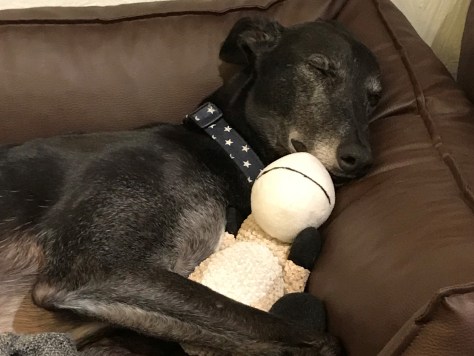
“Greyhounds are brilliant for first time owners as they are gentle, loving and relatively low maintenance! There’s a preconception that they need loads of exercise, but they are described as 30mph couch potatoes – this is so true! They are the laziest dog you will ever meet. Greyhounds are more like cats than dogs.  They love to sleep all day and will demand fuss.”

GreyhoundsChoosing the right breed

Becca says she’d been desperate for a dog for as long as she could remember and luckily, when she met her husband, he was persuaded he would like one too!  They wanted something that would fit into their lifestyle, but were also keen on getting a rescue dog.  Becca’s godmother had a Lurcher and this is what started her interest in sighthounds.  She did some research and felt Greyhounds were perfect for them.

There are so many Greyhounds needing homes, as they are often retired young after racing (if they even race at all) and are either euthanised or end up in rescues.  Greyhounds are part of the Hound group of dog breeds, (see Types of dog).  They are a healthy breed, as they have been around for a long time.  They generally live for around 12 years.

“They’re great for older people looking for a companion as they don’t need miles and miles of walking and they’re quiet and gentle. This also works for families with children or people who want a dog, but don’t have hours and hours of time to dedicate to exercise or don’t want a really high maintenance breed.”

GreyhoundsSettling In

Sora arrived with Becca and Neil around 6 years ago, arriving just after they bought their first home.   She took a few days to settle into a routine and learn what their routine was, but after a bit it was like she’d always been with them.  Basil came as a ‘foster’ but he chose them as his forever home, and again, felt like he’d always been part of the family.

Great for working homes

Although I would not normally recommend people who work full time to get a dog, Greyhounds are a good choice if this is your situation, because they are so lazy!  Becca says

“We both work full time so we needed a dog that would be ok with being left for a few hours (with a walk in the middle of the day). Sora was perfect, as long as she’d had a walk in the morning and was taken out midday, the rest of the time she just slept. Neil now works from home, but they still sleep all day! The best thing about them is that they will walk for as long or as short as you’re happy to do. “

Becca and Neil took their Greyhounds with them on their honeymoon to the Lake District and walked for hours each day, which they adored.  Equally they will settle down after a 20 min walk when you’re pushed for time or the weather is vile.

Love sponges

Becca describes her Greyhounds as ‘love sponges’; they just want to be with you and be loved!  Sora thinks every visitor to the house is there to see her specifically. Poor Basil was abused and is very wary of new people, but he adores Becca and Neil.  He is the most loving, special boy, despite everything he’s been through. They are so gentle, very respectful of you and other dogs and generally very placid.

GreyhoundsSora doesn’t like bouncy dogs and will tell them off, but in the politest way possible.  Greyhounds will give you hugs by leaning on you! Becca says she has never known other breeds to do this and it makes her smile every time she meets one! (Busy does this too by the way :p)

“Greyhounds are like skinny Labradors in that they are food obsessed! They are also the biggest drama queens you will ever meet. If you are owned by a Greyhound, you will be aware of the scream of death!”

A minor hurt or injury (such as accidentally treading on them) will elicit the most blood-curdling scream from them.  It is horrifying when you first hear it and they will always do it in public!

The prey drive

The prey drive in Greyhounds can be very strong and this is to be expected due to their breeding.  That being said, many Greyhounds live with cats and Becca’s two live with chickens! They pretty much ignore them now, although she wouldn’t trust them not to chase if the chickens got out .

“We have to be aware of small furry things when out on walks as cats are still quite interesting for them. We never let them off lead except in enclosed spaces.”

They’re happy with this and don’t need to be let off.  On the other hand, it is fabulous watching them run! Becca and Neil took them to a beach in Norfolk and thought they’d successfully tired them out, until they started trotting off down the beach together.  They then decided to race each other and disappeared off over the horizon!

GreyhoundsThey have very selective hearing; once they get excited and start to run/chase something they will go deaf.   You have to be aware of  the front door being open and the dogs being around in case they spot something they want to chase…

Words of advice

Becca says she would get a Greyhound again in a heartbeat; she can’t imagine having any other type!  They would always go for an ex-racer.  There are so many needing homes.

“The best piece of advice I would give myself is to give myself time, let them settle and don’t panic if they’re a bit stressed or make messes when they first arrive. They will settle, find their feet and becomes the most loved member of your family that you can’t imagine being without. Be prepared to lose your sofa (as they are a large breed).  Hide anything edible – they will find it and they will eat it!”

GreyhoundsAs always, I am incredibly grateful to Becca for giving us such a clear insight into owning these adorable dogs.

Ask for help?

I hope you have enjoyed my insight into owning Greyhounds?  Please comment and share your views and experiences?  What breed would you like to know about?  Or do you have a breed of dog and would like to share your views on living with your dog?  Please CONTACT ME to let me know?

You are very welcome to CONTACT ME to ask for my advice?  I can help you with a variety of issues and problems around getting a dog and suggestions for tackling training issues.  Go to the What Dog? page for more information on my new service.

Remember..

Please CONTACT ME if you want to know more about me and my dogs?  And feel free to COMMENT if you want to tell me what you think.  If you want to know more, why not FOLLOW ME?  Then you will receive an email when there is a new post.

NB: If you read my posts in an email, you may be missing out on the lovely pictures!  Please click through to my website to see the post in all its glory?

Cat Kennel – a snug home for your feline friend

What is a cat kennel? Why would you need one?

I have previously talked about Cages and Crates for dogs, but why would I need a cat kennel?  Mainly so that he can be self-sufficient.

Poor Tatsu!  He is a sweet boy, who has always been a bit damaged.  Unlike my dogs, I got him through an advert in a pet shop.  I decided I wanted a tabby girl, having mainly had black and white boys.  My mum came with me, assuring me that he was a girl.  ‘Tatsu’ means dragon in Japanese and I thought it would be a fitting name for a tatty tabby girl.

cat kennelUnfortunately, apart from the fact that he is a boy not a girl, lol, he also has a heart murmur, so has never been particularly strong.  Having had my son’s cat to stay a few times, I have realised that he is actually quite weak.  He can clamber over the fence and the gate, but he has no strength to jump up onto a worktop surface.

With 5 dogs in the house, I do obviously have to feed him on the worktop.  But now that I’ve established that he cannot jump that high, how can I leave food out for him, where the dogs can’t get it?  I designed a solution for him in my mind, then found what I wanted online – simple!

Cat Kennel

This is a great solution for him.  It also means he can come and go as he pleases.  He had previously had a cat flap, but not surprisingly Chris is not keen to saw a hole in our back door – especially as it is unlikely we will have another cat..

cat kennelThis kennel is pretty sturdy, but also light enough to be moved if necessary.  There is room for a bed and a couple of dishes of food.  So he can have dry and wet food available, whenever he wants them.

Water

Cats apparently like their water to be in a different place to their food.  Did you know that?  They really like to drink from a tap, but will find some water outside if possible.  I therefore make sure there is a water bowl and a bucket of water available, filled from our water butt.

cat kennelWhy have a cat?

You might be asking yourself why I have a cat, when I am clearly a dog person?  Well puppies need to learn about cats as part of their socialisation programme, that’s why!  Oh and he is a nice pet, really.


Ask for help?

You are very welcome to contact me to ask for my advice.  I can help you with a variety of issues and problems around getting a dog and suggestions for tackling training issues.  Go to the What Dog? page for more information on my new service.

Remember..

If you like receiving updates on my recommended products and services, why not FOLLOW ME?  Then you will receive an email when there is a new post.  Please CONTACT ME if you would like me to write about a specific topic?  And feel free to COMMENT if you want to tell me what you think?