All posts by Dentbros

The Kennel Club – Friend Or Foe?

Why we should support the Kennel Club

I am receiving large numbers of enquiries for puppies once again, as people realise that a dog will improve their lives. It is so frustrating not to be able to offer any support to these people, because puppies are not toilet paper and cannot be made to order.

I always recommend that people contact the other Kennel Club Assured Breeders and ask to go onto their waiting lists. I’m delighted to have recently had my three-yearly inspection as part of this scheme. I am disappointed that there isn’t wider recognition and take-up of this scheme.

The history and purpose of the Kennel Club

It’s a very old organisation that runs dog shows. I think that is the public perception of the Kennel Club. The organisation was set up in 1873 “to have a consistent set of rules for governing the popular new activities of dog showing and field trials. It was the first national kennel club in the world.”

dog showing
dog showing

The home page of the brand new Kennel Club website now states it is:

The largest organisation in the UK devoted to dog health, welfare and training. Our objective is to ensure that dogs live healthy, happy lives with responsible owners.

What does the Kennel Club do?

The Kennel Club still runs dog shows. Although most people are aware of Crufts, the world’s oldest and largest dog show, they probably don’t know everything that happens there. The show really is a celebration of dogs! You can find out about different dogs, watch dogs at work, doing what they do best and enjoy the amazing relationships between dogs and owners.

I love watching the heelwork to music displays and the excitement of the flyball. I love watching the agility and was very proud as a breeder to have one of my pups competing last year. It’s a great place to learn about dogs and what brings them into our lives. And there is LOTS of shopping to be done!

heelwork to music
heelwork to music

Other dog shows around the country are run by the Kennel Club. Breed shows promote the enormous range of dog breeds we have available to us in the this country. Sadly though, dog breeding is still viewed as an elite hobby and one that is regarded as subject to corruption and bias. I do feel that something based on the subjective opinions of individuals is likely to be a bit unfair. However, I have learnt through writing the Breed Index, that there are breed standards and that these are rigorously checked.

Healthier Dogs?

I do believe that the Kennel Club is a force for better dog health. There have been scandals in recent years about dogs with poor conformation winning prizes. I think that on the whole, there is a momentum of support for healthier dogs.
health and health screening

The Kennel Club claims the following:

“We help improve the lives of dogs, now and in the future, through research, collaboration, resources and health schemes.”

For pedigree dog breeders, there is a wealth of information and support. As an Assured Breeder, I am not able to register my puppies as pedigree Border Collies without meeting the health testing requirements for my breed. If I want to use someone else’s dog to mate with mine, I am able to check the health records of that dog and ensure that the dogs are a good match.

Sadly, the Kennel Club is not as rigorous in recording the health of all dogs. You are not required to health test crossbreeds. You can still ‘register’ puppies with the Kennel Club, but this is just a record of existence, not a certificate of proven parentage and health. Do you think this could be improved?

Getting a dog

Just as I have tried to support people in finding a dog, the Kennel Club have a huge amount of support and resource to help people. You can find out about different breeds, check the health of a dog’s parents, and think about what different dogs might need in terms of care. The Kennel Club provide support on finding a rescue dog and help you find an Assured Breeder.

finding a dog
finding a dog

Admin issues

Part of the problem the Kennel Club has is to do with the sheer volume of information it holds and the demand for dogs in this country. In this message to its users published yesterday, the Chief Executive Mark Beazley said “we know that many of our customers have not had the experience they deserve and expect from The Kennel Club in recent months.” The message details the progress that has been made to work through and resolve these issues. I believe there is still work to be done, but with 40 million records to transfer, I can quite see why this is a challenge!

What do we want from the Kennel Club?

I have said that we need more responsible breeders. The Kennel Club should promote and manage this more assertively.

Personally, I would like there to be a much clearer message about dog breeding and health. It makes me sad that someone with a mixed crossbreed dog can embark on breeding with no thought for checking the health of their dog beforehand. They can produce a litter of pups and sell these to random strangers for thousands of pounds. If you ‘don’t care about paperwork’ they don’t have to produce proof of parentage and health testing.

We do now have an understanding that if we keep demanding puppies, that there are unscrupulous people who will force dogs to breed continuously, in horrible conditions – a puppy farmer. You may not yet always be savvy enough to spot a dog that has been bred this way. You can still buy dogs from unregulated online adverts, and this means we can easily be the victims of fraud. This affects us all, because getting a dog without proper care and due diligence can result in emotional trauma.

introduction to breeding

Breeders are under no obligation to vet prospective owners of dogs. I can breed from my dogs and send them off to complete strangers, without any checks. There is no guidance on the questions to ask prospective homes. Sadly, it is the puppies that are ‘carelessly homed’ that end up in rescue. Good breeders take their puppies back, and provide a lifetime of support to their owners.

Please let me know what you think? What do you think the Kennel Club should do better? How do you think things should change?

Buy the Workbook

The Workbook – A Year With Your Puppy is available to buy. I wrote and designed it to be a hands-on, interactive book for you. You will be helped to survive the first year with your puppy. This book acts as a memento of that time and the journey you have been on. You can write notes and stick in pictures of your puppy throughout the year. Lovely!

Remember..

Please CONTACT ME if you would like me to write about a specific topic?  And feel free to COMMENT if you want to tell me what you think?

What is a Puppy Farmer?

Puppy Farmer – how do you know when you see one?

A Puppy Farmer breeds dogs for money. So anyone who breeds from their dog simply to make some money could be seen as a farmer, but that’s not it. Having one or two litters from your pet dog is not the same as setting up a business and doing it on a large scale.

Breeding professionally is not necessarily the same as breeding commercially. If you LOVE your dogs and decide to promote them, show them and then breed from them, you might end up with lots of dogs. They might have lots of puppies. You might then decide to have a professional setup, which involves kennels and outdoor runs. (Or you might just end up with lots of dogs in your house, on your sofas, on your beds, by your feet…)

puppy farmer

It might seem a fine line then, between breeding for the love of dogs and breeding for the love of money. If you love your dogs, you might find the money generated from having puppies comes in handy to pay for your dogs. But that isn’t really true. If you LOVE your dogs, you will spend ALL your money on them.

Puppy Farming – Definition

“Puppy farmers produce lots of puppies in poor conditions and with little consideration for their health and welfare.”

The Kennel Club: avoiding puppy farmers

What does that mean exactly?  Quite simply, it means that the breeder cares more about making money than how healthy and happy their dogs are.  They do not care about their customers either; they are simply the mugs stupid enough to buy whatever is being sold, at any price.

puppy farmer

What does a Puppy Farmer do differently?

Here’s a description of someone’s experience of buying a puppy:

“She went through the puppy pack with all the breed details from mum and dad with us but didn’t give it to us to take away. She is a ‘breeder’ rather than the same as you (breeding your pets). Albeit a well organised breeder. She breeds 4/5 different ‘types’ and has a big set up. Was all very professional, clean, spacious etc but not ‘pets’. Lived in a massive beautiful house with lots of land and kennels. She clearly make lots of money from it! “

puppy farmer
Is it a Labradoodle?

Here are the alarm bells for me:

  • Didn’t give away details of parents – were they actually the parents of that pup? Had they been health tested appropriately for their breed? Unless you are given copies of paperwork, you can’t easily verify what your puppy is and where it has come from.
  • A breeder, but not ‘breeding pets’.  Sorry? Aren’t you buying a pet?  Why would you want something not bred as a pet?  That’s the very definition of doing it as a business.
  • She breeds 4/5 different types and has a big set up.  Not pedigree dogs, defined by their characteristics and lineage, just random mongrels.  A big set up – 20 dogs? 50? Not much time for them then. No personal care and cuddling. These puppies may never see a human being before they are sent off.
  • She clearly makes lots of money from it!  No other income? Relying on this income to live on means the litter must be profitable.  So not spending money on health testing, toys and good quality food. Not to mention health tests. It costs a LOT of money to breed well.

Paperwork is essential

If I had a pound for every time someone said to me “I’m not interested in the paperwork, I don’t want to show/breed from my dog”, then I’d be a rich person. I recently realised that buying a dog should be like buying a car – it’s a big, expensive purchase that you have for years. Unlike a car of course, dogs are living, breathing animals that are part of your family!

So, would you go along to some tatty garage and pick up a car that looked like it was cobbled together from different cars? Would you pay thousands for a car with no paperwork? There is a registration system for cars, so that we know where they are from and who has owned them before us. We need cars to have health checks (services and MOTs).

puppy farmer

Dogs need these things too, We need to record where they are born and who their parents are. It is vital that we take advantage of health tests available, to ensure we produce healthier dogs.

One ‘type’ of dogs is enough

If you care passionately about your dogs and want to breed from them, you don’t often have more than one or two different breeds. When you DON’T care about what you are producing, you might mix and match to get whatever the buyer wants. You might even tell the buyer a dog is one type of crossbreed, when it is something else entirely! That is fraud, pure and simple, but it happens all the time.

Questions for the breeder

Here are a few questions you could ask your breeder:

  1.  How many dogs do you have?  Can I see them?  Where do they live?  Good breeders might have a number of dogs, but they will be part of the family.  They might spend some time each day in crates or runs, but should be in the house for most of the time.
  2.  How many litters do you have per year?  How many does each dog have?    How old are they when they have the first litter?  And the last?  A litter of puppies is extremely time consuming (or should be!) So the more litters you have, the harder it is to spend time cuddling the pups.  Dogs should have no more than 4 litters each, between the ages of two and eight.
  3.  Who is the sire?  Why was he chosen? How closely related is he to the mother of the litter?  What is the in-breeding coefficient? Stud dogs should be from good lines, fully health tested and with a good temperament.  They should be similar in breeding to the bitch without being too closely related.
  4. What health tests have the parents had?  Can I have copies of these test certificates?  If the correct tests have been done for the breed, copies of these tests should be given to you as part of your puppy pack.

If the puppies are pedigree dogs, all this information is available on the Kennel Club website.  You can look up dogs and breeders and see who has had what, how they are related and what health tests they have had.  As soon as you move away from pedigree dogs, this information is not compulsory, therefore breeders don’t need to bother following the KC rules.

border collie breeder
NOT a puppy farmer

What to do if you suspect someone is puppy farming

People are (unfortunately) cunning and devious. They know many ways to take your money. Equally, there are good people out there with the best of intentions, who don’t know how to do the right thing.

If you think that a breeder may be a puppy farmer, or is breeding irresponsibly:

  • Never purchase a puppy from them, even if you think you are rescuing the puppy. That puppy may be better off going home with you, but by giving the “breeder” money, you are funding them to breed even more dogs, possibly from the puppies’ mother, in horrible and unethical conditions
  • Report them to the RSPCA, the police or your local authority –local councils, animal health officers and the police have the power to enforce the law.

Taken from The Kennel Club: avoiding puppy farmers

A final thought

“Dogs owned by people who spent more than an hour researching where to buy them from are likely to live twice as long as those who spent under 20 minutes choosing a puppy, with mean mortality ages of 8.8 and 4.3 respectively.”

Taken from the KC report ‘Collaboration is the Key – the Way Forward for Breeding Regulations’

As a result of buying from puppy farms, people claim to have suffered emotional and financial hardship, the KC report. Do your research! Read how to get a perfect dog!

Buy the Workbook

The Workbook – A Year With Your Puppy is available to buy. It was written and designed to be a hands-on, interactive book for you. It will help you survive the first year with your puppy, but also act as a memento of that time and the journey you have been on. You can write notes and stick in pictures of your puppy throughout the year. Lovely!

Remember..

If you want to know more, why not FOLLOW ME?  Then you will receive an email when there is a new post.  Please CONTACT ME if you would like me to write about a specific topic?  And feel free to COMMENT if you want to tell me what you think?

Dog Breeders Wanted

URGENT: More dog breeders are needed!

Warning: controversial post! We recently had a massive hoo-ha over a proposed TV programme about people wanting to ‘make money by breeding from their dogs’. I do not want to cause a sensation in writing this, but I feel I must write about this topic.

want dog

We do not have enough RESPONSIBLE dog breeders in this country. This causes massive heartache to dog owners and wannabe dog owners. It also leads to thousands of unhealthy, poorly-bred dogs. And a huge market for unscrupulous, money-grabbing people who breed commercially. Finally, it drives the existence and persistence of rescue centres, where dogs are dumped unceremoniously on a daily basis.

Where there is a market, there will be puppies

The Kennel Club registered 250,000 puppies last year, including pedigree and crossbreeds. Isn’t that an amazing figure? We want puppies! Last year everybody wanted a dog, but of course we soon run out – see my post on why dogs are not toilet paper.

border collie puppies

We do absolutely adore dogs in this country and they are a massive part of our lifestyle and culture. Sadly, dogs don’t live as long as we do, so we are likely to own multiple dogs in our lifetimes. We also want more than one, because we are greedy consumers! Although not everyone is lucky enough to have five like me. So there is an enormous market for dogs and this will not go away.

Go to a rescue

I see endless people on social media moaning about dog breeders and telling people to ‘get from a rescue’. Rescue centres are heroic and I applaud them all. I love the work they do and particularly the way they vet new homes. However, I do know that new homes often don’t work out and the dog ends up going to multiple homes before ending up in their ‘forever home’. Poor dog.

The Sunday Times issued an article this week about Lockdown puppies being dumped, just as we knew they would be. “Hundreds of “lockdown puppies” that were purchased in the pandemic are being sold online or handed to rescue centres, only months after the owners had taken them home.”

Disillusioned buyers say they are unable to cope with their dog’s lifestyle or have found it too difficult to juggle work and a puppy. One person, selling a six-month-old collie-spaniel cross for £1,500, writes: “Unfortunately, due to work commitments now we are no longer able to give him the loving and care he requires and deserves.” Heartbreaking, I’m sure you’ll agree.

puppies

People see rescue centres as being like shops. You go along and choose a dog from the ones available and take it home straight away. Then you try it out and see if you like it. If not, you simply take it back to the shop. We have successfully introduced Lucy’s Law, to exert controls over commercial breeding and stop ‘third party selling’ ie selling dogs in pet shops. But what is the difference between buying from a pet shop and buying from a rescue centre? Not that much, if you think about it.

Responsible breeding

Let me ask you a question: How many of my puppies do you think have ended up in rescue? Yeah you’re right, none. Why do you think that is? Because for me, breeding is a lifelong commitment. When one of the owners from my second litter rang me a few months ago, I guessed it was bad news. He cried, I cried. That dog was so loved, for all of his eight years. Of course that owner will be having another one from me, fingers crossed.

Responsible breeders will consider the health of their puppies to be a priority, which increases the probability that they will go on to live long and happy lives.

want dog

When I began my breeding journey over a decade ago, I knew I wanted to be a responsible breeder, to ‘do it right’. I had experience of my mum’s breeding and knew about health testing. My ethos right from the start was ‘Beautiful Border Collies, bred for better temperament and health’. That is what I do and who I am. I’m proud to say that my puppies are pretty healthy, with currently 51/54 alive and living happy lives. My first litter will be 11 years old tomorrow.

Get started

The Kennel Club provide a huge amount of advice and support to first time breeders. Unfortunately, people don’t realise that this should be their first port of call.

I am extremely proud to be a registered Kennel Club Assured Breeder. Only 5% of the puppies registered last year were bred by an Assured Breeder. It’s a scheme with rigorous standards, including an inspection every 3 years. Unfortunately, last year the Kennel Club closed to new applicants during the pandemic and when they re-opened they had 300 applicants. I believe we should be demanding an increase in the places available on this scheme.

breeder

If you are hoping for just one litter from your dog, you can still breed responsibly. After you have read the Kennel Club advice and done the relevant health tests, you are ready to go.

My no 1 piece of advice? Get a mentor, someone who has done some breeding and can provide support and information.

Buy the Workbook

The Workbook – A Year With Your Puppy is available to buy. It was written and designed to be a hands-on, interactive book for you. It will help you survive the first year with your puppy, but also act as a memento of that time and the journey you have been on. You can write notes and stick in pictures of your puppy throughout the year. Lovely!

Remember..

Please CONTACT ME if you want to know more about me and my dogs?  And feel free to COMMENT if you want to tell me what you think. 

If you want to know more, why not FOLLOW ME?  Then you will receive an email when there is a new post.

Dobermann: Interview with an Owner

Dobermann – an intelligent and courageous service dog

Today we are talking to Karen, who has two Dobermanns, Finn and Rae. She says “I’ve always loved the big powerful looking guard breeds that are invariably big softies on the inside. I used to have a German Shepherd but I find the Dobermanns are more ‘family orientated’ and with their shorter hair they are cleaner and easy to groom.”

The Kennel Club describes the Dobermann as follows: a squarely built, clean outline with a wedge-shaped head and keen expression. The breed was recognised by the German Kennel Club in 1899. They are a mix of a number of other breeds; a foundation of Pinscher blood, with added Weimaraner, Greyhound, Manchester Terrier, Rottweiler and German Shepherd blood to get a combination of intelligence, speed and toughness of character.

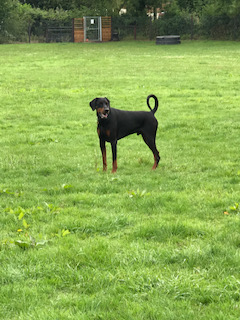
Dobermann
Finn and Rae

The Dobermann’s intelligence and trainability are described by the Kennel Club as having been harnessed by the armed forces and the police and he has been used as a guard dog, a tracking dog and in various other roles. However, his loyal and obedient nature equips him to be an excellent family dog, a role in which he is equally comfortable.

A bad reputation

Karen says the hardest thing about owning a Dobermann is other people’s reaction to them! She says “I can’t tell you how many times people have crossed the road, made some comment or picked up their dogs when they see us coming, even when the dogs are on lead. This can also be a problem when booking holidays or visiting people who are not familiar with this breed.” This reputation is not completely unfounded, because as Karen says, they are sensitive, which can lead to anxieties. However, most owners of dogs like these learn to manage them perfectly well.

A dog that has been bred to guard will always be protective of its family – that is its job! Karen says they will also tell you if a bird lands in the garden, or a leaf blows. In addition, Karen says they are stubborn and strong-willed. “They need boundaries from the start – don’t give an inch or they will exploit it! They use ‘pester power’ to get what they want.”

Dobermann

Other problems Karen mentions are that they can be very destructive, especially when left alone. This is a problem with many dogs, both big and small, perhaps most notably with the Husky. Dobermanns are pack animals and can be very needy (they will accompany you to the bathroom). There can be same sex aggression.

Worth the effort

A Dobermann is not a ‘beginner dog’ by any means, but Karen says that once you’ve owned one they own your heart. She says “they are funny, goofy clowns, who love to entertain and be entertained! They are extremely loyal, smart dogs who want to please you. Their thought processes can be two steps ahead of yours – there’s no fooling them! Dobermanns are easy to train when you find what motivates them, whether that is food or toys.”

Dobermann

“They love nothing more than to snuggle on the couch with you or even on your lap if allowed…..yes even at 40kgs+ they will try to sit on you. They are the ultimate companion. Dobermanns are good with other animals and children when properly introduced. However some can have a high prey drive, so beware around small animals or excitable screaming children!”

Health and care

Dobermanns’ are easy to groom and keep clean. They have fine hair with no undercoat so feel the cold easily. Dogs with short, fine hair are more susceptible to minor cuts and injuries.

The Kennel Club require Dobermanns to be health tested, including hip scores and eye tests. They also require a DNA test for von Willebrand disease. Karen lists a number of issues common in the breed:

  • Dilated cardiomyopathy is a big killer in Dobermanns (50%)
  • Hypothyroidism – one of my previous Dobies had this from quite a young age. She lived a full and happy life on medication with regular blood tests.
  • Wobblers
  • Von Willebrand disease (see above link)
  • Bloat/bowel obstruction – my current boy unfortunately had two bowel obstructions due to eating foreign bodies, which resulted in surgery both times.
  • Cancer

This seems like a long list, but in fact many dogs suffer from far more conditions than these. Please remember that a crossbreed is likely to suffer from ALL the conditions from BOTH breeds of dog? All responsible dog breeders will try to continue to improve the health of their lines. Whereas a puppy farmer only cares about taking your money (the start of a great deal of money you may pay out in health care for your dog).

Dobermann

The best home for a Dobermann?

Karen says “They are hard work at times so need someone with a lot of patience and kindness, who has time to spend with them and invest in their training. If you’re going to work all day leaving them alone then this breed really isn’t for you. The saying ‘you get what you put in’ is very true about Dobermanns.”

Dobermanns are big strong dogs that need space, so a garden is a must really. They need plenty of physical exercise and mental stimulation, but also need ‘calm time’. Karen says “My dogs get 1-2 hours of exercise per day, mostly off lead. They love daily brain games, hide and seek, snuffle mats and filled Kongs. We mix it up a bit so they don’t get bored. In the nice weather we place objects in the garden and hide treats in them. Currently they are obsessed with a flirt pole!”

Dobermann

Final advice

“They live to be loved – cuddles on the couch is not optional!”

As all my breed owners have said, Karen says: Find a reputable breeder that does all the health checks including the heart. Meet the pups mother, both parents if possible. This is important with any puppy purchase. Ask lots of questions! ”

In addition, Karen recommends investing in top insurance. She says it will be worth it in the end. Karen suggests joining an online Dobermann owner group and asking them questions, maybe arrange to join them for a walk.

Remember they’re hard work but the love they give you is priceless!

Thank you Karen for such a valuable insight into your fascinating, challenging and rewarding dogs.

Remember..

Please CONTACT ME if you want to know more about me and my dogs?  And feel free to COMMENT if you want to tell me what you think. 

If you want to know more, why not FOLLOW ME?  Then you will receive an email when there is a new post.

Hoopers

Can’t jump? Go through hoops instead!

You’ve probably never heard of hoopers as it is a relatively new dog sport. Canine Hoopers UK was formed in 2017, to provide an activity that strives to protect the long term well-being of the dog. This is done by maintaining flowing courses of low impact obstacles. The aim is to direct your dog around a course of between 15 and 24 obstacles, including hoops, barrels, tunnels and a mat.

Tracey has been training in agility for over 30 years, but more recently has been doing flyball and hoopers as well, as she loves doing things with her dogs. She currently has 5 dogs; Harris 12 year-old terrier, Vali 9 year-old kelpie, Vader 5 year-old collie, Mouse 3 year-old kelpie and Zarko 14 week-old working cocker. Vali, Vader and Mouse regularly compete in agility, hoopers and flyball.

hoopers

Why choose hoopers?

Tracey says “As my workaholic Kelpie gets older I wanted something to challenge us both, but without to much strain on his joints. Hoopers is perfect. And my younger Kelpie just wants  to run as fast as possible so loves hoopers. It has also had a positive impact on her agility training.”

The sport aims to be inclusive, making sure that it is accessible to all dogs and handlers, in particular large and tiny breeds. It is also available to dogs which require a little extra space, patience or understanding and also to handlers with limited mobility.

Who can teach Hoopers?

All Accredited Canine Hoopers UK Instructors have been thoroughly assessed. They will only be awarded accreditation when they prove their understanding, knowledge and teaching aptitude. Accredited Trainers are consistently teaching to a high standard, using only force-free training techniques.

Tracey says she did a training day in 2019. Then she completed the online good hoopers awards with her dogs in March 2020. She then went on the take the instructors course and becoming an accredited CHUK instructor in May 2020.

hoopers
Tracey and the gang!

What are the pros and cons of Hoopers?

The biggest positive about hoopers is that it is suitable for any age or breed of dog. You do need to have some basic obedience before you can start. Tracey says “The main challenge is to handle from a distance. You can can run with your dog, but you get extra points for staying behind lines or in boxes.”

There are regular competitions throughout the year, including a national finals. Tracey says “There is also an award scheme run in classes called the good hoopers award. You can earn a fab rosette and certificate for foundation, bronze, silver and gold.”

Thanks Tracey for sharing the information about this exciting new dog sport!

hoopers

Buy the Workbook

The Workbook – A Year With Your Puppy is available to buy. It was written and designed to be a hands-on, interactive book for you. It will help you survive the first year with your puppy, but also act as a memento of that time and the journey you have been on. You can write notes and stick in pictures of your puppy throughout the year. Lovely!

BUY NOW!

Remember..

Please CONTACT ME if you want to know more about me and my dogs?  And feel free to COMMENT if you want to tell me what you think. 

NO PUPPIES AVAILABLE

Rhodesian Ridgeback: Interview with an Owner

Ridgeback – a big old softie

A natural calmness is described as the best feature of this breed by Helen, perhaps not something you would expect from looking at them? The Kennel Club describes the Rhodesian Ridgeback as a “Lion hunter from Southern African, who are athletic and courageous.” Ridgebacks are a large breed with a short coat, originally developed as a scent hound to track a variety of game.

ridgeback

The Kennel Club says that the breed takes its name from a ridge of hair growing in the reverse direction along its spine. His ancestry is linked to the ancient dogs of the Hottentots which possessed this same feature. Canine folklore suggested that a well-marked ridge was a sign of courage.

Long hikes or duvet days

When choosing the Ridgeback, Helen says “We were looking for a large, short-coated breed with a calm nature, who is independently thinking, can be taken on hour long hikes, but is equally as happy having a duvet day – initially, we whittled it down to a few gun dog breeds and the Rhodesian Ridgeback. What swung it for us is spending time with a few breeders and their dogs. We were bowled over by their calm, (not needy) nature, so Ridgebacks was the breed for us and we now live with three of them.”

Helen says “Give a Ridgeback what they need and you have the most loyal and loving partner in crime, who you can take anywhere!”

Generally healthy

The Ridgeback is a largely healthy breed. Most common issues such as hip dysplasia are quite rare, despite them being in the large breed category. They can suffer with Dermoid Sinus, which is where a hair grows inwards and can cause excruciating pain. This is however diagnosed when they are pups and is not something that develops later in life. It will require an operation, which good breeders will do before they go to their forever homes.

Recent studies have shown that intact male Ridgebacks are more susceptible to developing prostate cancer later in life.

ridgebacks

A slight aloofness

The Ridgeback is described by Helen as being ‘an independent thinker’. She feels that where things might go wrong is when people try to be their boss, or micro-manage them. Helen says “He does very much make his own mind up, based on what’s in it for him, so Positive Reinforcement teaching is an absolute must for this breed!

They are naturally suspicious of strangers and can be a bit aloof. Continuous socialisation and habituation is also an absolute must.

Another aspect to be aware of is their prey drive. Helen says “Ridgebacks are hounds, so they will leave their owners behind in the quest of chasing rabbits, squirrels etc. They live for the chase though, so once they have scratched that itch, many are happy to return to their owners afterwards, IF the return has been reinforced sufficiently!”

ridgeback

Luckily Helen has never had any issues .“We have always worked with what they gave us and reinforced their good natural choices. This is always my number one advice for any new Ridgeback owner.”   

Sofa sleepers

The Ridgeback is very versatile, so they can easily adapt to busy family life or with a single person, in a house or even a flat. However, Helen says “People must have the time to give them good quality off-lead exercise. You must not be precious over your soft furnishings. Ridgebacks are not floor dogs, they need their warmth and comfort!”

Helen recommends having more than one Ridgeback, as they are destined for pack living. I would NOT recommend getting more than one puppy from a litter though – that is asking for trouble! Here’s the link to my thoughts on this issue.

Rain or shine?

Helen is quite clear that Ridgebacks do NOT like rain! She says “Unless it rains, we take our dogs out twice daily in the summer and once daily in the winter. As long as they get to have a good off-lead run through the woods or across the fields, they are more than happy stopping in for the rest of the day, wrapped up in a duvet!”

ridgebacks

Best advice for new owners

People who are happy with the breed of dog they have chosen ALL say the following. “We were lucky that we have chosen the perfect breed for us but only because we did our homework. Always DO YOUR RESEARCH and spend some time with people who have lived with the breed for a long time. Good, responsible breeders will happily answer any questions. They may also let you join them on walks, so you can observe them in real life, not just on paper.”

Thanks Helen, for a really honest and clear description of this distinctive breed.

Buy the Workbook

The Workbook – A Year With Your Puppy is available to buy. It was written and designed to be a hands-on, interactive book for you. It will help you survive the first year with your puppy, but also act as a memento of that time and the journey you have been on. You can write notes and stick in pictures of your puppy throughout the year. Lovely!

BUY NOW!

Remember..

Please CONTACT ME if you want to know more about me and my dogs?  And feel free to COMMENT if you want to tell me what you think. 

NO PUPPIES AVAILABLE

Tollers: Interview with an Owner

Nova Scotia Duck Tolling Retriever (Tollers) – big name, big character?

Marlene wanted an active dog who would fit in with holidays and hiking. She says Ludo is that and much, much more.  I never thought I could ever love a dog as much as this.  He makes me laugh every day.” How lovely is that! Let’s find out more about Tollers!

Toller

The Nova Scotia Duck Tolling Retriever, known as a Toller, is described by the Kennel Club as a powerful, handsome, web-footed swimmer from Canada. They are one of the Retrievers, within the Gundog group, but are quite different in appearance to Labradors, being more like a Border Collie in size and coat. Their character and temperament is as ‘retriever’ as you could hope for and the ‘buff’ or ‘red’ colouring is very distinctive.

Toller

Tollers are relatively new to the UK, having been brought over from Canada in 1988. The Kennel Club describes Tollers as follows “His method of work may appear strange to many; his task is to lure wildfowl to within range of the guns. It is reputed that he uses his vigorous tail action to achieve this. He lives up to his name as a good retriever, especially from water, where his webbed feet, a breed feature, enable him to swim powerfully.

“The Toller has been selected over the generations for his intelligence and trainability. As a result he makes an ideal and enthusiastic family companion for the active household, performing well in a variety of activities such as agility, flyball, tracking and obedience.

Getting ready for the challenge of Tollers

Ludo was Marlene’s first dog, so she read up on the breed, talking to breeders and vets. She also met a few at Crufts, so she was somewhat prepared.

Toller

The best thing about Ludo is that he is a loving, gentle boy who just wants to play but loves the praise he gets from working with me too.  He understands things very quickly and is extremely perceptive which may or may not be just a breed thing, as I know of a lot of other clever dogs too. 

“Because he is quite clever, he can also be opportunistic so prepare yourself to be in charge.  (I taught 5 year olds in my old life so I had great training for being consistent and in charge.)  As a breed, I have heard some can be aloof but most Tollers I know will choose their time and people for showing affection.

The Toller scream

Marlene says that Tollers have a famous ‘scream’ when they get excited, which can put people off the breed. She finds it quite funny to hear! She says Ludo will only resort to this if he thinks someone is on the property that shouldn’t be there. Marlene is training him to calm down with hand gestures and rewards.

Toller

Health issues?

Like other retrievers, they need to have their hips scored and low scores are desirable, to reduce the risk of dysplasia. They also require eye tests, similar to those needed for Border Collies.

Marlene says there she has had no experiences with health issues. She recommends talking to the breeder to check health records and details of issues. As Marlene says “Good breeders will avail their track records and will be very honest.

Exercise and training needs

As with any dog, it is essential to make sure that they have the opportunity to get out and about every day. Marlene says We walk every day but the walks vary in length and purpose.  Some walks are feral rambles – I love these! Other walks include safety training, manners, basic skills, tricks, play.  Some walks are led by my dog walker who offers pack walks.  She carefully handpicks about 3-4 dogs who work well together, so that they learn manners and responding to her calls, not just mine.”

Toller

Tollers are not suitable for inactive homes. You will need to be prepared to get out and about. Like Springer Spaniels, they love to sniff and search and should not be walked on lead. Tollers will suit an active family or people who can spend a lot of time with them.

Marlene retired to make space in her life for Ludo. She says “I have a very active lifestyle i.e. I am a rower so fitness is essential. Long off-walk rambles and short on-lead walks are part of our routine.  I see  each activity as a learning opportunity for Ludo and me.

Thank you Marlene for telling us about your gorgeous boy.

Buy the Workbook

The Workbook – A Year With Your Puppy is available to buy. It was written and designed to be a hands-on, interactive book for you. It will help you survive the first year with your puppy, but also act as a memento of that time and the journey you have been on. You can write notes and stick in pictures of your puppy throughout the year. Lovely!

Remember..

Please CONTACT ME if you want to know more about me and my dogs?  And feel free to COMMENT if you want to tell me what you think. 

NO PUPPIES AVAILABLE

Top Tips to Finding A Dog Trainer

How to find a dog trainer to suit you and your dog

As an Assured Breeder, registered with and inspected by the Kennel Club, I am required to provide advice to all my new puppy owners. This puppy pack includes a few basic training tips, such as ‘let your puppy off lead on the first walk!‘ The Puppy Pack also includes advice about finding a suitable dog trainer for you and your puppy to attend.

dog trainer

Before this year, my advice related to going along to classes in person. Now we have to consider alternatives, but I am going to talk about both options.

A trained dog is a happy dog

House training aside, every puppy needs to be taught good manners and have constructive lessons in basic control and social interaction. This includes:

  • Responding to its name
  • Learning how to greet and behave politely around other people and dogs
  • To come back when called (see my posts on recall for details)
  • To walk nicely on the lead
  • To sit down and stay on command
  • To allow itself to be groomed and examined by you and your vet
dog trainer

Dog training classes

Most if not all owners can benefit from attending good training classes, and training in the company of other dogs is very useful, because of the realistic distractions it involves. Ideally, you should start your classes as soon as your puppy’s vaccinations are complete, but classes can be invaluable for older dogs too.

dalmatian

There are various different styles of dog training and it is naturally important that you find a class and training instructors with the right approach for you and your puppy. You can find training classes by using the Kennel Club’s Find a Club service. You can also ask your vet and other dog owners for recommendations, or see my recommendation below. Dog training can be lots of fun and very rewarding.

A trained dog is a happy dog, and a happy dog makes for a happy owner too.

Finding the best dog training club

Before enrolling with a dog training club it can be beneficial to go and visit several classes first (without your puppy) to make sure you have made the right choice. Things you may wish to consider include:

  • Do you like what you see – are the trainers friendly, are people happy and enjoying training their dogs?
  • Are the dogs happily focused on their human family?
  • Are the instructors giving lots of encouragement and information to all attendees?
  • Are the instructors maintaining a controlled, safe environment for all?
  • Are instructors treating everyone fairly and meeting the needs of the whole group?

Some of these points still apply to online classes, but let’s consider these in more detail.

dog training

Online or In-person?

Since before the pandemic, dog trainers have realised that some elements of dog training can be done online. During the first Lockdown, we all had to adapt and good trainers have been able to transfer the majority of their training to be done remotely.

A good online dog trainer, will provide a range of tuition methods:

  • Live video calls to a small group, covering the topic for that week’s lesson
  • Use of a ‘demo dog’ to show how to carry out the instructions and reward the dog
  • The opportunity to watch the recording of the class later, for revision or if the live class has been missed
  • The chance to post videos of your own training to a private group
  • A way of asking questions and receiving feedback

Pros and Cons to dog trainer class styles

There are pros and cons to both types of classes, in my view. It is easier to attend an online class, especially if you can watch a recording later on. No travelling or parking issues. Very useful if your dog is not yet good at travelling.

You might feel that an online class will make it harder to ‘show off’ your dog’s training and discuss the issues you are having. I believe this is not the case. It is much better to watch the trainer’s explanations and demonstrations without your puppy messing around/ barking at other dogs/ weeing on the floor. Honestly, it can be really hard to manage your puppy whilst sitting in a draughty hall. Much better to sit calmly at home, paying attention to the lesson. Then go away and practice, in your own time.

dog trainer

Once you’ve mastered the lesson, or if you are having problems with it, posting a video showing where you’re at is a great way for your trainer to see what is happening. What might seem confusing and tricky to you will soon be sorted by your trainer. I highly recommend Adam Delderfield at Delders Dogs for expert online training.

Group interaction is so useful

One of the nice things about going along to an in-person class is meeting other puppy owners. You can show off your baby! It is lovely comparing notes and hearing that they are going through all the crap (literally) that you are going through.

But this can be done easily through a private social media group. These days we are pretty adept at communicating in this way. My Sweetie Litter were the first to have their own WhatsApp group and they talk to each other most days, even after 18 months! We are currently discussing neutering and relationships with our vets 🙂

Practice makes perfect

Whomever you go to for training, just going, engaging and practising the lessons will make your dog better. Building your relationship with your dog is the key element of the training sessions and the value of this cannot be over-emphasised. Please go and please practise and please, please put in the effort to train your dog? Your dog will thank you 🙂

For specific help with behaviour issues, I very much recommend a specialist such as Dan Callaghan at MK Dog Behaviour and Training.

Recommended trainers

As mentioned above, I recommend online classes at Delders Dogs and specialist behaviour support from MK Dog Behaviour and Training.

I also recommend Nicole Vento from the The Calm Canine Academy. Please visit the website to find out more about their training methods and the services they offer. When you book training with any of these people, please mention me? Thanks!

Buy the Workbook

The Workbook – A Year With Your Puppy is available to buy. It was written and designed to be a hands-on, interactive book for you. It will help you survive the first year with your puppy, but also act as a memento of that time and the journey you have been on. You can write notes and stick in pictures of your puppy throughout the year. Lovely!

Remember..

Please CONTACT ME if you want to know more about me and my dogs?  And feel free to COMMENT if you want to tell me what you think. 

NO PUPPIES AVAILABLE

Greeting dogs: How to Say Hello

Dog greeting – “Don’t worry, he’s friendly!”

“It’s all right, he’s friendly!” is the phrase most hated by dog owners the world over. I have seen many, many rants on social media over the years, with people furious that yet another dog has barged into their dog, causing a dust-up, resulting in injury, or worse, increasing the fear in their dog that the owner was working so hard to overcome. What can we do to help dogs greeting each other?

dog greeting
nice to meet you – two polite dogs saying hello

Why is it not OK to let your dog rush up to other dogs? They just want to play, right? They don’t mean any harm, so it will be fine, won’t it? Your poor dog is desperate for some company and activity and dogs like each other, don’t they?

How would you feel?

Imagine walking along minding your own business. Enjoying the sunshine, listening to some music. Imagine a person running really fast towards you, then stopping two inches from your nose and saying “HELLO! Do you want to play with me?” How would you feel? Yes exactly. Well believe it or not, that’s how most dogs feel.

In fact in can be even worse for a dog. They might be old and infirm, well past their playing days. They might be recovering from an operation, or have an ongoing illness. Dogs can be quite shy and unsure, particularly if they don’t spend much time with other dogs. How would you know if a person felt like this? Would you still bounce into their face to say hello?

dog greeting
tell me about yourself – a calm introduction

It’s also much worse for dogs on the lead. If someone runs towards you looking scary, the natural response might be to run away from them. But if you are attached to a stupid great person, this is not an option. Aargh!

The final reason why a dog approaching another dog is NOT OK is that people become scared. And dogs know that. It is their job to protect their human. So when a dog doesn’t initially want to talk to another dog, their human tries to stop that happening again. But then the dog learns that ALL approaching dogs are scary, so tries to stop that happening. Poor dog.

What should you do?

Teach your dog some manners! You might think this will be difficult but it really doesn’t need to be! It’s exactly the same as your parents teaching you to say ‘please’ and ‘thank you’. You might remember them saying to you ‘Say please!’ or ‘what do you say?’

You can do that with your dog. When you see another dog, get the attention of your dog. You do NOT need to put them on the lead, but you will need lots of treats and/or a toy (paid ads). It is also essential that you are EXCITING! Be more interesting to your dog than anything else. This might be quite difficult to do, but I promise you, it will pay off.

Get your dog to ‘watch’ you. Say ‘watch’, repeat a few times. Then ‘click’ and reward. The click can just be you saying ‘yes!’ and then stuff some sausage into your dog. Then break off and play with them. I’ve talked about ‘playing with your dog‘ on this post, with a video of a game of tuggy. Have a great toy, (paid ad) and engage with your dog. You can then control their interaction with other dogs more easily.

Can you ever say hello to another dog?

Yes of course. But only when you dog is polite about it! Once you have built up your relationship with your dog and it has learnt some manners, together with a rock solid recall, you should be able to manage their greeting of other dogs. The photos show two beautifully behaved dogs enjoying some calm interaction. It is possible and it is achievable.

dog greeting
now we’re friends – perfect gentlemen

A polite dog greeting another dog is absolutely fine. Hello, how are you? Would you like to play? No? That’s fine, I can have fun with mum or dad instead. Yes? Great! Let’s play! Hurray! It’s lovely to see, isn’t it?

Don’t Panic!

It will go wrong. It’s bound to. Dogs, just like people have to learn and this takes time and practise. Please, please don’t think that because your dog has a ‘bad day’ or a bad experience, that they can’t be let off the lead again? That’s really unfair on your dog and lazy of you. Make the effort to continue practising and allow for some failure.

And if some horrible person starts shouting at you because your dog bounced up to their dog over-exuberantly, please don’t take it out on your dog. Please just apologise to the person and tell them that you are working on it with your dog, but if you don’t try, they’ll never learn?

Help is at hand for dog greeting

It is hard to teach these things and usually people need help. I recommend finding a reputable trainer. Here in Milton Keynes we are lucky to have Adam Delderfield, of Delders Dogs. Adam gives lots of personal support.

I’m also very fortunate that JB lives with Stella, who works alongside Adam. He’s such a polite dog, greeting other dogs perfectly!

Buy the Workbook

The Workbook – A Year With Your Puppy is available to buy. It was written and designed to be a hands-on, interactive book for you. It will help you survive the first year with your puppy, but also act as a memento of that time and the journey you have been on. You can write notes and stick in pictures of your puppy throughout the year. Lovely!

Remember..

Please CONTACT ME if you want to know more about me and my dogs?  And feel free to COMMENT if you want to tell me what you think. 

NO PUPPIES AVAILABLE

Dog Breeding – Conformity vs Individuality?

Be the same, but different when dog breeding!

Jeremy Vine does a series of pieces entitled ‘What makes us human?‘ on Radio 2 and this is a picture that sums up a viewpoint I have realised over the past few days in relation to this question.  It is similar to a picture I saw on social media with a man in camouflage trousers and a neon top with the caption “do ye wanna be seen o’ no?” (Scottish) Lol.  Here I am, with my camouflage jacket and my bright purple hair. How does this relate to dog breeding?

dog breeding

What’s the point I am making?  We want to be the same as everyone else. We are desperate to conform, to fit in, to be seen as ‘normal’, to go unnoticed.  AND we are desperate to be different, to stand out, to be memorable.  In order to achieve these two opposing and confrontational goals, we will buy the latest fashion, follow the trends, look carefully at what others are doing and copy it.  There are many entertaining social experiments about people going along with a crowd, performing in increasingly bizarre ways, just to do the same as everyone else.

Equally, there is a constant battle to be just a little bit different, to be memorable and not the same as everyone else.  We give children ridiculous names, or spell their names in ridiculous ways.  Or we get tattoos, with our own versions of patterns or pictures making us look a bit different from other people (while following the fashion for body art).  We dye our hair!

How does this relate to dogs?

I watched the Catherine Tate programme Saving the British Bulldog the other night (watch it, if you haven’t already, it’s really good).  Catherine presents a really clear, balanced picture of what has happened to the bulldog breed and why this has taken place.  In my view, this represents  this same dichotomy between conforming and being different.

The Kennel Club have a breed standard for the British Bulldog. It says right at the outset:

“A Breed Standard is the guideline which describes the ideal characteristics, temperament and appearance including the correct colour of a breed and ensures that the breed is fit for functionAbsolute soundness is essential.

“Breeders and judges should at all times be careful to avoid obvious conditions or exaggerations which would be detrimental in any way to the health, welfare or soundness of this breed.

There it is, in black and white.  So what’s going on?  Breeders are breeding for health and to produce the best examples of the breed, conforming to the ‘standard’ set.  BUT people don’t want all dogs to look the same.  They want them to look different. People want a dog, but they want it to look like a baby.

dog breeding

As the programme demonstrates, this make the dog unhealthy, because it becomes deformed.  This is NOT the fault of the Kennel Club, nor the breeders, but the buying public, who are trying to find a particular ‘look’, no matter what that costs.

Health comes first

Surely we would not deliberately buy something that was unhealthy, would we?  We wouldn’t choose to have an unhealthy child, would we?  So why would we choose to have a dog with inherent health problems?

crufts best in show 2018

If we only cared about dog health, we would all have dogs that are shaped like dogs.  A bit like this year’s Crufts Best in Show, Tease the Whippet, (Collooney Tartan Tease). The Kennel Club says that the Whippet was originally bred for rabbit coursing, with gambling on racing in the North of England.  It goes on to say:

“Although Whippet racing continues on a very minor scale, the breed is now hugely popular in the show ring where its elegant lines and smooth daisycutting action has won many admirers. As a family companion, the Whippet is gentle and affectionate and enjoys the comforts of domestic life.”

Sounds lovely, doesn’t it?  But we don’t all want Whippets, do we?  We want something different. This is why dog breeding is so complicated.

dog breeding

The same, but different

This is all just an excuse to talk about my puppy, Ounce.  I LOVE that she is different – pretty unique in fact.  She is a lilac and white Border Collie, which is a colour that is found in only around 1% of the breed.  In addition, she has blue eyes, which is even rarer.  Blue eyes are definitely not part of the breed standard.

At the same time, Ounce conforms to the ‘show type’ of Border Collie, because she is from those lines.  So she is more ‘stocky’ than a farm-bred, working sheepdog type Border Collie.  She has the pedigree Border Collie broad, short back and head, and she has a thicker, longer coat than a working sheepdog.  She has very even markings, with a white blaze, full mane, white socks and white tail tip.  Ounce is also a ‘typical collie’ in her temperament and behaviour. Lovely. A great balance of dog breeding – something fit and healthy, but a bit different

The evolutionary compulsion

In my opinion, there is a biological reason why we want to conform and be different.  We need to ‘fit in’ so that we can be desirable to others, but we also need a diverse gene pool and we need to attract a mate.  To meet these needs, we are prepared to do almost anything and ‘variety is the spice of life’.

Producing extremes in dog breeding

Going back to the health issues, we are, unfortunately, prepared to do many things in order to be ‘attractive’ to others.  People have always been happy to mutilate themselves and each other in the name of beauty, eg stilettos, makeup, piercings, FGM.  This is well documented, so I do not need to detail it here.

This compulsion is transferred to our dogs.  We want the same as everyone else, but we want ours to be better.  More beautiful, more unusual, more extreme, more fierce and so on.

My mother has passed down a family expression to me, which my sons now say.  It was said by my great-grandmother; “It’s a good job we’re not all the same, or we’d all want to marry the same man.  And it wouldn’t be you Charlie.”  Poor Charlie!  My conclusion is that we strive to be different, while fighting to be part of the human race.  It’s what makes us human, but also what makes us part of the evolutionary process.  Purple hair, purple puppy, something different.

Conclusion – a healthy normal

Hopefully, we can recognise the need to promote the healthy ‘normal’ while celebrating the beautiful variety of life.  Pedigree dogs should be healthy, but this is only true as long as responsible breeders can produce enough dogs to meet public demand. Once we clamour for more and more ‘designer dogs’, unscrupulous people will see a chance to make big bucks by compromising standards, as Catherine Tait’s programme demonstrated.  Please bear in mind what a dog should look like when considering what to get for your best friend?

Buy the Workbook

The Workbook – A Year With Your Puppy is available to buy. It was written and designed to be a hands-on, interactive book for you. It will help you survive the first year with your puppy, but also act as a memento of that time and the journey you have been on. You can write notes and stick in pictures of your puppy throughout the year. Lovely!

Remember..

Please CONTACT ME if you want to know more about me and my dogs?  And feel free to COMMENT if you want to tell me what you think. 

NO PUPPIES AVAILABLE