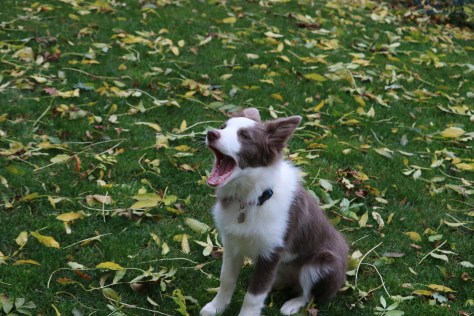
Dog Doc Question 15: How do you cope when your dog is reactive?
Chasing cars, or bikes, or runners, or cats. Barking at squirrels or cats in the garden. Chasing or fixating on lights and reflections. These are all examples of ‘reactive behaviours’. Dogs are very good at reacting to stimuli in their environment; it is what they are designed to do. They hunt, they chase, they watch out for danger. Being alert is what helps a dog to survive.
What we need to ask ourselves is, “Is this behaviour a problem?” First of all, “Do we think that chasing, barking, or fixating on something is detrimental to the dog?” If they are chasing cars, then the answer is almost certainly “Yes!” It is a dangerous activity that can only end badly. Barking at squirrels might seem like a less harmful activity but there are two problems with this; one, they will annoy your neighbours and two, they can become over-stimulated.
In order to be a successful pet dog, our dogs should be able to cope with living in our world. This includes cars, bikes, cats and everything else. We don’t want them lunging and pulling every time they see a car. We don’t want them chasing all cats, especially not if we have one in our house.
Another question we should ask ourselves, in order to assess whether the behaviour is a problem is “Can I put up with it?” Again, if it is a barking issue, or a cat chasing issue, then it is your neighbours you need to worry about. But you might also have behaviours that ‘drive you mad’. Most people just put up with these behaviours, as a quirk that having a dog brings. You don’t have to.
Dog reactivity to noise
Here is a video of Aura, showing what happens when we want to use something in the kitchen that makes a high-pitched noise:
I am using Aura because she is the worst, although you can hear Busy joining in. They definitely wind each other up, but it’s Aura who suffers the most, in my view. What can we do about it?
Step one: Move to a safe distance
Can you see how agitated she is? She knows something is going on and she really wants to be there to bark at it and ‘give chase’. Aura is an obedient dog who is well trained and quick to react to commands. But you can see here that she is finding it really hard to concentrate. Poor dog.
Step two: Move closer, but stay ‘safe’
We’ve moved a bit nearer, with one less door between us and the noise. I felt as though I was torturing her here! She is really agitated and doesn’t want to do anything, poor girl. You can see she is trying to pay attention to me but it’s really hard for her. Can you see her ‘lip licking’? And can you see her showing the whites of her eyes? She wants it to stop. These are what is known as ‘calming signals’.
Step three: Move beside stimulus
Finally, for this demonstration, I move her back into the kitchen. What I realised in going through this process, is that the other dogs are definitely making her reactivity worse. She is agitated as much by their noise and excitement as by her own desire to bark and react. So I have moved them a couple of doors away, where they can no longer hear or be heard.
Result! Aura is calmer in this clip isn’t she? Despite the noise still being present, she is more focused on me and is able to think a bit more about what she is doing. She is making good eye contact with me and is not looking towards the noise.
Step four: The long-term fix
In order to reduce her reactivity to these kitchen noises properly, I need to train this regularly and consistently. I need to practise with her every time we use something to which she reacts and I need to ensure that I give plenty of praise every time she ‘succeeds’. Did you notice that when she was a bit calmer I gave several treats and lots of verbal praise? That’s what we are looking for – the jackpot moment.
You can do this too! It’s not rocket science. These clips show how to put simple bits of training into practice. I have done the different steps one after the other; ideally you should stay on each step until the dog is calm in that situation, then move closer.
This training can be used to ‘de-sensitise’ your dog to anything; cars going by, cats in the garden, the postman coming. It is literally about how much effort you put in, together with your consistency.
Ask me for Advice?
You are very welcome to contact me to ask for my advice. I can help you with a variety of issues and problems around getting a dog and suggestions for tackling training issues. Please let me know if you have found this post helpful?
If you want to know more, why not FOLLOW ME? Then you will receive an email when there is a new post. Please CONTACT ME if you would like help with a specific topic? And feel free to COMMENT if you want to tell me what you think?

 ome people think they only need to use treats when their puppy is little. Why? I still like chocolate and I’m 55 years old! If you asked me to do something and offered me chocolate I would DEFINITELY do it! Sunny will always come back to me, no matter whom I call, just in case I feel like giving her a sweetie. Well of course I do! She’s 11 years old but if she comes when I call, she
 DON’T: Shout at your dog

 Oops. Ounce is nearly 7 months old now and this is often when the trouble starts. She is more or less fully grown (although she will fill out and might creep up a bit more in height). She is also becoming more mature, which mainly means that she is a bit like a teenager; she thinks she knows best!


 Six of my seven dogs have been girls and I’ve never had a problem with them coming into season. This is the term used to describe their fertile period. With dogs, this is approximately every six months (but can vary from dog to dog) and it lasts for three weeks. They may come into season for the first time at any time from the age of six months (although usually not till around their first birthday for collies). The bigger the dog, the later they mature and the longer the gaps may be between seasons.
 You don’t need to worry too much about this, (most dogs are neutered after all). I also find that Sunny starts to ‘range’ a bit more than usual, which I need to be aware of, but she will still come back when called. You DO need to worry if your bitch starts lifting her tail when another dog is around, as this indicates the height of her fertility. She stands still, with her tail curling up and over her back, saying “I’m ready, come and get me!”


 One or two – which is easiest?