

Socialisation part 2: the puppy party
I decided to continue talking about socialisation of puppies; it is so important it is worth banging on about it. When I send my puppies off to their new homes it is a crucial part of their puppy pack. I sit down with my owners before they are allowed to depart and go through the pack with them. I make sure they know that they are aware of the Puppy Socialisation Plan I tell them what I have done already and what they need to do now. This includes the puppy party.
Out and about
It seems pretty obvious that when you have a new puppy you want to show it off! Of course that is only natural. However, we are always told that puppies cannot go out until after their first vaccination. Well yes and no.
First of all, puppies are covered by their mother’s immunity, so they should not be vaccinated until they are at least 8 weeks of age. Many vets are asking owners to wait a little longer before starting the vaccination program, which seems sensible to me.
Secondly, puppies can go to places that are unlikely to be contaminated by dogs with diseases. So if you are allowed to take your puppy to work and the only other dog there has been vaccinated, you are likely to be safe.
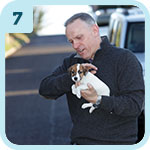
Thirdly, why not carry your puppy? This is what I did with Ounce, at the start of her adventures last year.
 Puppy party
The KC plan says:
“Introduce your puppy to friendly healthy vaccinated dogs if you know any. If not, speak to your veterinary practice or your chosen puppy training class – some have days where your pup can meet friendly staff dogs in a safe environment.”
 Veterinary practices usually run a ‘puppy party’ every few weeks to allow people to enable their pups to interact with other dogs. However, a word of caution here. Some puppies are naturally lively and boisterous, wanting to play with everything that comes along. Other puppies are more reticent, easily feeling overwhelmed by the prospect of noisy, puppies bouncing into their faces.
Just as when dogs are unhappy about interacting with children, puppies can give ‘calming signals‘ to other dogs to show that they have had enough. Please pay attention to your puppy and understand when he has had enough? Don’t let your puppy become the party pooper who spoils everyone’s fun!
Other ideas
 All experiences need to be totally positive – so if it is a person, they should give the puppy a treat. If it is an experience (car, traffic, pub etc) you need to make sure you treat and reward the puppy in that environment. Play a game with him, feed him his dinner there. Socialising a young puppy is easy – as most people you meet will want to see him and will be happy to help!
 Use interactive toys stuffed with food, to give him problems to solve. He needs controlled frustration to deal with to continue his brain development in his new home. Introduce him to tunnels, steps, things to clamber over, and different surfaces to walk on.
Being alone and settling down
 Teach him that part of his new life includes being left alone for short periods of time – or not having constant access to you. Do this from the first day you bring him home. Use a dog cages or crate or a baby gate to separate him from you at least once every day. This should be at times when there are positive things happening (eating dinner, chewing a stuffed Kong etc). To start with he should still be able to see you (and so not feel deserted).
 Continue to use the noise CD that the breeder has been using (or you can buy one from Amazon) to play unexpected noises (if he hasn’t had the benefits of the first 8 week Puppy Plan, start these very quietly at meal times or game times, and slowly build up the volume).
 Teach your puppy about relaxation, being calm around you etc. This includes being groomed, and being handled around his feet, face, mouth, ears etc. Remember to reward him all the time when he is still and relaxed. Many owners miss this one in all the excitement and so the dog thinks everything is a game and never keeps still when the owner is around.
 Encourage periods of quiet time – when he is relaxed and settles down in your presence. Start these as very short periods, using a crate or a play pen beside you if necessary. Give your puppy something to occupy him such as an interactive toy (like a Kong stuffed with food).
Ask for help?
You are very welcome to CONTACT ME to ask for my advice. I can help you with a variety of issues and problems around getting a dog. This includes suggestions for tackling training issues. Go to the What Dog? page for more information on my new service.
Remember..
Please CONTACT ME if you want to know more about me and my dogs? And feel free to COMMENT if you want to tell me what you think. If you want to know more, why not FOLLOW ME? Then you will receive an email when there is a new post.
If you receive my posts via email, remember to click through to the site to see the photos.

 When should socialisation start?
 Put more interactive toys into the puppy pen at times when you can supervise. These can include wobbly objects, tunnels, bits of cloth to climb over or burrow under, suspended tennis balls, larger balls that can be rolled about, empty plastic bottles with some pebbles in them that will roll noisily, small boxes that can be climbed on or in, trays filled with stones or shallow water… Anything you can think of to introduce new stimuli to the puppies.
 Over the next couple of weeks, try and make sure the puppy meets as many different types of people as possible – women, men, children, people with beards, hats, high heels, hoods etc – and that they have rewarding experiences to associate with them (games, treats etc).
 Having heard all the usual household objects, it is time for him to experience them – this includes the TV, vacuum cleaners, ironing boards… anything that will form part of his life as a dog in a busy household. As always, make sure these experiences are positive. Start very slowly with these things not moving or switched on, and reward the puppy with a treat or a game for ignoring them not playing with them. Slowly you can begin to move them, switch them on at a distance etc – always going back a step if the puppy is reactive towards them.
 On occasions, feed the puppy separately from his mum and littermates – and a little bit away from you (in a crate, behind a baby gate etc). Start to teach him that good things can happen when he is on his own. Also on occasions, feed him from your hand – he also needs to learn that having humans around his dinner is always a good thing.
 Positive interactions
 Try to take each puppy out individually to sit in the car, drive round the block, see and smell things that will be part of his daily life (traffic, trains etc). As he is unvaccinated (although will still have immunity passed to him from his mother) he should be carried but he should have all these experiences in these really important two weeks when his confidence is at its highest and his fear responses are at their lowest.
 My reply was sadly unenthusiastic, as I recommended that she wait a bit longer still. It is really frustrating living without a dog, I know. I was lucky enough to be able to take on one of my mum’s, aged 8, when my sons were babies, which was great as I didn’t have a puppy and they grew up with a dog from the start. We got a puppy when the boys were aged 5 and 3 and it was hard work! I didn’t give Buzz the time he deserved and he was never that great. He adored the boys, but they completely ignored him and he was nippy with other children.
 The right environment
 First dog, best dog?
 Saying No!
 Be consistent – please?
 Why say no though?
 ome people think they only need to use treats when their puppy is little. Why? I still like chocolate and I’m 55 years old! If you asked me to do something and offered me chocolate I would DEFINITELY do it! Sunny will always come back to me, no matter whom I call, just in case I feel like giving her a sweetie. Well of course I do! She’s 12 years old but if she comes when I call, she


 Rushing all day long
 Ask for help?

 Symptoms of Pyometra include:
  Luna made such a great recovery from the operation and really rocked the shirt provided by the vet, which was brilliant compared with the stupid lampshade they usually provide. She was moving around normally within a day or two and a month today since the op she if fully healed and back to her usual self. On the strength of that, I decided to go ahead with Aura’s spay. Aura is more active than Luna, so I thought it might be harder to manage her recovery. Silly me! She is younger and fitter than her mum, so was completely better within the week. Amazing.

 Question 1
 Question 4


 It’s scary and difficult, knowing what to do in this situation. How do you deal with it? I’m lucky that it has happened rarely to me in all my years of dog ownership. I think our first instinct is to try and grab your dog and pull it away. Don’t do this! It is quite likely that your dog will turn round and bite you, thinking it is being attacked from behind. Or you will get bitten by the other dog.
 How to prevent the fighting
 When you have a reactive dog, you keep it on the lead. You walk at times you think will be quieter, along less busy routes. Maybe you are constantly on guard, watching out for other dogs. When other dogs coming bouncing over, with the owner calling out “it’s OK, he’s friendly”, you can become angry or tearful.
 Teach good manners