Childhood dogs – teaching us how to look after dogs
I regularly receive enquiries from people looking for Border Collie puppies; I am an Assured Breeder for Border Collie after all. Many people come to me because they are thinking of getting their first family dog or their first dog as an adult, having had dogs in childhood.
When I ask people if they have had dogs before, as part of my vetting process, people often say “yes, we had such and such dogs when I was growing up”. Sometimes people even tell me they have previously owned dogs and it isn’t until I meet them and they talk about these dogs that I discover that the dogs actually belonged to their parents.
What’s the difference?
If your parents own a dog, then it’s yours too, right? Well maybe. If you grew up with a dog or dogs, can you answer the following questions:
how was your family dog chosen?
who chose its name?
where did your dog sleep?
who was responsible for feeding your dog?
who trained your dog?
did you walk it regularly?
who cleared up your dog’s poo/sick?
did you care for it when it was ill?
what health issues did your dog have?
how long did it live?
Taking responsibility
Living in the same house as a dog is not the same as owning one. I’m sure plenty of people were able to answer some of these questions, but ultimately, it’s about making decisions. Starting with what kind of dog to get. Most children have a dream of owning a dog, but hopefully their parents are the ones making the choice, doing the research and buying the dog.
Very often parents wait until their children are in their early teens before getting a dog. This means that by the time the dog is old enough to need care and (often medical) attention, the children have left home. They therefore miss most of the ‘owning an old dog’ stage.
Adulting – learning from childhood
Just because the dog wasn’t yours doesn’t mean you didn’t learn anything from the dog you owned in childhoood. Hopefully you experienced the joy of dog ownership. You probably cuddled the dog when you were sad. It is likely that you ran around with it in the garden from time to time. I would definitely hope that your parents dragged you out on walks with your dog occasionally, although probably not every day. You might remember some of the challenges – chewed shoes, accidents, fighting.
Look back on these experiences in childhood with a dog and understand what you learnt and what are the limitations? Be realistic about the fact that it won’t feel like that to you, as an adult? Read about 10 common mistakes made by new dog owners?
One of my puppies went to a lovely young family where the husband had grown up with collies. Sadly, the puppy developed epilepsy and they had an extremely challenging eight months before she was put to sleep. Not what they signed up for. Be prepared for the fact that it’s not all cuddles and carefree walks in the sunshine. It is mostly that though.
Ask for help?
You are very welcome to CONTACT ME to ask for my advice. I can help you with a variety of issues and problems around getting a dog and suggestions for tackling training issues. Go to the What Dog? page for more information on my new service.
Remember..
Please CONTACT ME if you want to know more about me and my dogs? And feel free to COMMENT if you want to tell me what you think. If you want to know more, why not FOLLOW ME? Then you will receive an email when there is a new post.
And if you receive my posts via email, remember to click through to the site to see the photos and lots more information.
We generally think we know how to apply for a job, don’t we? We reflect on our skills and aspirations and craft these into a CV. We then put together a carefully worded application form, which is relevant to the job for which we are applying. It is a challenging and time-consuming process. Should contacting a dog breeder be the same?
Proud breeder
I have worked in HR for many years and have seen many variations in the quality of applications. You can tell straight away whether someone is committed to the job, or if they have just sent out a generic ‘give us a job, any job’ application.
First contact
You may have already read some of my posts about the challenges of being a Responsible Breeder. What I haven’t really talked about so much is the challenge of finding suitable homes for the puppies.
Of course a Puppy Farmer doesn’t really care who has his puppies – he’s just breeding dogs to make money. They are a commodity, nothing more. But if you care about the dog you are bringing into your home, wouldn’t you want to find the right one for you? Wouldn’t you want to ‘apply’ for a dog from someone who equally cares about who you are?
How would you feel if you received a message like this?
“Hi, I saw that you breed border collies, I wondered if you had a litter? Thanks”
What would you say? I honestly try to reply to every enquiry I receive, but really, what can I say to this person, whoever they are? No. Why should I say anything else? Even if I did have a litter, why would I bother to reply to this message? Contacting a dog breeder requires more effort than this!
Sell yourself when you contact a dog breeder
When you contact a dog breeder, you need to let them know who you are. At the very least, you might tell them your name! But actually, if you really want a puppy, you need to sell yourself to the breeders. By contrast with the message I received, I also had a phone call from someone. He was keen to tell me all about himself, his family and his previous dog. I told him that I wasn’t going to have a litter for a while, but he was keen to wait for the right dog, from the right breeder. He had already done some research and asked some great questions. (He’s got through to the next round :))
What should you say?
Here my list of a few points that you might say to a breeder, just by way of introduction:
Your name, where you live, your circumstances – do you work full time? Who lives with you? Do you have children?
Your current and previous dog ownership
What you are looking for in a dog?
When you want to have a dog – this year or next, not too specific
What you would like to do with your dog
What should you NOT say?
Equally, there are a few ‘no-nos’ when you make contact with a breeder:
I want a puppy now, or on a specific date (it’s not an exact science!)
Specifying colour or markings – I want a black one
Asking for unusual characteristics – I want one with blue eyes
Saying you have a 2 year-old child (too young, really)
Wanting a puppy before your old dog dies. Old dogs don’t take well to puppies.
Born in a bedroom
Breeders talk to each other
Breeding dogs responsibly is quite a specialist ‘job’. There are not that many Assured Breeders around and we know each other! This is partly because we need to find non-related dogs to breed with and partly because we give each other support and advice.
This means that we help each other out when we have litters, sending along good homes once we have found homes for our pups. We also tell each other if someone seems unsuitable! So be warned, even if you think you are making a casual enquiry, you might be jeopardising your chances with a number of breeders.
NO PUPPIES AVAILABLE
My beautiful girl
A final thought
“Dogs owned by people who spent more than an hour researching where to buy them from are likely to live twice as long as those who spent under 20 minutes choosing a puppy, with mean mortality ages of 8.8 and 4.3 respectively. As a result of buying from puppy farms, people claim to have suffered emotional and financial hardship, the KC report.”
The Workbook – A Year With Your Puppy is available to buy. It was written and designed to be a hands-on, interactive book for you. It will help you survive the first year with your puppy, but also act as a memento of that time and the journey you have been on. You can write notes and stick in pictures of your puppy throughout the year. Lovely!
Please CONTACT ME if you want to know more about me and my dogs? And feel free to COMMENT if you want to tell me what you think.
If you are a breeder, you can talk to me about how I vet my puppy owners, together with advice on the information I provide to my puppy homes. CONTACT ME for more information?
Please let me know if you have found this post helpful?
Health in dog breeding – how the Kennel Club is helping our dogs
“Did you know that in 2017, the Kennel Club Charitable Trust gave over £450,000 to aid scientific research? Or that Mate Select, a free online Kennel Club health resource for breeders, was used approximately 1.8 million times? Or that the Kennel Club emailed around 140,000 dog owners and breeders to promote 40 different independent health surveys, research projects or health clinics? “
[Source: KC Newsletter March 2018]
These are just a few of the ways in which the Kennel Club strives to make a difference to dog health. To find out what the Kennel Club did in 2017 to help improve canine health, have a look at the KC Dog Health Brochure.
Why is the health of our dogs important?
If you have never had a child or pet suffer an illness or injury, lucky you! As soon as you go through the agonising experience of watching someone you love, be it child or animal, in pain, you just want to take that away. You hate to see them suffering and want to do anything to restore them to full health.
Any steps that can be taken to improve the health of our beloved pets is therefore worthwhile. I believe that it is better to start with a healthy animal than to try and nurture something that is sick to start with. Bad health might be due to a poor start in life from irresponsible breeding (puppy farming) or from genetic breed health issues.
Canine Health Schemes – helping you to improve dog health and welfare
Canine Health Schemes (CHS) works with the Kennel Club and British Veterinary Association to support breeders in improving dog health and welfare by enabling you to make informed decisions with regard to your breeding programmes. The four schemes run by CHS, which are open to all breeders, are the Hip Dysplasia Scheme, Elbow Dysplasia Scheme, Eye Disease Scheme and the Chiari Malformation/ Syringomyelia Scheme.
To find out more and to learn how to screen your dogs, have a look at the Canine Health Schemes.
Hip dysplasia
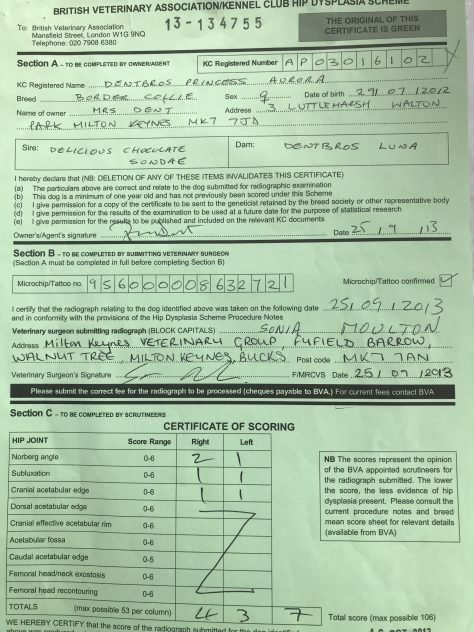
I thought is would be useful for you to see a copy of Aura’s hip score certificate. She was x-rayed to see if her hips were healthy, for which she needed to be sedated. These are sent to a panel of veterinary experts for review. They examine the images for health defects, which highlight the likelihood of future problems. They mark each defect on both sides. The lower the score therefore, the better the health of the dog’s hips.
Breeds scores are recorded and over time and the figures give a clear picture of the health of the hips of different breeds. You can then see whether you are producing dogs with at least as good as average hips. The overall aim is to reduce the breed average, the probability of hip dysplasia and the likely future suffering of the dogs.
Border Collies currently have an average hip score of 13, taken from 7, 648 dogs.
Labradors have an average of 14, taken from a sample of 74, 094 dogs.
Bulldogs have an average of 44, taken from a sample of 26 dogs.
Why is the sample of Labradors so large? We know that they are very likely to suffer from hip dysplasia, so breeders are working hard to remove this from the breed. Why is the sample of Bulldogs so small? In 2012 (when the figures were published) the breed was declining. This was due in part to its poor health, short lifespan and inability to give birth naturally. You don’t need to x-ray a bulldog’s hips to know that it can’t move freely. 🙁
Remember..
If you are buying a dog, start by looking at the What Dog? page, then contact me? Or if you want to breed, read this Dog Breeding Blog and then please CONTACT ME to discuss this, as I may be able to mentor you?
Please CONTACT ME if you want to know more about me and my dogs? And feel free to COMMENT if you want to tell me what you think. If you want to know more, why not FOLLOW ME? Then you will receive an email when there is a new post.
Jeremy Vine does a series of pieces entitled ‘What makes us human?‘ on Radio 2 and this is a picture that sums up a viewpoint I have realised over the past few days in relation to this question. It is similar to a picture I saw on social media with a man in camouflage trousers and a neon top with the caption “do ye wanna be seen o’ no?” (Scottish) Lol. Here I am, with my camouflage jacket and my bright purple hair. It’s an example of conformity (hiding in the crowd) and individuality (wanting to be different).
What’s the point I am making? We want to be the same as everyone else. We are desperate to conform, to fit in, to be seen as ‘normal’, to go unnoticed. AND we are desperate to be different, to stand out, to be memorable. In order to achieve these two opposing and confrontational goals, we will buy the latest fashion, follow the trends, look carefully at what others are doing and copy it. There are many entertaining social experiments about people going along with a crowd, performing in increasingly bizarre ways, just to do the same as everyone else.
Equally, there is a constant battle to be just a little bit different, to be memorable and not the same as everyone else. We give children ridiculous names, or spell their names in ridiculous ways. People get tattoos, with our own versions of patterns or pictures making us look a bit different from other people (while following the fashion for body art). We dye our hair.
How does this relate to dogs?
I watched the Catherine Tate programme Saving the British Bulldog the other night (watch it, if you haven’t already, it’s really good). Catherine presents a really clear, balanced picture of what has happened to the bulldog breed and why this has taken place. In my view, this represents this same dichotomy between conformity and being different.
The Kennel Club have a breed standard for the British Bulldog. It says right at the outset:
“A Breed Standard is the guideline which describes the ideal characteristics, temperament and appearance including the correct colour of a breed and ensures that the breed is fit for function. Absolute soundness is essential.
“Breeders and judges should at all times be careful to avoid obvious conditions or exaggerations which would be detrimental in any way to the health, welfare or soundness of this breed.“
There it is, in black and white. So what’s going on? Breeders are breeding for health and to produce the best examples of the breed, conforming to the ‘standard’ set. BUT people don’t want all dogs to look the same. They want them to look different. People want a dog, but they want it to look like a baby.
As the programme demonstrates, this make the dog unhealthy, because it becomes deformed. This is NOT the fault of the Kennel Club, nor the breeders, but the buying public, who are trying to find a particular ‘look’, no matter what that costs.
Health comes first
Surely we would not deliberately buy something that was unhealthy, would we? We wouldn’t choose to have an unhealthy child, would we? So why would we choose to have a dog with inherent health problems?
If we only cared about dog health, we would all have dogs that are shaped like dogs. A bit like this year’s Crufts Best in Show, Tease the Whippet, (Collooney Tartan Tease). The Kennel Club says that the Whippet was originally bred for rabbit coursing, with gambling on racing in the North of England. It goes on to say:
“Although Whippet racing continues on a very minor scale, the breed is now hugely popular in the show ring where its elegant lines and smooth daisycutting action has won many admirers. As a family companion, the Whippet is gentle and affectionate and enjoys the comforts of domestic life.”
Sounds lovely, doesn’t it? But we don’t all want Whippets, do we? We want something different. Conformity equals boring, in some people’s minds.
The same, but different
This is all just an excuse to talk about my puppy, Ounce. I LOVE that she is different – pretty unique in fact. She is a lilac and white Border Collie, which is a colour that is found in only around 1% of the breed. In addition, she has blue eyes, which is even rarer. Blue eyes are definitely not part of the breed standard.
At the same time, Ounce conforms to the ‘show type’ of Border Collie, because she is from those lines. So she is more ‘stocky’ than a farm-bred, working sheepdog type Border Collie. She has the pedigree Border Collie broad, short back and head, and she has a thicker, longer coat than a working sheepdog. She has very even markings, with a white blaze, full mane, white socks and white tail tip. Ounce is also a ‘typical collie’ in her temperament and behaviour. A perfect balance of conformity and individuality!
The evolutionary compulsion for conformity
In my opinion, there is a biological reason why we want conformity and to be different. We need to ‘fit in’ so that we can be desirable to others, but we also need a diverse gene pool and we need to attract a mate. To meet these needs, we are prepared to do almost anything and ‘variety is the spice of life’.
Going back to the health issues, we are, unfortunately, prepared to do many things in order to be ‘attractive’ to others. People have always been happy to mutilate themselves and each other in the name of beauty, eg stilettos, makeup, piercings, FGM. This is well documented, so I do not need to detail it here.
This compulsion is transferred to our dogs. We want the same as everyone else, but we want ours to be better. More beautiful, more unusual, more extreme, more fierce and so on.
Conformity can be good
My mother has passed down a family expression to me, which my sons now say. It was said by my great-grandmother; “It’s a good job we’re not all the same, or we’d all want to marry the same man. And it wouldn’t be you Charlie.” Poor Charlie! My conclusion is that we strive to be different, while fighting to be part of the human race. It’s what makes us human, but also what makes us part of the evolutionary process. Purple hair, purple puppy, something different.
Hopefully, we can recognise the need to promote the healthy ‘normal’ while celebrating the beautiful variety of life. Pedigree dogs should be healthy, but this is only true as long as responsible breeders can produce enough dogs to meet public demand. Once we clamour for more and more ‘designer dogs’, unscrupulous people will see a chance to make big bucks by compromising standards, as Catherine Tait’s programme demonstrated. Please bear in mind what a dog should look like when considering what to get for your best friend? Consider conformity, please?
Buy the Workbook
The Workbook – A Year With Your Puppy is available to buy. It is designed to be a hands-on, interactive book for you. This book will help you survive the first year with your puppy. It also acts as a memento of that time and the journey you have been on. You can write notes and stick in pictures of your puppy throughout the year. Lovely! Find out more by clicking here, or click the button to buy it.
I have spent the day at Crufts, at the NEC in Birmingham. Such a lovely atmosphere – dog people are the nicest, always. Watched the YKC agility, including Hollie, who owns Ounce’s sister Pixie, running with her other dog, Blue.
Then I met some great breeders of hounds and terriers, talking to them about the challenge of finding a good dog and wanting to have other great breeders and breeds of dog to recommend, as part of my What Dog? service.
Did some shopping, including a little something new from Dogs & Horses – more on that later.. And some new toys for the girls, of course!
Then into the arena to watch the Heelwork to Music, followed by some great agility. Heaven!
Agility at Crufts
Congratulations to Sam Lane and Rival for winning the Novice Cup at Crufts!
Buy the Workbook
The Workbook – A Year With Your Puppy is available to buy. This book is a hands-on, interactive book for you. It will help you survive the first year with your puppy, but also act as a memento of that time and the journey you have been on. You can write notes and stick in pictures of your puppy throughout the year. Lovely! Find out lots more by looking at the Contents page.
Managing long-term health conditions like diabetes in your pets
Just as with human medicine, animal medical care is advancing all the time. We are constantly improving what we can manage and how long animals with long-term conditions can be kept alive. The great thing is that any advances in animal care may well be transferred to human medicine, meaning that we all live even longer – great!
I have already talked about Luna in relation to her last litter and written about what went wrong. Since then, Luna has been diagnosed with diabetes and I thought it would be useful to review the management of this condition so far.
Symptoms of diabetes
These are similar to the symptoms of type 1 diabetes in humans, namely:
excessive thirst
excessive urination
lethargy or depression
unexplained weight loss
Luna has always been a ‘thirstier dog’ than my other dogs. She has also been more prone to urine infections and has been the one more likely to have the occasional accident overnight. She has had periods where she will suddenly produce a huge amount of urine in the house. These symptoms were not hard to manage and I just thought that she had slightly poorer bladder control, compared with the other dogs.
When she was pregnant last year, both the drinking and urination seemed to get worse. I was a bit unhappy about this, but she had no other symptoms and seemed generally in good health otherwise. However, after she had gone through the delivery and subsequent operation, she had a period of seeming better than before. This was followed by a gradual decline in her demeanour. She became less lively and more subdued. It was hard to pinpoint, but over the course of a few weeks we became aware that something wasn’t quite right.
Over Christmas, I realised that Luna was losing weight. Again, it was quite a slow process and quite subtle, but by the time we were into the Christmas holidays, I knew she wasn’t right. So on 27th December, I took her into the vet’s, expecting the worst. Her weight had gone from 17-18 kgs to 15.95 kgs. Straight away, the vet knew it was diabetes; there was glucose in her urine and a blood test confirmed it.
Initial management – routine is the key
So there we were, learning how to inject our dog, using a teddy bear to practice on! It was a bit daunting, but we were given a ‘medipen’ which seemed pretty foolproof. Well Chris managed to bend the needle on one of his practices, but we felt reasonably confident about having a go.
We were told that routine is the key to managing diabetes successfully in a dog. So it would be no good giving her a quick walk round the block some days and a great long hike at the weekends. Or putting down food for her to pick out when she wanted. Or giving her treats throughout the day.
Fortunately for me, I also thrive on routine. I get up and feed the dogs at 7am, every day, more or less. The dogs are walked for around an hour, off lead, every day, roughly an hour after breakfast. I used to feed them again at 4pm, but Luna must have her injections every 12 hours, with food. So now they are fed at 7pm as well. That was the biggest change. It is also the hardest to stick to, since if we go out for a meal, or to the cinema, or I have a governors’ meeting and no-one else is in, then the routine must change slightly. But we are really lucky, because I am around most of the time and able to set my own routine.
Diabetes injections
Giving the injections every 12 hours has become as routine as cleaning my teeth. Fetch kit from fridge, open and screw on needle, turn dial to required number of units, remove cap. Wait for Luna to finish her (special diabetes) food, grab a handful of skin on the scruff of her neck and jab in the needle. Press the button, wait 5 seconds and rub it. Give her a kiss and tell her she is a special girl. Remove needle and put in sharps bin. Return kit to fridge. Check there are plenty of needles and insulin phials. Order more of these and/or sacks of food as required. (I recommend Pet Drugs Online for this)
Of course there has been the odd mishap. I have stuck the needle into my finger or thumb a few times. Bent the needle once or twice. Squirted the insulin onto my hand instead of into her neck. Panicked that there isn’t enough left in the phial and when I should change it over.
Stabilising the condition
Luna immediately improved following the diagnosis. She went back to her normal self; happy and lively. Her weight slowly returned to normal, over the next few weeks. She stopped drinking and weeing to excess. Fantastic. We were told it could take a few months to stabilise the condition and to sort out the correct dosage of insulin. Luckily, we have a good routine and this seems to have really benefitted Luna, as she has been doing really well.
After a couple of weeks, Luna spent the whole day at the vet’s having something called a ‘glucose curve’ done. They did the equivalent of a pinprick test on her every hour and looked at the level of glucose in her blood. This told them whether she was on the correct dosage. Then a month later, she went back for a blood test, which showed the levels over a longer period. This will be reviewed again 3 months later.
Hypo or hyper?
When the glucose levels are not stable, diabetics can become hypo- or hyperglycaemic. In people, this is a concern and diabetics generally check their blood glucose levels throughout the day and change their food intake accordingly. However, in dogs this is less variable, so less of an issue. We were told that if her glucose level was ‘out’ she would generally seem unwell and we should take her into the vet’s to be checked and treated accordingly. Fingers crossed, nothing has happened, yet.
One variable Luna has to cope with is her agility training and competition. We made the decision to continue with this, as she really enjoys it, it keeps her fit and mentally stimulated and is part of her normal life. She was so happy to be back! She really loves running around with Chris. I tend to find that a few hours after a lesson, she will come up to me and tell me that she is feeling in need of a ‘little something’. I give her a handful of her normal food and she is fine. Simple!
Other long-term conditions
In addition to managing Luna’s diabetes, I monitor Sunny’s arthritis. She has spent her life jumping around after balls and doing agility (she retired aged 10), so it’s not surprising that she has a bit of stiffness in her shoulders. She is on an anti-inflammatory for this and I make sure that she has regular check-ups.
Then the cat also suffered from pancreatitis last year and has had some ongoing kidney issues, for which he has a specialist renal diet. All good fun!
As you can see, there are many ways in which we monitor and care for our pets, thanks to the ongoing development of veterinary medicine. Personally, I don’t believe animals should be kept alive at any cost, but for something like diabetes, the prognosis is really good. I am indebted to MK Veterinary Group for their care.
Buy the Workbook
The Workbook – A Year With Your Puppy is available to buy. It was written and designed to be a hands-on, interactive book for you. It will help you survive the first year with your puppy, but also act as a memento of that time and the journey you have been on. You can write notes and stick in pictures of your puppy throughout the year. Lovely!
Happy 4th Birthday to my magical imp, Busy. Part of a Fairytale Litter and a fairytale story. She wasn’t meant to stay with me; I had three dogs at the time, which was quite sufficient, thank you. Within a few days of them arriving, I had seven lovely homes for seven lovely puppies. But friends kept saying to me “You love that one, don’t you?” And I really did. When the puppies were three weeks old I had a really hectic weekend with all seven owners coming to meet their puppies for the first time. Some of these were complete strangers to me, so it was hard work. I had mentally allocated all the pups beforehand, so was pleased to be able to sort out who was going where.
Unfortunately, Busy had other ideas. After everyone had gone, I had a sleepless night, realising that I could not let her go. She was my little imp, that’s all there was to it.
The Dentbros family
What a dog she has turned out to be! After all the others had gone, I spent four weeks waiting to take her out, sitting around the house. I was trying to catch up with my work, which meant that the house was quiet and we just sat around all day. When we were finally allowed out, people kept saying to me “Isn’t she calm?” Which was a bit of a shame, since I had called her Busy!
Busy
Actually, she is a bit of an contradiction, as she is extremely busy when running around in the woods, or on the agility field. She is very good at entertaining herself and rushes about the kitchen, shaking her favourite toy ‘Snakey’ in a very entertaining way.
Yet she is also extremely gentle and the perfect dog to work with children in school. Because of her I have met some wonderful children and staff at my local Junior School, as part of the Pets As Therapy Read2Dogs scheme.
Busy proved to be a brilliant mum to her litter and continues to play with and tolerate the puppy. They look so funny, tearing around on our walks.
Overall, Busy is an amazing dog, who has definitely changed my life. I still think her mum, Sunny is my ‘dog of a lifetime’ as she introduced me to breeding AND agility and has created a legacy of amazing dogs. I think Ounce will also prove life changing; she is a very special character, whom I have already trained differently to my other dogs. How lucky am I to have such incredible dogs in my life?
Remember..
Please CONTACT ME if you want to know more about me and my dogs? And feel free to COMMENT if you want to tell me what you think. If you want to know more, why not FOLLOW ME? Then you will receive an email when there is a new post.
Turns out, a responsible breeder looks a bit like me! Well not all of us have purple hair, although we do have a tendency to eccentricity, since our lives revolve around our dogs.
Assured Breeder Seminar
On Saturday, I went to an Assured Breeder Seminar, run by the ABS department of the Kennel Club. It was a great day, well run, well attended (100 people) and with some very interesting talks, on the following subjects:
Fourteen years of the Assured Breeder Scheme; how the scheme has developed since its inception
The importance of health testing and screening, such as hips scoring, elbow grading and EBVs
Changes to the puppy contract; showing compassion and dealing with issues; and the legal implications of social media to exacerbate issues
The rise in illegal puppy imports
Breeding Licence Regulations and the DEFRA Reform
Focus groups to allow breeders to discuss recommendations for the future of the scheme.
I learnt a great deal and had the chance to speak to lots of lovely dog breeders. It seems that there are in fact plenty of responsible people doing a great job, just for the love of it. Listening to the history of the scheme and the way it has progressed reflects the way that we think about dog breeding in this country.
front row: Luna, Sunny back row: Aura, Bea, Pudding, Wispa, Chip, Busy. And me, the proud breeder!
Demand for dogs
It is estimated that in this country we ‘need’ around 800,000 puppies each year, just to ‘replace’ dogs that have died. The Kennel Club expects to register around 300,000 dogs this year. The remaining dogs will include crossbreeds and people doing a ‘one off’ litter from their family pet. Sadly, a large number of these puppies also come from commercial breeders and illegal imports.
We were told that 73% of breeders only have one litter and only 5% have more than 10 litters. There are around 4,500 members of the Assured Breeder Scheme. Talking to the breeders around me, most of us Assured Breeders have had dogs for a long time and generally have around one litter per year. That’s around 5-10 puppies, per year. Not enough to meet demand, is it?
Breeding for health, not money
What was apparent in listening to other breeders, backing up the view I expressed last week in my post Should I breed from my dog?is that it is difficult to be a responsible breeder AND make money doing it. It’s one or the other, generally. This is one of the reasons that Assured Breeders do not generally have a licence from their Local Authority; we see it as a hobby only.
“Where you buy could determine whether they live or die”
Lovely babies!
Responsible breeders stop dogs going into rescue
They do this by:
vetting prospective owners and matching puppies to the correct homes
telling owners to look at alternative breeds and/or not to have a puppy
taking puppies back rather than allowing them to be dumped.
It is a never-ending challenge for the Kennel Club, trying to persuade dog buyers that this is the case. Fortunately, other organisations such as RSPCA, Dog’s Trust, Battersea and the Government are now working alongside the Kennel Club to promote this message.
Responsible breeding saves money
Agria Insurance have done an extensive survey and been able to demonstrate that there is a significant saving in vet’s fees when dogs are bred responsibly. For example, puppies from an Assured breeder are 23% less likely to visit the vet and owners spend around 18% less in vet’s fees.
Why breed?
I did a poor job of answering this question last week. In fact we do it to:
improve the breed
continue strong, healthy breed lines
produce dogs that have good temperament and are fit for purpose.
Think before you buy?
One key fact that I learnt on Saturday about supply and demand should give us all pause to think. From 2007-2016 demand for French Bulldogs went up, resulting in 3000% increase in registrations of the breed. From 2015-16 registrations went up by 47% and this year it is expected that there will be 30,000 registrations for the breed. There are now 31 Assured Breeders for the French Bulldog and 160 other breeders of the breed. Wow! Compared to just 23 listed Border Collie Assured Breeders.
In order to make so many puppies, what kind of life do those dogs have? Who is loving them? Are they having a litter every six months? Are they being illegally imported, whilst pregnant, so that they can provide the puppies that the public are demanding? What will happen to these dogs once the demand dries up? Dumped or dead, most probably. Please think before you buy?
Remember..
Please CONTACT ME if you want to know more about me and my dogs? And feel free to COMMENT if you want to tell me what you think. If you want to know more, why not FOLLOW ME? Then you will receive an email when there is a new post.
What do I need to think about if I want to breed from my dog?
Discussing this round the dinner table yesterday, my father-in-law made an interesting point. He said “If you’re breeding cows, you want to breed them to produce lots of milk. If you’re breeding racehorses, you want them to run really fast. But with dogs, you want so much from them. You want to them to look a particular way, but also to have a good temperament as a pet, and to be keen to do dog sports etc etc.” It’s a bit of a challenge, isn’t it?
As a breeder, I believe that I am just doing ‘what anyone would do’. But is appears that this is not the case. I want to produce the best puppies I can, who will go out there and enhance their owners’ lives. I want them to be good with people and other dogs, to be ready and keen to learn, to be confident, outgoing dogs. I want them to be as healthy as they can be and to live long, healthy lives. I also want them to look fantastic!
In the last couple of days I have heard about a renowned agility trainer and competitor who has a large number of breeding dogs. They are kept in barns and all mixed in together, so the parentage is not always clear. They are delivered to their new owners, who do not visit and will not see them with their mum. They are not registered as pedigrees, so they are not regulated.
I have also heard about a renowned obedience trainer and competitor who has had a fifth litter from a dog aged over 8 years, bred to a cousin probably. Not ideal. Again, not registered as pedigrees, so not regulated.
Finally, (and most upsettingly) I have learnt that a dog owned by a show breeder who has sired an epileptic pup, has been used to sire another litter. Because there is no proof that epilepsy is carried genetically and there is no test for epilepsy, they can do this. Would you buy a pup, knowing that it might develop this disease?
All of these examples demonstrate that dog breeding is a minefield. For those of us trying to do the right thing, we struggle to find dogs to mate with ours that are from healthy lines and have no temperament issues.
Why bother to breed?
The first thing to think about when considering whether to breed from your dog is why you want to do it. Please, please do NOT do it for the sake of the dog. I promise you it is a stressful and difficult process and they won’t thank you for it. Many dogs hate the mating itself. The health testing involves sedation and/or anaesthetic. The births can involve trauma and the feeding is exhausting. Even for a male dog, the process is hard work and stressful. Keeping a male entire might seem like the kind thing to do, but you then have a dog being tormented by raging hormones and once used at stud, they will be forever searching for the next female.
I had watched and been involved with my mum having over a dozen litters from 7 different dogs over the years. She had a very laid back approach and produced lovely puppies without too much difficulty. I loved my dogs and loved the puppies, so always thought it would be a ‘fun thing to do’.
When I started, I was fortunate to have an experienced breeder to mentor me. She ensured that my dog was fully health tested and advised me about many aspects of breeding that I had not previously considered. I have run a successful business and am a good administrator, so I have enjoyed that side of breeding, as well as producing lovely dogs. But I had completely underestimated how emotionally challenging it would be, finding suitable homes and dealing with all the owners, supporting them through the process of taking their puppy home.
Health Testing
Before you do anything else, you need to ensure your dog is as healthy as it can be. If you go and look at the KC Health testing page you can look up the requirements for each pedigree breed. Of course if you are breeding a crossbreed, you should ensure that the parents have all the relevant test for their breed. Poodles need eye testing and Labradors definitely need hip scoring, for example. As I said, some tests involve the dog being knocked out and all are expensive.
Temperament Development
If you want to breed from your dog, you should ensure that it is of sound temperament. This means that you need to train it. If your dog is an uncontrollable maniac, it won’t make very nice puppies. You need to engage its brain and develop its obedience. You need it to be good with people, including children and other dogs. You need to expose your dog to a variety of experiences. It should be fit and athletic, participating in sports appropriate to its breed.
Proving your dog’s value
In order to demonstrate to people that your dog is worth something, you need to ‘campaign it’. This means either showing it, or competing it in a sport, or having something to prove that it is not just any old mutt. Of course eventually, if you have plenty of dogs and you produce lovely puppies, you will have testimonials and people will want to buy from you, being prepared to wait. However initially, you may well find yourself with ten puppies and no homes for them.
Assured Breeder Scheme
Ideally, you want to become a Kennel Club Assured Breeder. More about this scheme can be found on the KC website, looking at Assured Breeders for Border Collie for example.
Don’t do it for the money
You won’t make any! If you go into as a commercial enterprise, you will be a puppy farm, putting the money before the welfare of the dogs. It costs thousands of pounds and months of time to produce a litter of puppies and doing it on any sort of scale inevitably compromises the dogs.
In Conclusion
Dog breeding is an incredibly exciting and rewarding experience. It’s certainly the best job I have ever had! But it is also the worst; the hardest, the most emotional, the most upsetting. Have a look at this Novice Breeder Checklist and then ask yourself: “is it worth the hassle?”
Remember..
Please CONTACT ME if you want to know more about me and my dogs? And feel free to COMMENT if you want to tell me what you think. If you want to know more, why not FOLLOW ME? Then you will receive an email when there is a new post.
What does it mean for a dog to have ‘good temperament’?
How would you describe yourself to someone new? I think my husband might describe me as being ‘high maintenance’. Intelligent, but a bit tricky, demanding and emotional. Others might add that I am caring and thoughtful. My sister would add ‘feisty’. Thinking about my own temperament makes me realise why I love Border Collies so much – we are pretty similar.
“Beautiful Border Collies, bred for better temperament and health”
I think the picture of Aura above sums her up really well. She is looking adoringly at me, because she wants me to throw the ball! She is an extremely loving, caring dog who is generally happy and confident, liking nothing better than to cuddle up to you. However, she is also a bit neurotic, as she is on the ‘fussy’ side, easily spooked and a bit wired when it comes to coping with different situations. Aura is the most typically collie of my girls. She gets really excited when someone arrives, squeaking and wriggling around them, wanting a fuss. Busy tends to stay in her bed when Chris arrives home, remaining calm and slightly aloof.
Aura reacts to high-pitched noises, such as the food processor, or the knife sharpener, so she starts whining and rushing about when we open the cutlery drawer, in anticipation of ‘something happening’. If Sunny happens to be singing ‘Happy Birthday’, Aura will get hysterical with excitement and usually bite Sunny. Not ideal.
All these characteristics are typical for Border Collies. They are not really a problem for us, as the house is generally pretty quiet and we are easily able to manage Aura, putting her away in another room when making soup, for example. But they are good examples of how temperament affects the behaviour of our dogs and how we need to manage them. A great description of Border Collies and why they are so ‘special’ can be found on the Border Collie Breed information page.
What should you be looking for?
The puppy is not like her cousin. Ounce is much more like her mum, Busy, in that she is relatively placid and easy-going. This is what I am aiming for in my puppies. I would like a dog that can ‘cope’ with new situations and not worry about much. I want a dog who is confident enough to go into a new, busy environment and find it interesting and stimulating, rather than stressful.
At the same time, I want my dogs to have ‘focus’ and ‘intent’. I want them to want to learn and do things for me. I want them to be motivated to please me, so that I can train them to behave well and ‘work’ in agility, or in school, or doing tricks. Other breeds of dog are far more easy-going than border collies, but they don’t care about what you want so much. A Labrador will be happy to hang out, but won’t necessarily work too hard to figure out what you want from them, unless you have sausage of course!
How do we get good temperament?
As so often, good temperament comes down to a combination of nature and nurture. First of all, we need good lines to breed good dogs from. I absolutely knew that Ounce would be lovely; easy-going yet engaged, loving and bright, because both her parents are like that. I’m feisty because I’m like my mum and my son is the same (only one of them thank goodness!)
Once we have the building blocks for good temperament in place, we then need to add to this with a good breeding environment. As you know, I have my puppies in my house at all times. They are constantly being handled (cuddled) and I work hard to ensure that they are exposed to as many different people as possible, usually around a hundred in the first eight weeks.
I also work on some basic bits of training and expose the pups to different experiences and all the usual noises that are in a normal family home. Border Collies are not bred to cope with noise (see Border Collie Breed information), but early exposure really helps.
Finally, I provide my new puppy owners with plenty of information and advice on how to develop their puppies over the first few weeks and months after they take them home. They are told to take them out and about and introduce them to a variety of situations and environments.
Can you change your dog’s temperament?
I’m not sure about this question. I know you can change a dog’s (or a person’s) behaviour, but their underlying temperament is harder to alter. A dog will have a predisposition to cope with life, or not. What do you think?
Ultimately, we want a dog who is happy to live the life we provide for it. A happy dog is easy to live with and means we don’t have to spend time worrying about it all the time. We can ask other people to look after it for us, or we can go out for a few hours, without having to rush back, thinking about it howling or wrecking the house. We can relax in the knowledge that we will have less visits to the vet because our dog is suffering from stress-related illness.
Aura is going to be taking part in the Great Big Hairy Winter Stress Study being run by the Royal Veterinary College (for more details go to RVC Canine Epilepsy Research). A hair sample will be examined for cortisol levels, indicating her level of stress over time. I am going to keep a record of her behaviour and activity over the next 3 months, to demonstrate any particular incidents, so that the study can see if there is a spike in stress related to these incidents. All of this is part of a bigger study to relate stress to epilepsy in dogs, particularly collies.
I have chosen Aura because she is the most likely to get stressed – the others are too laid back to care! Love my princess! NB: Stress is not always a bad thing – she is my ace agility girl after all 🙂
Remember..
Please CONTACT ME if you want to know more about me and my dogs? And feel free to COMMENT if you want to tell me what you think. If you want to know more, why not FOLLOW ME? Then you will receive an email when there is a new post.