Category Archives: A Year With Your Puppy

AYWYP: Week 25 – Hormones!

Your puppy’s hormones and the teenage phase

Do as I say, not as I do! Last week I talked about why you should not tell your puppy off. Today I could have cheerfully killed mine! Aargh! Such a naughty little sh*t. My family were trying to make me laugh about it by telling me about this great blog post explaining why you shouldn’t tell off your puppy. I told them that shouting at him made me feel better. Hormones are the cause, making your cute puppy turn into a monster!

Not waiting

What did he do? He climbed over the back of the sofa onto the sideboard, dug some soil out of a plant pot, (having already killed off the plant that was in there last week). And he got one of my Christmas gnomes and de-stuffed it. Thanks Quin.

Why does your puppy’s behaviour get worse?

When they begin to reach sexual maturity, your puppy goes through what is known as the ‘teenage phase’. I remember a couple of years ago, one of my puppy owners saying to me “When do they stop being difficult and annoying?” I (unhelpfully) replied “Around two years of age.” Hopefully it’s not quite that bad.

At two years of age, you have a fully-formed adult dog. From six months old though, you have an adult-sized dog with a puppy’s mind. They are still bouncy, lively, playful, untrained and annoying. They still chew, destroy things, demand attention and generally fill up more time than you have. And their hormones are raging!

Teenage puppy not coming (near the spaniels)

In the video above, he does a lovely wait (albeit lying down not sitting) but then won’t come to me because the spaniels are there.

This is the age that things can go a bit backwards, to be honest. That fantastic recall? Not so much now. Am I bothered? I have better things to do. You know how we worked so hard to ignore other dogs? Well now I’m going bark at them. Or chase them off. Or play with them. And when you call me, I won’t hear you. Little bugger.

New anxieties

Quin misbehaved this morning and last weekend because he was left unsupervised. There were other dogs in the room, but I went upstairs (to do some cycling) and l thought he would be OK. Nope. So although he doesn’t have the mindset to think ‘What can I do to really piss her off?’ he does feel a bit anxious and lonely and look around for something to do. I suppose it’s possible that me telling him off will make him decide not to do it again.

Much more likely that he won’t do it again because I have:

  • moved the (now plantless) plant pot outside
  • moved the sofa further from the sideboard
  • asked other family to stay with him while I go upstairs
  • taken him with me when I’m working or exercising
  • put him in his crate if I do go out
  • make sure he practises being on his own.

Dogs suffer from ‘separation anxiety‘; they get stressed if left alone. This is particularly true if they normally have company. They may have been fine for months, but as they get older they learn to depend on you more for company and care more when you are not around.

Dealing with separation anxiety is possible, but as with everything else, it takes work.

Maybe one day Quin will be as handsome as Bodie

Keep practising to cope with hormones

As I prepare to watch the final of Strictly Come Dancing I think about the amount of work it takes those celebrities to achieve what they do. That catchphrase ‘Keeeeep Dancing!’ is at the heart of the high standards of performance. And my friend Sam has just won a jumping agility class at the Horse of the Year show (they have dogs too). I know the level of dedication she has for training and working with her dogs.

Basically, the more effort you make, the better behaved your dog will be. I’ve been pretty distracted recently, with all the usual Christmas crap we have to do. As a result, my puppy is not as well-behaved as he should be! So, keeeep training!

Don’t give up on your puppy

Puppies are most commonly re-homed around 6-8 months of age. The Blue Cross saythe most common reason for dogs needing our help to find them a new home is that their previous owner no longer had the time to care for a pet.” However, what this means is that people just cannot be bothered to keep on training the bloody annoying puppy. So they give up. Which is a shame, because in just a few more months you will have that dog you dreamed of having. Won’t we Quin?

Couldn’t love him more

Weekly Focus Challenge

What does your dog do that drives you mad?  Is that a phase or an ongoing problem that needs to be fixed?  Try to be patient with your dog – they are changing!

Please share your thoughts and a photo? You can do this in the AYWYP Facebook group, or buy the workbook to keep your own record. Details below.

Buy the Workbook

The Workbook – A Year With Your Puppy is available to buy. It was written and designed to be a hands-on, interactive book for you. It will help you survive the first year with your puppy, but also act as a memento of that time and the journey you have been on. You can write notes and stick in pictures of your puppy throughout the year. Lovely!

Remember..

Please CONTACT ME if you want to know more about me and my dogs?  And feel free to COMMENT if you want to tell me what you think.  If you want to know more, why not FOLLOW ME, by filling in your email address below?  Then you will receive an email when there is a new post.

NO PUPPIES AVAILABLE

NB: I am not a dog trainer, or a dog behaviourist, just a dog breeder and owner. I can only offer my opinion, based on my experience.

AYWYP: Week 26 – Celebrate your puppy!

Let’s celebrate! How well do you know your puppy?

Can you believe it? I’ve had Quin for 6 months! He’s my 8th dog and my second boy, so I haven’t had many surprises, but if you’ve just spent 6 months with your first dog, how’s it been? Let’s celebrate the successes and reflect on what still needs a bit more work?

Arla at 8 months

If you’ve spent time with your dog, you should know them pretty well, right? Ah but how much time do you consciously spend time with them? This morning I was doing some focused work on Quin’s recall, which has deteriorated bang on time, as his hormones kick in and he enters the teenage stage.

So here we go, how much do you know about your dog?

Around the house

  1. What is your dog’s favourite food? Are they a good eater? Do they need to be slowed down when eating? Quin is a steady eater and always finishes his food. I’m happy with his weight and the firmness of his poo.
  2. What treats or snacks does your dog like? Raw carrot is a favourite of my dogs. They all love crisps and will offer lots of tricks to win these!
  3. Where does your dog like to sleep? Do they go on the sofa or your bed? Or do they prefer to find a quiet corner? I’m putting money on the fact they don’t often sleep in that expensive bed you bought? My dogs like a raised bed with some lovely vet bed on it. They usually just lie on the floor.
  4. When does your dog wake up in the morning? What time do they go to bed? Does this work well with your routine? It’s hard work changing your dog’s body clock isn’t it?
  5. How often does your dog need to go out to toilet? Do they always go in the same place? Do they prefer to toilet in the garden or on a walk? I like my dogs to be able to toilet in the garden, so that I don’t have to take them out – it’s so much more convenient. But I know they prefer to toilet on a walk. So I make sure I pick up after them in the garden as well as on walks and I walk them after breakfast so they can toilet then.
It looks like a bed, so why not?

Out and about

  1. How often do you take your dog out for a walk? Do you go at the same time each day? For the same length of time? My dogs have an hour long walk, off lead, around an hour after their breakfast, from 7.30 am.
  2. Where does your dog like walking? Do you go to different places, or do the same trudge every day? Dogs love variety and thrive on visiting different walks. My dogs love the woods! So many interesting smells 🙂
  3. Where else have you taken your dog? Have they been to the pub? Or to a cafe? It’s a good to show off your dog and give them a different experience. Quin went to the pub a few times back in the summer and was a good boy.
  4. Have you visited someone else’s home with your dog? Don’t be afraid to take them into new situations? Quin recently went into school and behaved himself brilliantly!
  5. I know this is a tricky question in the current climate, but have you taken your dog away? Quin has been up to Scotland and down to Devon – he loves it!
First beach walk

Tricks and games

  1. Can your dog do the basics? Sit, down, wait? How often do you practise these? Every few days is a good starting point.
  2. How is your dog’s recall? How often do you practise this? As I said at the top, Quin’s recall is currently going through a dodgy phase and definitely needs extra work.
  3. Can your dog do any other tricks? Quin does this really cute ‘roll over and die’ trick when I point at him and say ‘Bang!’ He can also do a ‘twist’ which is pretty easy to teach.
  4. What’s your dog’s favourite game to play with you? If you have other dogs, do they play together and what games do they play? Quin loves to play tuggy and will bring me a toy to get me engaged. He also loves to play tug with Ounce, but he plays rough and tumble with Busy.
  5. Does your dog engage with other dogs when out on walks? Do they try and say hello nicely, or bounce into other dogs’ faces? Quin is wary with other dogs, but annoyingly barks at dogs on lead. He does occasionally engage with another dog with a bit of chase. He’s cautious, but not aggressive, so that’s not too bad at this age.
playdate!

Training and activities

  1. What classes have you done with your puppy? Did you do a 6-8 week block of puppy classes? What did you learn? Quin didn’t go to puppy classes because he is my 8th dog – I could run the classes! I did consciously try to cover the areas.
  2. Did you continue with classes after the initial block? Was the trainer good? Did you find it useful spending time with other people with pups the same age as yours? I think that’s one of the best things about going to training – knowing you are not alone!
  3. Have you tried out other types of training? Quin has been to a few scentwork classes. He found it quite hard being in a classroom for an hour, but was perfectly capable of doing the training.
  4. Hoopers is a great way to introduce your dog to the skills you need for agility. If you plan to do agility, you need to get onto a waiting list, as trainers are hard to find and often fully booked. You can’t start agility properly until they are a year old, but there is plenty of foundation work you can do.
  5. Obedience training is another way to challenge you and your dog and build on your working relationship.
Visiting the school

Health and breeding

  1. How typical is your dog for its breed? Or breeds? If they are a crossbreed, can you see traits belonging to each breed? I had a couple of spaniels here over the weekend and the difference between them and the Border Collies is quite remarkable.
  2. How healthy is your dog? Have you been to the vet? How many of those visits were your fault? Did your puppy eat something they should not have done? Were any of these visits dues to breed or breeding issues? So far, Quin has not been to the vet (other than for his vaccinations).
  3. Is your puppy what you expected? If not, why not? Have you had support from your breeder? Have you been in touch with the owners of your puppy’s siblings? Each of my litters has a WhatsApp group, so they can share problems and celebrate successes!
  4. Are you happy with way your dog was bred? Do you think they were given the best start in life? I have learnt that it makes a difference. A puppy that is cuddled every day likes being cuddled. It’s that simple.
  5. Is there anything about getting your puppy that you would do differently?
spaniels – adorable

What still needs work?

I know that the current problems with Quin’s recall are only temporary. He probably won’t wreck much more around the house, if I pay him attention! But I need to work on his barking at other dogs, as this is irritating and can be fixed.

Please take a moment to reflect on your successes and the remaining challenges? Think about what you’d like to do with your dog in the next 6 months? Please do get in touch if you’d like to share any of the answers to my questions?

Weekly Focus Challenge

Please take a moment to reflect on your successes and the remaining challenges? Think about what you’d like to do with your dog in the next 6 months? Please do get in touch if you’d like to share any of the answers to my questions?

Please share your thoughts and a photo? You can do this in the AYWYP Facebook group, or buy the workbook to keep your own record. Details below.

Buy the Workbook

The Workbook – A Year With Your Puppy is available to buy. It was written and designed to be a hands-on, interactive book for you. It will help you survive the first year with your puppy, but also act as a memento of that time and the journey you have been on. You can write notes and stick in pictures of your puppy throughout the year. Lovely!

Remember..

Please CONTACT ME if you want to know more about me and my dogs?  And feel free to COMMENT if you want to tell me what you think.  If you want to know more, why not FOLLOW ME, by filling in your email address below?  Then you will receive an email when there is a new post.

NO PUPPIES AVAILABLE

NB: I am not a dog trainer, or a dog behaviourist, just a dog breeder and owner. I can only offer my opinion, based on my experience.

AYWYP: Week 27 – Tackling a bored puppy

When your puppy is bored

I find the week between Christmas and New Year boring at the best of times, so it seems a good time to write about how to tackle a bored dog. I feel I am going over the same ground as I talked about a few weeks ago when I explained about punishing your dog, followed by the post about the disobedient puppy.

The purpose of this post is to stress that dogs do get bored if they are not correctly cared for. That boredom will inevitably appear as destructive behaviour, which will then lead to punishment and ultimately, re-homing. That’s no good for anyone, so let’s focus on tackling boredom in our puppy?

How much physical activity does a dog need?

This is like saying how long is piece of string, because not surprisingly dogs need different amounts of exercise and stimulation. Big dogs need not too much walking (bad for their joints) while little dogs need not too much walking (they only have little legs). NB: No puppy needs loads of exercise, but at 8 months old they are fine with an hour or so, if they are fit and healthy.

Walking your dog is NOT the way to stop boredom! If you walk a dog for hours every day what do you get? A fit dog (I typed ‘git’ dog – you’ll get that too :p) And if you walk your dog on lead you absolutely won’t solve the boredom. If anything, you’ll make it worse, by increasing their frustration. What you cannot do is ‘tire out’ your dog. No way.

Out and about

A dog needs to sniff and wander. It needs to move at its own pace, exploring and running around. Dogs do NOT travel in straight lines! Any attempt by you to keep your dog moving with you is detrimental to the dog’s stimulation. Less stimulation means more boredom. An interesting walk, with plenty of sniffing, in a range of different environments (woods, fields, parks, beach) will tire out your dog. It will also make them calmer.

What else is an activity for a dog?

Apart from walking your dog, off lead, there are plenty of other ways to provide stimulation and enjoyment. Playing is obviously the main way you can entertain your dog. Ideally, they should be able to play on their own, or with your other dogs (I recommend having 5 dogs for this).

Quin brings me toys for him to tug. It’s a great game for him and relatively easy for me to do while reading a book, or watching TV. Tug, tug, tug. The girls prefer to bring toys to be thrown. Ounce loves to be thrown a toy, with the challenge being not to let her jump to catch it, or throw it where it causes accidents to furniture or other people or dogs.

Lots of toys for lots of dogs

Aura likes to watch Ounce’s ball or toy being thrown, then try to get it before she does. Ounce will then either take it out of her mouth or tell her to drop it, which she instantly does. That’s their game. You do have to watch that Aura doesn’t sneak off with a toy, as she will then eat it, which the others rarely do.

Busy loves a shaky, snakey toy. Shake it! She does like you to throw it for her, although if you’re busy with the others she’ll just play with it herself. Running around, shaking her toy. Funny girl.

Dog toys do not need to be expensive. You can use plastic bottles, flower pots, or bits of old jeans plaited together to make toys.

Chewing stops boredom

Hmm, well we don’t want our dogs to chew, do we? Well yes, if they have the right thing to chew. Mine have filled bones, which last for months, even years. These are natural treats and really help to keep your dog occupied. You can buy lots of alternatives to these, such as antlers, buffalo horn, chicken feet etc. All pretty yucky if you’re vegan, although dogs love them.

NB: Antlers are very hard and can break dogs’ teeth. Luna broke a canine tooth on one, which had to be removed by the vet. Ouch!

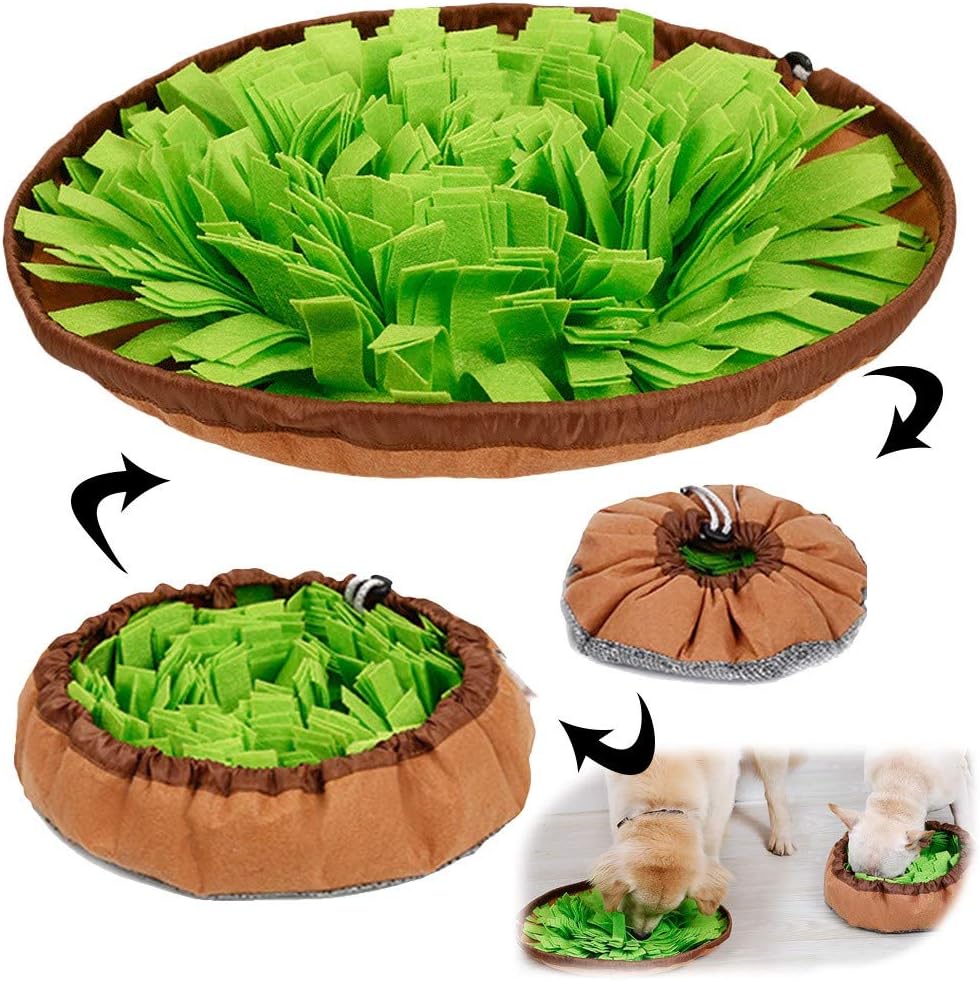
Snuffle mat

There are other food related boredom busters. Kongs are an obvious one, but there are also licky mats and snuffle mats. All these require a bit of input from you to set these up, which can last for hours.

Training to fight boredom

Ultimately, your dog will be happiest and most relaxed if you spend time with him. When you hang out with your dog and better still, when you engage with your dog, they will not get bored and look for other entertainment. Just making a fuss of them, stroking and talking to them, will make them perfectly calm and content.

More tuggy play

Training your dog is an even better way to provide stimulation for your dog. This might be a few tricks, or just a bit of ‘work’ whilst you are out on your walk. Perhaps a practice wait, or a down, or a bit of heelwork?

You might also try out some other activities; Quin and I have only tried a few scentwork classes so far, which I am continuing with Ounce. We plan to do quite a few other activities in the next few months.

Finally – a word of warning

Please, please don’t overdo it? Dogs sleep for around 12 hours a day, which means they should be asleep for large chunks of the day. Having that ‘down time’ is absolutely vital for their wellbeing. If your dog lives in a busy household, with lots of comings and goings, please try to make sure they have a quiet space to go to and are left alone for long periods?

Weekly Focus Challenge

How do you keep your dog entertained?  What activities do you do?  Can you plan what to do with them in future?  Have you had problems because your dog has been bored?  Do you think you could manage this differently in future?

Please share your thoughts and a photo? You can do this in the AYWYP Facebook group, or buy the workbook to keep your own record. Details below.

Buy the Workbook

The Workbook – A Year With Your Puppy is available to buy. It was written and designed to be a hands-on, interactive book for you. It will help you survive the first year with your puppy, but also act as a memento of that time and the journey you have been on. You can write notes and stick in pictures of your puppy throughout the year. Lovely!

Remember..

Please CONTACT ME if you want to know more about me and my dogs?  And feel free to COMMENT if you want to tell me what you think.  If you want to know more, why not FOLLOW ME, by filling in your email address below?  Then you will receive an email when there is a new post.

NO PUPPIES AVAILABLE

NB: I am not a dog trainer, or a dog behaviourist, just a dog breeder and owner. I can only offer my opinion, based on my experience.

AYWYP: Week 28 – Crate training

Why a dog crate is essential for your puppy

I am still using Quin’s crate for him to sleep in, so I am reviewing why this is such an essential piece of equipment for your puppy.

There are people who say ‘I would never put my puppy in a cage!’ That’s lovely for them, as long as they are able to watch over their puppy 100% of the time and don’t mind a few vet visits when the puppy eats a sock or other undesirable item. For most people though, a cage, or crate represents an easy way of keeping your puppy safe.

Hiding from a scary noise

Keep your puppy safe

Someone once commented that you wouldn’t put a baby in a crate. Well dur – what is a cot? Looks like a crate to me! We used to put children in playpens and I’m sure plenty of parents still use these. A dog crate is nothing more than a means to keep your puppy out of harm’s way. You can’t be watching your dog at all times and nor should you. Having the ability to pop them away safely for a while is common sense.

Ounce’s clever trick

Having said that, you should not be using a crate at all times. My dogs sleep in their crates for 8 hours, but I wouldn’t ever leave them in a crate during the day for more than a couple of hours. They have been absolutely fine in the van for 8 hours travelling up and down the country, just being let out once or twice to toilet. But I wouldn’t especially do that all day, every day. Dogs who spend lots of time in crates can become bored and frustrated, which may lead to them being more anxious or guarding.

A safe space for your dog

Believe it or not, your dog loves to have its own quiet corner. Wild dogs will make a nest or bed in a ditch or under a bush. Dogs about to give birth will find a dark corner to nest in, away from the hustle and bustle of the house.

Set up your crate to be an enclosed, dark space, with a cover over most of the outside. I have seen people sharing horror stories of dogs becoming tangled in the covers or eating them, but I’m sure your dog will be fine if you use large blankets or towels to cover the crate and fold it neatly, so that only flat surfaces are facing the insides of the crate.

I always use vetbed inside. It’s soft and fluffy, but is extremely lightweight and easy to wash. It is absorbent so if your dog has an accident, they will not be uncomfortable. If they are wet after a walk and then have to be left, they won’t get cold. Vetbed is also durable so less likely to be chewed than standard pet beds.

How to train your dog to enjoy its crate

When I get a puppy, I feed them in their crate. Then, quietly close the door. Puppies love to search and sniff for pieces of food, and once they have found and eaten everything, they often settle down and drift into sleep for an hour or so. This gives you a chance to do other things without worrying about what the puppy is up to, and it is a good experience for the puppy to curl up and sleep in the crate by choice.  You can gradually increase the time the puppy stays in the crate and initially this should be whilst you are in the room with it.

Such a cosy space

I try to have my puppy sleep in its crate from day one, but sometimes they need a bit of reassurance from you to start with. It’s useful to say ‘in your bed’ when you want them to go in there.

NB: Always reward your dog for going into its crate. If you are going to leave them in there, make sure they have been to the toilet first, then give them a treat for going in, as well as some verbal praise. And please:

  • Never shout at your dog to go into its crate.
  • Never drag your dog by the collar and shove it into the crate.
  • Never allow children to get into the crate, with or without the dog
  • Never take food or toys off your dog, especially when they are in their crate.

When to put the crate away

Most people long to pack their crate away, because it takes up space. I usually find that by six months your puppy should be reliably house trained and have stopped chewing most of the time. Or at least they are better at only chewing the things you give them! However, if your dog is happy to sleep in the crate, I would leave it up, if you can. They are safe and they feel safe.

Weekly Focus Challenge

Where does your dog sleep?  If you have a crate, how have you found it?  Does your dog like sleeping in it?  How much time do they spend in it?  Do you reward them every time they go in it?  When do/did you take it away?  Have you had any issues since then?

Please share your thoughts and a photo? You can do this in the AYWYP Facebook group, or buy the workbook to keep your own record. Details below.

Buy the Workbook

The Workbook – A Year With Your Puppy is available to buy. It was written and designed to be a hands-on, interactive book for you. It will help you survive the first year with your puppy, but also act as a memento of that time and the journey you have been on. You can write notes and stick in pictures of your puppy throughout the year. Lovely!

Remember..

Please CONTACT ME if you want to know more about me and my dogs?  And feel free to COMMENT if you want to tell me what you think.  If you want to know more, why not FOLLOW ME, by filling in your email address below?  Then you will receive an email when there is a new post.

NO PUPPIES AVAILABLE

NB: I am not a dog trainer, or a dog behaviourist, just a dog breeder and owner. I can only offer my opinion, based on my experience.

AYWYP: Week 29 – Tricks training

Tricks to entertain you and your puppy

Teaching your puppy tricks is so much fun! Getting them to do something counts as a trick. You give the word and they do as you ask – hurray! So it could be as simple as getting your dog into a sit, or a down. Anything which gives you a bit more control when you need it is useful to have.

Taking it to the next level is a way of engaging with your dog and making sure that they listen to you. It is also a great way of giving your dog rewards for paying attention. This will keep your dog stimulated and ultimately happy. It’s incidentally a brilliant thing to have up your sleeve for when it’s raining, or you’re bored, or you can’t walk your dog because of illness, either in your dog or in you.

starting to learn to bow

Getting started with tricks training

Before attending a class, you need to consider if you will be bothered to work on any of the tricks. You might feel that your dog is fine just mooching around the house and having a bit of petting and love from you. That’s absolutely fine.

If you want a bit more from your dog, start by teaching simple commands like ‘sit’ and ‘wait’. Or you could teach a ‘down’. Recall is also part of basic training for any dog. There are quite a few tricks that are useful for a dog to have. Just being handled and coping with you or someone else, such as a vet or groomer touching your dog can become something that you need to work on.

Some tricks are more interesting for the dog to do or just more entertaining for you to have. Last week I shared the video of Ounce opening the door of her crate and going inside. Clever girl!

Luring vs Shaping

When Quin and I went to our first ‘Trickstars‘ training class, the excellent Nicola Smith from Lucky Dog Training started by talking about the difference between luring and shaping.

Luring is when you use your hand, holding food, to show your dog what you want. You put the food on the end of his nose and move it slowly where you want him to go. This is easy to do and produces good results. Great, you think, I’ve taught my dog to sit, or go into a down. That was quick!

paws on

Unfortunately, your dog has not learnt to do those things. They have learned to follow your hand in order to get the treat. If you remove your hand, or even if you just remove the treat, your dog will struggle to do what you want. It’s quite hard for your dog to understand what you want and they probably weren’t paying much attention to you when there was food at the end of their nose.

Wait for it…

Shaping is when you wait for your dog to offer you the right behaviour. When it works, it’s like magic! So how do you make it work? You wait for it. It’s much more difficult to do. The dog must be ‘set up to succeed’. So when I talked about training your dog to fetch a toy, I said you needed to reward your dog for going near the toy, or sniffing it. This is shaping the behaviour of your dog. You are encouraging the dog to think about what gets the reward and to allow them to process that.

You can start shaping by putting down an obstacle and seeing what the dog will do to get a treat. That’s the first thing we tackled in our class yesterday. Or you can do what I do, eat a bag of crisps and wait for your dogs to offer something to get one. Ounce has quite the repertoire! She will twist, go down, sit, give a paw and speak (loudly). Give me a crisp mum!

Clicker training

Lots of dog trainers use a clicker to mark the behaviour that they are looking for in the dog. A clicker makes a noise when pressed, which you can do at the exact second your dog does what you like. You then give them a reward. The only problem with a clicker is that you need lots of hands! You need to hold the clicker and make it work, hold the treats and give them to your dog, hold your dog’s lead, or toy, or show your dog what you want.. It’s a lot to manage!

An alternative to a clicker is to replace it with a word, or a tongue click. Most people use ‘Yes!’ as it is quick to say, has a distinct sound and is rewarding for you as well as the dog!

tidying up

Simple tricks to try

I recommend using a trainer like Nicola and following a course or attending a class. It’s quite intense going to a two hour workshop, but a good trainer like Nicola will break it down and teach a variety of tricks during the session, with a break halfway through. The tricks we covered yesterday included:

  • Paws onto step, back feet on floor
  • Nose touch to hand
  • Card touch as a starting point to teach touching something on a wall
  • Turn around bowl – going on from the first one but moving back legs around in a circle
  • Nose into cone, to start hiding their face
  • Bow, like the play bow dogs do
  • Head down on the floor when they are lying down
  • Pick up duster – tidy up! 

Quin was brilliantly behaved and managed to keep going even though it was hard work. He finished off with a real highlight. He is used to getting objects and bringing them to me, so immediately grabbed the duster and brought it to me. I was then offering his tuggy to play, as he’d had so many treats. This made him drop the duster, so Nicola then placed an upturned step underneath and he dropped in on that. Tidying up!

It was a fantastic end to a great session. See the website for all the courses and tricks Nicola offers. We can’t wait for our next class 🙂 Thank you to Emma Conlisk of Beancroft Agility, Hoopers and Scentwork for such a great venue and hosting the session.

Weekly Focus Challenge

What tricks can your dog do so far?  Do you fancy learning anything else?  It’s great to have a ‘party piece’ so I recommend picking one or two things to try teaching your dog.

Please share your thoughts and a photo? You can do this in the AYWYP Facebook group, or buy the workbook to keep your own record. Details below.

Buy the Workbook

The Workbook – A Year With Your Puppy is available to buy. It was written and designed to be a hands-on, interactive book for you. It will help you survive the first year with your puppy, but also act as a memento of that time and the journey you have been on. You can write notes and stick in pictures of your puppy throughout the year. Lovely!

Remember..

Please CONTACT ME if you want to know more about me and my dogs?  And feel free to COMMENT if you want to tell me what you think.  If you want to know more, why not FOLLOW ME, by filling in your email address below?  Then you will receive an email when there is a new post.

NO PUPPIES AVAILABLE

NB: I am not a dog trainer, or a dog behaviourist, just a dog breeder and owner. I can only offer my opinion, based on my experience.

AYWYP: Week 30 – Review the problems

What are the problems you have with your puppy?

Puppy problems can be hard to tackle, but we don’t necessarily have to solve every problem. At this age, we may feel that we have our finished dog. They are adult-sized and we have had them for a long time. Unfortunately, it’s not quite that simple. We still have work to do, if we want to get the finished dog we dreamed of having.

The dream dog

Hopefully when you read through my questionnaire celebrating six months with your puppy, you thought about what was really great about them? And what was not so great? Did you find yourself realising that there are things you are not entirely happy with? I know I did. Quin is so lovely around the house and when he meets people. He is not so great with other dogs and this is the area that needs thinking about.

Defining the puppy problems

When you think about your dog, what problems spring to mind? The most common puppy problems around the ages of 6-10 months are:

Sound familiar? These problems are really common! So first of all, recognise that you have a dog and that’s what dogs do? Hopefully, some of these problems are ones you have already tackled, with me. Click the links above to see the posts I have already written about these issues?

Decide what to do

You have recognised your dog’s biggest issues. Now decide what you want to do? You have three choices:

  • Do nothing
  • Manage it
  • Train it away

First of all, don’t underestimate the decision to do nothing. You have a dog. Some things that you find really annoying are just part of who your dog is. You might just need to accept that and cope with it. Barking is the biggest of these types of puppy problems.

Quin watching TV with his dad

Do nothing

Quin barks at lots of things, including animals (especially dogs!) on the TV. It’s hilarious. Most dogs don’t react to the TV, or only look round if a dog barks. Quin leaps up and stares at the screen if a chicken appears! He is very fierce and gets really annoyed if we watch a wildlife programme. Funny boy. We don’t really mind, we just call him to distract him and give him a fuss once he stops barking. It’s fine.

One of the posts I’ve linked to above shows my efforts to stop Aura going berserk when the food processor is switched on. However, it doesn’t really bother us when the dogs all go mad occasionally, so I don’t keep revisiting this training.

Manage it

Barking around the house can be managed relatively easily, by putting the dog away from the source of the stimulation. So when someone comes to the door, put the dog in another room so they don’t get rewarded by the door being answered. You’re pretty unlikely to stop them barking altogether, but at least they are not rewarded for barking.

The most common issues that people choose to manage are pulling on lead and not coming back. People use harnesses with their dogs so that when they pull on lead they don’t strangle themselves. That’s fine if you don’t mind being pulled along. It’s actually useful if you are doing Canicross!

When dogs don’t come straight back to their owners, the owners get scared their dog will get run over, or that they will be attacked by another dog. So they keep them on lead. Some owners don’t even try to let their dogs off lead.

Dogs should be off lead

For me personally, I think it’s absolutely tragic if you choose not to tackle either of these issues. In my opinion (humble or otherwise), it is absolutely essential for dogs to walk off lead. Therefore they don’t necessarily need a harness if they don’t walk far on lead, but it’s obviously better if they can walk sensibly. And it’s vital for a dog to be able to wander and sniff, at their own pace.

Train it away

By far the best solution, for you and the dog, is to put in a bit of work to make puppy problems more manageable. WARNING: Some problems are more easily solved than others! Jumping up is a relatively simple problem to solve, whereas reacting to other dogs and not coming back when called are worthy of several blog posts on their own.

Hopefully though, this post has encouraged you to think about the ongoing issues with your problem puppy and make a plan about what you want to fix, what you are able to manage and what you can just ignore? I am working hard with Quin to help him cope with meeting other dogs – more on this in the coming weeks.

Weekly Focus Challenge

What does your dog do that drives you mad?  How are you going to tackle each of their problems?  Make a list of the problems and then decide how you are going to cope with them.

Please share your thoughts and a photo? You can do this in the AYWYP Facebook group, or buy the workbook to keep your own record. Details below.

Buy the Workbook

The Workbook – A Year With Your Puppy is available to buy. It was written and designed to be a hands-on, interactive book for you. It will help you survive the first year with your puppy, but also act as a memento of that time and the journey you have been on. You can write notes and stick in pictures of your puppy throughout the year. Lovely!

Remember..

Please CONTACT ME if you want to know more about me and my dogs?  And feel free to COMMENT if you want to tell me what you think.  If you want to know more, why not FOLLOW ME, by filling in your email address below?  Then you will receive an email when there is a new post.

NO PUPPIES AVAILABLE

NB: I am not a dog trainer, or a dog behaviourist, just a dog breeder and owner. I can only offer my opinion, based on my experience.

AYWYP: Week 31 – Dog food choices

Dog food – what is best for your dog?

The dog food market is absolutely enormous; it’s worth billions of pounds. So we are all subject to huge commercial pressure to buy certain types of food for our dog. When I was young the choice was between two or three types of tinned meat, plus a biscuit meal to add bulk. Even longer ago, dogs were simply fed scraps and leftovers – dog food didn’t exist.

Puppy food

Today we are bombarded with choice over different types of dog food and we now consider there to be four main ways we can feed our dogs:

There is a huge amount of information available now about what type of dog food is best for your dog. I am not a nutritionist, so I am not going to wade into this argument. I am simply going to highlight a few of the issues and questions around dog food, as I have done previously.

Dog food – fit for your dog

Dogs come in all shapes and sizes! They also live very different lives – from a toy dog, such as a Yorkshire Terrier, living in a city and being carried around, to Border Collie, working sheep in the hills. Clearly the needs of those two animals will be very different. So I think you need to start by examining your dog’s size and shape and considering their level of activity and fitness.

Yummy!

A good starting point with dog food is to talk to the breeder. Responsible breeders will have experience of the breed and what works well for them. That doesn’t mean you have to feed the same food, just that they have tried out different foods and worked out what works for them. As a Kennel Club Assured Breeder, I am required to provide advice about feeding to my puppy owners. I also provide a few days of puppy food and offer a sack of food at a discounted price.

Monitor your dog

When you get your puppy, you need to assess whether the food they have is working for them. Are they too fat, or too thin? Is their level of activity correct for the life they are living? I have seen dogs that are lacking in energy and struggling to enjoy the same walks that my dogs do. Equally, I have seen dogs that are ‘wired’, leaping around all over the house, struggling to settle.

Ready for action

Think about the what you need your dog to do? Hopefully you will keep their routine similar on a day-to-day basis. If you are going to go on a long hike, you need to think about giving your dog a bigger breakfast before you go and perhaps taking a small meal for them to have at lunchtime, while you are in the pub! Of course if you are going to run around with your dog, doing agility for example, you need to feed them early enough so that this is digested. Don’t feed immediately after exercise either.

Quality of poo

Well if you own a dog, you will come face to face with this issue on a daily basis! We have to pick up after our dogs, so we do become invested in what is coming out of them. A dog with an upset stomach is not nice for them or you. Border Collies are notoriously fussy, picky eaters. They certainly don’t eat everything! As a breed, they often have digestive issues and are quite sensitive to different foods. They are by no means the only breed to suffer in this way – poodles are quite sensitive to allergies, which obviously can affect poodle crossbreeds as well.

My healthy diabetic dog

Tailor-made dog food

For me, I like a nice complete food that is easy to feed. I was recommended to feed Royal Canin when I started breeding and it works for me. That doesn’t mean I feed it indiscriminately to my dogs. Luna has a diabetic version which helps maintains her health really well, despite her diabetes. I obviously feed the younger dogs a version for puppies and junior dogs, while the older dogs have a senior version.

In addition I add extra bits for interest. One of the main criticisms of feeding kibble is that it’s boring. Personally, that is not an issue for me, as I have bran flakes for my breakfast every single day. I like it, it’s easy and I don’t see why I have to have variety for breakfast. Again, the amount of variety your dog wants will vary from one dog to the next.

Puppies!

In my opinion, feeding raw meat to dogs is fraught with difficulties. It’s harder to manage from a hygiene point of view – see the government’s handling guidelines. The reason I don’t routinely feed it to my dogs is because they’re not bothered about it. It’s certainly not their favourite.

I have tried feeding my dogs Aardvark kibble containing insect protein. I love the idea of replacing meat with insects in our food. Again, the dogs weren’t that fussed. So I stick to what they eat, what keeps them the right weight and fitness. I add raw carrot and goat’s milk powder for a bit of extra tastiness. Lucky dogs! Here’s a video of Ounce, fussiest dog ever, picking through different foods.

Weekly Focus Challenge

Are you happy with the weight and condition of your dog?  Do you think they are ‘fit for purpose’?  Do they like their food or do you feel they are not that bothered?  If you have a very hungry dog, you may need to consider something different.  Or if they wolf their food down too quickly, you may want to feed them differently, using a snuffle mat, for example (see boredom fighting).

Please share your thoughts and a photo? You can do this in the AYWYP Facebook group, or buy the workbook to keep your own record. Details below.

Buy the Workbook

The Workbook – A Year With Your Puppy is available to buy. It was written and designed to be a hands-on, interactive book for you. It will help you survive the first year with your puppy, but also act as a memento of that time and the journey you have been on. You can write notes and stick in pictures of your puppy throughout the year. Lovely!

Remember..

Please CONTACT ME if you want to know more about me and my dogs?  And feel free to COMMENT if you want to tell me what you think.  If you want to know more, why not FOLLOW ME, by filling in your email address below?  Then you will receive an email when there is a new post.

NO PUPPIES AVAILABLE

NB: I am not a dog trainer, or a dog behaviourist, just a dog breeder and owner. I can only offer my opinion, based on my experience.

AYWYP: Week 32 – Recall revision part 2

How’s your recall going?

Recall is the hardest ‘skill’ to master when you have a dog – and the most important. I have already talked about calling your puppy several times during the course of writing this blog and elsewhere on this website. But it is so important it is worth revisiting and revising. Having just re-read the last post I wrote about recall, I don’t have much to add. I’m just putting this here to remind you to keep on practising.

Running around

Test yourself with these challenges:

  • Call your dog 5 times in the house, when you can see them. How quickly do they respond?
  • Call your dog 5 times from another room. Do they still come?
  • Call your dog 5 times from the garden. If you are inside and they are outside, do they still come back? Or do you normally just wait until they have ‘finished’ being in the garden and come in on their own?
  • Call your dog 5 times on your walk. Now what happens?

Why does recall work?

Think about the difference in the way your dog responds to you. What makes your recall successful? What stops your dog from coming back to you? What’s the quickest you can get your dog back to you?

I have previously mentioned having a ‘Pavlovian response‘ to recall and I think this is at the heart of making it work for you and your puppy. What you need to do is create a situation where your dog has a very strong association between you calling their name and them receiving a reward. Once you have that, it is very difficult for the dog to ignore you.

ready to return

Remember, your dog is not malicious. They don’t spend their time imagining ways to wind you up, or annoy you. Dogs want an easy, happy life. If you feed them tasty treats and play with them, they want to be with you.

Instant recall

How quickly do you need your dog back? Do you absolutely have to have them under control at all times? I urge you to be realistic and manage your expectations with regard to recall. If your dog is having a good old sniff, or has wandered off a bit in the woods to see if a squirrel is there to be chased, please be patient?

If your dog is rushing over to another dog, you need to weigh up the impact of that encounter. When you know that your dog is relaxed and happy meeting other dogs, you don’t need to panic, but you do still need to call them and pay attention to the meeting. If your dog is currently being a bit of a dick when seeing other dogs (like Quin) you need a sharper and more persistent recall. More on that later..

Ready to run

Breed variations in recall

Of course there are very specific breed characteristics that massively affect the quality of a dog’s recall. Border Collies have a strong desire to please, which means they will ‘work’ for a reward. However, they do run fast and far. They also have a keen eye, so if they spot something, they may well shoot off. Fortunately, they are pretty snappy to respond, even when they are heading off.

Other breeds are tricky for different reasons. Hounds and Gundogs are 100% scent driven and when they get a whiff of something interesting, can be extremely hard to turn around. Now that I am doing some scentwork training though, I feel that the smell of cheese, sausage or liver cake will carry quite a distance to a well conditioned dog!

I’ll come back for sausage

Some dogs, such as Toy breeds, are a bit slower to respond, because they are well, slower to respond. Training them is harder because they are more laid back and less focused. Patience is required! And practice, always.

Let it fail

Nobody’s perfect. Well I’m certainly not. Try to be kind to yourself and your dog? It won’t go perfectly every time, but if you keep practising, it WILL get better. I’ve definitely seen an improvement in Quin’s recall over the past couple of weeks. He was going through a phase of not being that bothered about coming back to me, especially if he was barking at another dog. That is getting better and he really is returning to me now – hurray! But there are still plenty of times when it’s not that great.

Remember the key rules for recall:

  • reward
  • practice
  • reward
  • be positive
  • reward

Weekly Focus Challenge

Try the recall challenge?  How did you get on?  Think about how much you practice your recall.  Do you need to do more?  Do you remember to take treats with you on your walks?  What do you think you need to do better?

Please share your thoughts and a photo? You can do this in the AYWYP Facebook group, or buy the workbook to keep your own record. Details below.

Buy the Workbook

The Workbook – A Year With Your Puppy is available to buy. It was written and designed to be a hands-on, interactive book for you. It will help you survive the first year with your puppy, but also act as a memento of that time and the journey you have been on. You can write notes and stick in pictures of your puppy throughout the year. Lovely!

Remember..

Please CONTACT ME if you want to know more about me and my dogs?  And feel free to COMMENT if you want to tell me what you think.  If you want to know more, why not FOLLOW ME, by filling in your email address below?  Then you will receive an email when there is a new post.

NO PUPPIES AVAILABLE

NB: I am not a dog trainer, or a dog behaviourist, just a dog breeder and owner. I can only offer my opinion, based on my experience.

AYWYP: Week 33 – Reactivity in dogs

Reactivity is such a challenge

How do you cope when your dog is reactive to certain situations? Reactivity is the worst problem we have to deal with in our dogs and for some people, very hard to cope with. Many owners sadly feel unable to train their dog past this and that is such a shame. Let’s start with a definition:

Reactivity is commonly confused with aggression. Dogs that are reactive overreact to certain stimuli or situations. Genetics, lack of socialization, insufficient training to learn self-control, a frightening experience, or a combination of these can cause reactivity, and fear is typically the driving force.

reactivity

What are dogs reactive to?

Reactivity results in manic barking and this can be at all sorts of things, including:

  • other dogs
  • runners
  • cyclists
  • cars
  • people

Remember, there are different types of barking and these are not all reactivity. Reactivity is when a dog is afraid, as described in the definition above. At other times the dog may just be excited! Start by learning about your dog’s different kinds of barking and whether they are really demonstrating reactivity.

How to tackle reactivity

I feel reasonably confident talking about this issue now, having had a dog who was pretty reactive. Quin has been barking very loudly at lots of dogs we have gone past on walks. I’ve found it really hard work to deal with and knowing how to tackle it. I have thought about putting him on lead more, or even buying a basket muzzle for him to wear, in case he went for other dogs. I have decided to work through it. Here are my tips.

Start by staying calm. You will not help your dog by ‘reacting’ yourself. Hopefully, you have a brilliant recall, or your dog is already on lead. Call your dog to get its attention, calmly and quietly. When your dog is focused on you, albeit they may still be looking at the ‘disturbance’, give quiet praise. My friend Kate from the The Canine Hub recommends saying ‘Nice!’ whilst rewarding, as it keeps everything calmer.

Nice!

That’s it. Calm, focus, distraction. The trick though is to be aware of what may cause a stimulation and a reaction and be ready to tackle it. I’ve come unstuck a few times when the dogs have been running ahead of me and another dog has suddenly appeared round a corner. Not surprisingly, Quin has been a bit wary and has reacted by barking.

Warning: Don’t come near me!

This is what your dog is saying. They are also saying ‘help me!’ Your dog is not sure what is happening and wants you to support them. They are also warning you that something might be a danger and they can easily turn this into a compulsion to guard you. How they learn to cope really does depend on how you tackle it. If you grip your dog’s lead, shout at them to be quiet and drag them away, the dog learns that barking is just what is needed.

Stay away from me?

One step at a time

Like so many areas of training your dog, reactivity is something best tackled one step at a time. You won’t fix it in one day, but need to persevere. As I said at the start of this post, I could have just put Quin on the lead on walks, or bunged a muzzle on him and dragged him past other dogs.

Instead, I have chosen to work through this problem. Here are some of the steps I have taken:

  • practise recall, many times a day
  • practise saying ‘nice’ when I have his attention, with gentle stroking
  • walk with friends and their dogs, to ensure he has plenty of interaction without reaction
  • stop and chat to people when he has reacted to their dog. This has made him calm down and he has been able to wander off, then come back to me for a fuss
  • grab hold of him as people are coming towards me and calmly hold him still, stroking and praising – nice!
  • pop him on lead or hold his collar whilst going past some people
How many dogs?

Result!

In the last few days, as we go towards other dogs, Quin has been able to turn and look at me, then come back for a quick cuddle (and a sweetie!) then go past the other dogs, just like the girls do. Hurray! This is so magical for me, as honestly, a couple of weeks ago he was barking so violently, right in dogs’ faces!

Of course I realise he will bark again – we haven’t stopped it permanently. I am sure I will forget to pay attention and another dog will rush up to him barking, which will set him back a bit. But that’s fine. It’s a work in progress. Other dogs are learning at their own pace. Quin will also have other problem I will need to tackle…

Happy dogs

Be kind

It is absolutely infuriating when other dogs rush over to yours and bark in their face. I can completely understand why people become enraged and shout at the other dog owner. ‘Control your dog!’ Please try to be kind though when this happens. If we don’t let our dogs off lead, they can’t learn to behave themselves. And if we don’t try and fix it, it won’t be fixed, will it?

Please don’t shout at the other person or their dog unless they are showing no attempt to recall it? If the other person is making an effort, try to be patient with them? Recall your dog and reward them for being brilliant!

Weekly Focus Challenge

How reactive is your dog?  What do they struggle to cope with? How do you manage this?  Do you think the problem is getting better, or worse?

Please share your thoughts and a photo? You can do this in the AYWYP Facebook group, or buy the workbook to keep your own record. Details below.

Buy the Workbook

The Workbook – A Year With Your Puppy is available to buy. It was written and designed to be a hands-on, interactive book for you. It will help you survive the first year with your puppy, but also act as a memento of that time and the journey you have been on. You can write notes and stick in pictures of your puppy throughout the year. Lovely!

Remember..

Please CONTACT ME if you want to know more about me and my dogs?  And feel free to COMMENT if you want to tell me what you think.  If you want to know more, why not FOLLOW ME, by filling in your email address below?  Then you will receive an email when there is a new post.

NO PUPPIES AVAILABLE

NB: I am not a dog trainer, or a dog behaviourist, just a dog breeder and owner. I can only offer my opinion, based on my experience.

AYWYP: Week 34 – Neutering

Neutering your dog – the pros and cons

Quin tried to hump his Auntie Luna this morning, so this seems likely a timely post! Neutering is not a simple issue and as with so many aspects of dog ownership, it is subject to fashion and cultural context.  When I was growing up, I don’t think neutering in dogs was done routinely; it was more often carried out when a dog was becoming a problem.  Male dogs were often allowed to roam the streets, looking for a mate and puppies were very often produced through a neighbour’s dog appearing in a garden one day.

Of course these things do still happen, but happily we are inching forwards to a culture where responsible dog ownership is becoming more commonplace.  There has been a view that dogs were who were not ‘entire’ would be affected in their personality; that this would be detrimental to their character.  Increasingly, I am of the view that any changes are positive, especially to male dogs.

Ounce, full of puppies

Most recently, there has been a movement to ‘protect a dog’s rights’; it is illegal to neuter dogs and cats in Norway without good medical reason. However, there is plenty of evidence for good medical reasons.

Freedom to roam

In the past, dog owners who were being responsible would whip their puppy off to the vet’s to be neutered almost as soon as it was brought home.  When I got my first puppy, in 1987, it was expected that he would be castrated at six months, so that his behaviour would remain more manageable.  He still cocked his leg and enjoyed playing around with Sunny when she was in season, but he didn’t hump your leg, (which was good!) and he didn’t try to go off roaming the neighbourhood.

More recently, we are finding that it is good to allow dogs to reach full maturity before they are neutered, both male and female.  If you search online, you will find articles such as this one from the Blue Cross about neutering your dog.  This says that there are a number of health benefits to neutering early, such as reducing the chances of cancers.

Should boys keep their bits?

However, another article cites the benefits of neutering later:

“When a dog’s testes or ovaries are removed, the production of hormones is interrupted, which affects bone growth. Because the bone growth plates may close earlier in dogs neutered young, orthopaedic problems such as hip dysplasia and cranial cruciate ligament tears may result. Neutered dogs also tend to gain excess weight, further stressing the joints. But neutering does not equal obesity. It’s more difficult to keep neutered dogs in shape, but it can be done.”

Personally, I think it does come down to good management.  If you feel that you will struggle to cope with an unneutered dog, get it done from the age of six months.  You might be able to manage for a while, so you can leave it until the dog has reached maturity, which for collies would be around a year to 18 months.  However, if you can’t be bothered with the hassle, definitely get them neutered.

Coming into season

Elsewhere, I have written about what happens to a bitch coming into season and how to manage this.  If you are prepared for the need to pay attention to your dog every 6-8 months and make sure that they do not come into contact with uncastrated dogs, then you may choose to leave your dog unneutered.

Buzz

As I said earlier, I had my previous male dog, Buzz castrated at the age of six months.  My first bitch, Rue was done in middle age, having had two litters of pups.  Much safer to have the operation, I thought at the time.  I had planned to have Sunny spayed once she had had her third litter, but I hesitated because I felt that it was a major operation that she did not need to have. 

Neutering – emergency procedures

I wrote about this subject a few years ago, having brought Sunny home from the vet.  She had an emergency spay, aged 12 years, following pyometra, or pyo.

Pyometra is defined as an infection in the uterus. Pyometra is considered a serious and life threatening condition that must be treated quickly and aggressively.”

Sunny

Symptoms of Pyometra include: 

  • Abdominal distention (from an enlarged uterus)
  • Vulvar (vaginal) discharge
  • Closed cervix
  • Lethargy
  • Depression
  • Lack of appetite
  • Vomiting
  • Frequent urination.

Fortunately for us, Sunny’s condition was picked up quickly and surgery was straightforward.  She stayed in overnight for observation, but she recovered remarkably quickly. However, I can’t understate the anxiety I have with all my ‘entire’ girls as they come into season and out again.

Other emergencies and health issues

Sadly, Luna had to have a Caesarian with her last litter and when the vet asked if I wanted her spayed as well, I thought ‘why not’.  I asked if it would make the operation more complicated and he said “No, it will be simpler, as it’s easier to remove everything.”  I then didn’t have to worry about post-op infection in her uterus as it had all been taken out!

Luna

Luna made such a great recovery from the operation and really rocked the shirt provided by the vet, which was brilliant compared with the stupid lampshade they usually provide.  She was moving around normally within a day or two and a month today since the op she if fully healed and back to her usual self. 

JB also had to be neutered, following a urine infection that just wouldn’t clear, leading to prostatitis. There are so many issues that can affect a dog’s health, unfortunately.

Quick recoveries

On the strength of that, I decided to go ahead with Aura’s spay.  Aura is more active than Luna, so I thought it might be harder to manage her recovery.  Silly me!  She is younger and fitter than her mum, so was completely better within the week. Amazing. Busy was the same.

Prevent family accidents

Now I don’t have to worry about them being in season when I enter shows and I have less girls to clear up after.  No more worrying about dogs chasing us when we are out – at least with these three.  I am a total convert. And of course now I have another boy, I don’t want a funny family business going on! Quin will still need careful management in future.

In conclusion

In my opinion, the recommendation I give my puppy owners is this: Leave it until they reach maturity, so that their bones have a chance to develop fully and normally.  Then do it!  Stop the production of unwanted dogs and make your life easier.  Then make sure you keep your dog fit and healthy, through exercise and training.

Weekly Focus Challenge

When do you plan to get your dog neutered?  What does your vet think about it?  You should respect their views and experience, whilst being mindful of what is best for your dog and your situation.  You certainly shouldn’t breed from your dog, unless you are a very experienced dog owner, with a good understanding of the issues involved.   

Please share your thoughts and a photo? You can do this in the AYWYP Facebook group, or buy the workbook to keep your own record. Details below.

Buy the Workbook

The Workbook – A Year With Your Puppy is available to buy. It was written and designed to be a hands-on, interactive book for you. It will help you survive the first year with your puppy, but also act as a memento of that time and the journey you have been on. You can write notes and stick in pictures of your puppy throughout the year. Lovely!

Remember..

Please CONTACT ME if you want to know more about me and my dogs?  And feel free to COMMENT if you want to tell me what you think.  If you want to know more, why not FOLLOW ME, by filling in your email address below?  Then you will receive an email when there is a new post.

NO PUPPIES AVAILABLE

NB: I am not a dog trainer, or a dog behaviourist, just a dog breeder and owner. I can only offer my opinion, based on my experience.