All posts by Dentbros

A Beginner’s Guide to Agility

Dog Doc Question 21: What activities can you do with your dog?  

There are loads of different sports and activities we can now enjoy with our dogs.  Here are some of them:

  • Agility
  • Obedience
  • Cani-X
  • Flyball
  • Gundog
  • Working Trials
  • Scentwork
  • Treiball
  • Rally
  • Hoopers
  • Heelwork to music

Today I am going to talk about my passion: Dog agility

Objective

Have fun with your dog!  It is vital to remember this, because agility is hard!  In competition, the objective is to get your dog round a course of 16-20 obstacles in the fastest time.  Easier said than done!

Organisation and rules

Kennel Club and UKA.  Shows are run by these two organisations, which have slightly different rules and ways of running things.  There are also independent shows, which are generally more relaxed and suitable for beginners.

There are 7 Grades in KC agility, with grade 1 being for beginners.  You need at least one win to make progress from grade 1, with things becoming more complex as you progress to grade 7, where your dog can become an agility champion.  An added complication is that once one dog has ‘won out’ of grades 1 & 2, subsequent dogs of the same owner have to start at grade 3.  Which means poor old Luna and Chris both had to start at grade 3 as Luna is my dog and Sunny won into grade 3. Are you confused yet?

Equipment

There are various obstacles to negotiate.  The jumps are usually put at different heights to correspond to the different heights of dog: small, medium and large.  This has recently been complicated by additional, optional heights being added.  Dogs have to be measured before competing.  We are trying to improve the health and safety of our dogs by improving the rules of agility all the time.  Equipment is being changed and removed as well, to improve safety.

Tunnels provide a bit of light relief for dog and handler.  They are fun to go through for the dog and handlers can usually run at them and shout ‘Tunnel!’ and the dog will go into them.  However, if you change direction before your dog is commited to them, they won’t necessarily go through them, as Aura demonstrates perfectly in this video:

Weaves are the most challenging obstacle for the dog to learn.  This is mainly because (for some reason) they have to start with the first weave on their left shoulder, no matter which angle they are approaching from.  They must then go through all weaves (either 6 or 12) in the right order.  Watch Luna miss the last one in this video:

It takes dogs years to learn to weave correctly and they often go wrong throughout their career.  What’s nice about my run with Aura above, is that she does go through the weaves perfectly AND I manage to run past her ready to get her to nip round the next jump.  I’ve only just learnt to do this.  Usually we tiptoe alongside our dogs while they weave, hoping for the best that they don’t come out.

The two runs above were at a show and we were competing in a JUMPING class.  This only consists of jumps, weaves and tunnels, although the jumps can be made more interesting.  There was a wall in the next ring to this one.  Long jumps can also be used, consisting of slightly raised boards.  There may also be a suspended tyre for the dog to jump through. Sometimes a jump is in two parts, making a spread.  Just like show jumping for horses in fact.

Contact equipment, including Dog Walk, A-frame and Seesaw is added to the mix for the AGILITY class.  These consist of something for the dog to walk over with a painted area at either end that the dog must touch.  This is to stop the dog leaping on or off and hurting themselves.  I’ve already done a post of me teaching Ounce how to get ready for the contacts.  Again, teaching the dog to do these 3 pieces of equipment takes many years and endless hours of patience.

Training Classes

So you teach the dog how to do the equipment and off you go, right?  Well yes in theory.  The challenge is that the judge or trainer sets the course and numbers the obstacles and then you have to persuade your dog to do all the right obstacles in the RIGHT ORDER!  In the beginning, you generally only go up and down, with simple, curved turns and minimal changes of direction.  As you go on it gets progressively harder.  You can see from the videos above that by the middle grades, 4&5, which is what we are doing here, the course is not entirely straightforward.  What we usually have are ‘traps’, where the dog is persuaded that something should be the next obstacle, but we know that it isn’t.  We then have to react in time to turn the dog the right way.

I took videos of six of us doing the same run this morning.  It is really interesting to watch these and compare the different runs:

Busy is an inexperienced dog who is still really ‘wild’.  She is also much, much faster than me, so that adds an extra challenge!  You can see when she emerges from the top tunnel and jumps the next jump that I fail to get her to go in a straight line, because she is turning round to ask me what she needs to do next.  We would have been given faults for ‘refusing’ the jump but might not have been eliminated.

Chris and Luna have a great partnership – Luna loves running with her dad.  Chris was focused on getting her into the tunnel at the bottom having seen me go wrong so over-compensated slightly; she goes into the wrong end – elimination.

Mark and Oscar are very experienced and again a great team.  Mark keeps running with great enthusiasm and purposefully gets Oscar to go into the ‘wrong end’ of the tunnel, ie not the end he sees first.  This is hard to do.

Another example of a dog that is faster than his owner!  Elaine handles Django really well, especially considering he is a cheeky Jack Russell with a mind of his own!  She had planned to cut across the corner at the bottom while he was in the tunnel, but a slight mis-timing meant he wasn’t fooled.  She did it perfectly on the next attempt – a great move.

Real professionals at work here.  Smurf is a grade 7 dog and again an old hand.  They work so well together, with Sarah knowing exactly where to go and what signals to give to get Smurf round in the neatest way possible.  Nice job!

Alex and Abi are the least experienced partnership in our class, but by no means the worst.  It is brilliant to see the patience and enthusiasm that Alex shows with Abi and the joy she has in running with him.

As you can see from these videos, there are different ways to ‘handle’ your dog, some more successful than others.  In competition, only around 10% of the runs are successful…

In conclusion

If you want to have fun with your dog, have a go at agility?  I can’t promise trophies and rosettes, but I can promise laughs and the chance to hang out with lovely people.  Everyone is really friendly and helpful, because we all know how hard it is!

NB: It is not always the fastest dog that wins!  

As you can see, agility can be done by all shapes and sizes of dog – Border Collies make up around 70% of dogs competing, but most dogs can have a go.  It can also be done by all shapes and sizes of handler.  I think it is especially great to see young and old, men and women, competing alongside each other.  Of course most of us are not as fast as our dogs, but that is the challenge!

Go to agilitynet for lots more information.


Ask for help?

You are very welcome to contact me to ask for my advice.  I can help you with a variety of issues and problems around getting a dog and suggestions for tackling training issues.  Go to the What Dog? page for more information on my new service.

Please let me know if you have found this post helpful?

Remember..

Please CONTACT ME if you want to know more about me and my dogs?  And feel free to COMMENT if you want to tell me what you think.  If you want to know more, why not FOLLOW ME?  Then you will receive an email when there is a new post.


Vaccinations – When should you vaccinate your dog?

What is the correct policy for vaccinations in dogs?

I don’t know.  I know what I believe to be the right practice with regards vaccinations, according to veterinary recommendations, but I know that many people hold other opinions.

Puppy vaccinations

Traditionally, puppies were always sent off having had their first set of vaccinations.  However, when I took Sunny along to be registered with a vet, they insisted on starting the process off again, as they wanted to be happy that she had been given the same type of vaccination, from the same ‘batch’.

There are several different types and makes of vaccinations given to puppies and different vets have different practices and policies.  Some don’t want to vaccinate at 8 weeks, when puppies first arrive in their new homes.  Some say the pups can go out within a week of the second vaccination, some want you to wait a bit longer.

A huge hit with the vet staff

Puppies are covered by the mother’s immunity when they are being fed by her.  These levels of immunity from the mother come from the first few days of feeding and this can last for variable amounts of time, from 6 weeks up to 20 weeks.

Your vet will start your puppy on a course of vaccinations against the four main infectious diseases:

  • Canine Distemper
  • Hepatitis
  • Parvovirus
  • Leptospirosis

All these diseases are fatal, so it is vital that your dog is protected from these.

More details about what vaccinations should be given and when can be found at KC health advice.

Can I take my puppy out before they have been vaccinated?

Yes.  You need to make sure they do not come into contact with dogs that have not been vaccinated, or go someone where they might pick up these diseases.  However, it is really important for pups to get out and about, as long as they are carried, or you know the dogs they are mixing with.  It is great experience for your puppy and a chance to show them off to family and friends!  Use a handy Pet Sling such as this one and off you go!

Ongoing vaccinations – how often should they be done?

Once again, times have changed.  In the past, we accepted that we should vaccinate our dogs every year.  However, we have come to realise that it is not necessarily appropriate to give our dogs all these vaccinations.  Vets have discovered through scientific investigation that in fact the effect of the vaccinations last a bit longer than a year.  They have therefore reviewed their policy for vaccinating.

My vet now carries out a rolling programme of vaccination.  They vaccinate against leptospirosis every year, but other diseases are done every other year, or every third year.  I have also discovered that the dogs are covered for up to 15 months.  I therefore make sure that I don’t now take them on the anniversary of their last vaccination, but wait until a bit later.  That saves me money and make sure that my dogs don’t get done unnecessarily.

Alternatives to vaccination

Some people feel that they would rather treat their dogs another way, rather than ‘over vaccinating’.  They might ‘titer test’ their dogs, which is a blood test used to determine the level of immunity in the dog’s system.  This is fine, on the day of testing, but it is not a reliable measure of the long-term cover the dog has.

I value the knowledge and expertise of my vet.  I believe that they have spent years training and studying to understand what is best for my dog.  It’s easy to be critical of something you don’t understand, but I would prefer to trust a professional person, than go through the hassle of learning all about it myself.  I go to the MK Veterinary Group and I am happy with their service.

People complain that vets charge too much money, but it must cost a fortune to run a practice, ensuring that they are ready and able to deal with everything that we throw at them.  I think my Veterinary Practice is great!

Buy the Workbook

The Workbook – A Year With Your Puppy is available to buy. This book is a hands-on, interactive book for you. It will help you survive the first year with your puppy, but also act as a memento of that time and the journey you have been on. You can write notes and stick in pictures of your puppy throughout the year. Lovely! Find out lots more by looking at the Contents page.

Remember..

Please CONTACT ME if you want to know more about me and my dogs?  And feel free to COMMENT if you want to tell me what you think. 

NO PUPPIES AVAILABLE


Flowers for Valentine’s Day

Something a bit different?

A few weeks ago I contacted Field Gate Flowers to thank them for my beautiful Christmas wreath, which was still going strong, six weeks after it was delivered to me.  I had really enjoyed it, particularly as it had a lovely smell.

I asked them if they would be able to do me a ‘Spring’ wreath, as I had previously been given an ‘Autumn’ wreath from a French market, which I had thoroughly enjoyed.

Happily, Field Gate Flowers said ‘yes’ and today I collected it.  What a lovely Valentine’s gift for us to have!I decided to add some hellebores as I have plenty of these in my garden.  I love the little pot of purple irises, don’t you?

Thank you – Field Gate Flowers!

Remember..

If you want to know more, why not FOLLOW ME?  Then you will receive an email when there is a new post.  Please CONTACT ME if you have a problem you would like me to talk about?  And feel free to COMMENT if you want to tell me what you think.

My Treasure – Ounce

The Puppy – first 8 months

This is my 200th post on this website, so I decided to try something different.  I know I thought, I’ll create a slideshow of Ounce’s first 8 months.  However, I don’t have the app, or the expertise, or anything.  This is my laughable effort (it is terrible)

Thing is, the puppy is still adorable, however you look at her.  Someone to love, just in time for Valentine’s Day xx

Remember..

If you enjoy hearing about Ounce and want more, why not FOLLOW ME?  Then you will receive an email when there is a new post.  Please CONTACT ME if you would like me to write about a specific topic?  And feel free to COMMENT if you want to tell me what you think?

Please Control Your Dog!

Question 20: Why should you keep your dog under control? 

Last week two people asked me to write about an issue and they were both relating to the same thing – keeping your dog under control.  I had already decided to talk about this because I was recently told off by someone while out on my walk, rightly so.

On Saturday mornings I walk up river, onto the OU campus, round by the church, across the bridge and into the park.  It’s a lovely walk and easy on a Saturday as there are no cars coming into the Open University.  However, because we do this walk around once a week, the dogs know the way and as we come round past the church they tend to rush ahead, over the bridge.  They then wait for me, usually lying around on the verge or the path.  Once I’ve crossed over, if they are lucky, I throw the ball.  So they wait.

Last week I was on the phone to a friend, chatting away, walking slowly.  As I came up to the bridge this woman stopped in front of me and told me that I should keep my dogs under control.  “They were out of sight of you and my dog is frightened of other dogs.  You were a long way behind.  And it’s happened before!”  I apologised profusely; she was in the right and I was in the wrong.

I could have said “oh but my dogs are under control, they are lying quietly waiting for me and not interested in your dog.”  That is not the point.  The point is that I wasn’t there, so my dogs could have attacked her dog.  Or her dog could have gone for mine and they could have retaliated.

“Don’t worry he’s friendly”

This is the most annoying thing you can say when walking your dog.  I can’t tell you how many people I see ranting on social media about how some idiot allowed a dog to come bounding over “just wanting to play” and getting right into a dog’s face.  Their owner is then astonished when their dog keeps getting attacked by other ‘horrible’ dogs.

Just like people, dogs do NOT like other dogs getting right in their faces.  It’s rude.  So if your dog does it to my dogs, they are likely to get snapped at, at best, or bitten at worst.  In my opinion, that would be your dog’s fault, not mine.

My dogs will never go up to another dog and attack it.  But they will tell another dog to f*ck off, if it gets in their face.  Fair enough, in my view.  My dogs are much too busy running around with each other and having a nice time together to talk to other dogs.  They don’t want to engage with other dogs.  That’s why we are able to go out for walks with other dogs, because generally, they will just get on with it.

The exceptions to this are when one of them is in season, when they might go and chat up another dog.  Or the puppy might decide to have a game of chase with another young dog.

Train your dog away

I have talked about this in the context of training the puppy.  When you have an excitable, friendly dog, it is up to you to keep their attention when another dog is going past.  Get their focus and reward that with treats, or play.  Be more interesting or exciting than the other dog.  It’s hard work, especially if you only have one dog, but it makes the walk much more rewarding for you.

If your dog goes for other dogs really aggressively, you will have to think about muzzling it.  A basket muzzle is a good way to manage this situation, as it means you can let the dog off lead and not have to worry about it the whole time.  The dog will not like the muzzle, but usually they can learn to tolerate it. This is a better solution than keeping the dog on the lead, which is miserable for the dog, hard work for you and can make the dog more reactive in any case.

Managing the fear from other people

This was the other issue raised to me last week.  How to help children cope with being afraid of dogs.  I have already written about helping children learn to speak dog, so that they understand why a dog might be running up to them and how to deal with that.

Once again though, it is your responsibility to manage your dog so that it doesn’t rush up to people it doesn’t know.   If you watch this video I made a couple of weeks ago, you can see that I have taught Ounce to stop.

Why don’t you try to teach your dog to do this?  Run towards you, then stop.  If you put up your hand and say “Stop!” or “Wait!” they should do it.  Say “yes!” straight away then go to them and reward.  It’s a really useful command to have.

Ask me for Advice?

You are very welcome to contact me to ask for my advice.  I can help you with a variety of issues and problems around getting a dog and suggestions for tackling training issues.  Go to the What Dog? page for more information on my new service.

Please let me know if you have found this post helpful?

If you want to know more, why not FOLLOW ME?  Then you will receive an email when there is a new post.  Please CONTACT ME if you have a problem you would like me to talk about?  And feel free to COMMENT if you want to tell me what you think.

How do you watch TV?

Snuggling up with your dogs on the sofa?  Or not!

This is how we watch TV.  Every evening, we sit down to watch something and the dogs decide it’s time to play.  You can see that Aura is very engaged with what Ounce is up to.  Busy also wants to know what’s going on, but will usually go off and play with her own toy.  Luna usually comes and grabs the toy then runs off with it, lol.  Sunny will take part, but only on her terms.  She won’t tug with another dog, only with me.  She gets really cross and starts shouting if someone (Luna) runs off with something she is playing with.

Anyway, I thought it was a good demonstration of how Border Collies are not the most ‘laid back’ breed!  I am sure that many dogs do love to play in the house with their owners, but perhaps only occasionally, or only for a few minutes?  Collies just keep going… and going… and going…

You might think that they are lacking in exercise and that another walk would be better for them.  (It certainly would be better than Ounce pinging on and off the sofa, which we obviously try to limit!)  You’d be right, I could of course walk them for a few more hours each day – they’d love it!  But then I would have dogs that are even fitter and likely to be even more demanding!  It is noticeable at the moment that Ounce plays during the day far more than the older dogs; that’s just a puppy thing.  More than just exercise though, collies need stimulation – something to think about.

My dogs have plenty of space, both inside and out.  They have each other, so can engage in dog play whenever they like.  They have many, many toys, which they wreck constantly.  And they have me, watching over them and engaging with them, every day.

It’s a dog’s life, fortunately.

Remember..

If you enjoy hearing about Ounce and want more, why not FOLLOW ME?  Then you will receive an email when there is a new post.  Please CONTACT ME if you would like me to write about a specific topic?  And feel free to COMMENT if you want to tell me what you think?

What type of dog should you have?

What dog will best suit you?

Where do you start when choosing a dog for the first time? It’s such a minefield. The Kennel Club lists over 200 pedigree breeds of dog and of course these day there are numerous crossbreeds to add to the confusion. I think we should start by considering what we should NOT be thinking about.

What should you NOT consider when choosing a dog?

In my opinion (humble or otherwise) you should NOT start your search for your best friend thinking about:

  • Cuteness – puppies are cute, dogs not so much
  • Ugliness – oh it’s so ugly – bulgy eyes, snuffley nose, wrinkly skin; all equals unhealthy
  • Cuddliness – do you want a dog, or a stuffed toy? Or a cat? Lots of dogs HATE being cuddled
  • Fashion – just because everyone else has one, does NOT make it the right dog for you

Types of dog

What are the criteria for choosing a dog?  The Kennel Club categorise dogs into 7 different Breed Groups.  This is for showing pedigree dogs, but I think it’s an interesting place to begin.

The groups are as follows:

  1. Gundogs – eg Spaniels.  Dogs originally trained to find and retrieve game.
  2. Working – eg Schnauzers. These are mainly used for guarding and include the Boxer, Great Dane and St Bernard.
  3. Pastoral – eg Border Collies.  These are herding dogs, usually working with cattle, sheep, reindeer etc.
  4. Toy – eg Bichon Frise. Companion or lap dogs.  Not all small dogs are toy dogs, some are terriers for example – there is a difference!
  5. Utility – eg Poodles.  These are breeds of a ‘non-sporting origin’, including the Bulldog, Dalmatian and Akita
  6. Terrier – eg Bedlington.  Dogs used for hunting vermin. Brave and tough
  7. Hound – eg Beagle. Breeds used for hunting by scent or by sights.  Also includes Greyhounds.

Straight away, there are all sorts of difficulties.  A breed might be small, but is not a ‘toy’ breed.  It might be a terrier, but be really big, such as an Airedale terrier.  The Utility group in particular is described as being a varied group of miscellaneous breeds!  So it’s not really much use to us when thinking about the kind of dog we want.  However, don’t dismiss it completely, as it will give you an indication of the type of work the dog was originally intended for and therefore what drives its behaviour.

Other ways of defining dogs

What kinds of criteria are we actually going to have when choosing a dog?  Here are some suggestions:

  • Size – definitely a key point to consider.  These days, people tend to live in fairly small spaces.  We usually live in a town or a city and we don’t have a big garden.  That doesn’t mean we can’t have a dog, just that we need to be aware of how that animal will fit into the space available.  One dog will pretty much fit anywhere though, so it does start off with your personal preference.  It’s not so much about how big they are, as how active they are.
  • Activity – some dogs really do need more exercise than others.  Having said that, ALL dogs need exercise, just as we do ourselves.  They all need to go outside to toilet, and they really do need to have the mental stimulation of a walk.  Even toy dogs need this!  However, toy dogs and a fair number of other breeds, manage perfectly well with a small amount of exercise, which with today’s busy lifestyles can only be a good thing.  Surprisingly, Greyhounds do NOT need masses of long walks; they are sprinters, so generally spend their time pootling about.  Similarly, very large dogs, such as Great Danes, do not benefit from long walks.

Hair everywhere?

Hair – a key criteria for many people.  I think many people have had experience of a Labrador, where the whole house is covered in hair.  They are classified as a ‘shedding’ breed, which means that their short coat is continually being replaced (and therefore ‘shed’ all over the place!)  People seem to consider this to be a major drawback with having a dog.  Personally, with today’s hard floors and efficient vacuum cleaners, I cannot see why it is a problem.  There are many other drawbacks to dog ownership and I don’t think this is the worst!  Other breeds might ‘moult’; this is when the coat comes out all at once, usually once or twice a year, eg Border Collies.  You can make a replacement dog from the hair at these times, but it’s only for a few weeks.

I think it is worth highlighting here that if a dog doesn’t shed or moult, they will need to be clipped.  This is a regular, lifetime requirement and costs money!  Of course you can learn to do it yourself but either way, the coat requires regular maintenance.  Moulting and shedding dogs’ coats are generally self-maintaining.  You obviously need to check them over regularly, but you shouldn’t have to spend a great deal of time and money looking after their coat.

More considerations

  • Temperament – this is really the heart of you thinking about your dog and what you want from it.  Do you want to cuddle it?  Many breeds of dog do NOT like to be cuddled.  You should find that a well-bred puppy raised in a sympathetic environment will enjoy sitting on the sofa with you, but this is by no means guaranteed.  Toy dogs have been specifically designed to be picked up and carried around, but remember this does not include all small dogs.  Equally, some large dogs really love a snuggle, but just because it is hairy doesn’t mean it likes you in its face.  An Afghan Hound would be a good example of that kind of dog.
Happy boy! Mowgli
  • Trainability – some dogs are easier to live with than others!  People believe that because Border Collies are intelligent that means they are easy to train, but it is not quite that simple… If you don’t need a dog that can read :p, turn left or right on a word command or need you to do something with it for several hours a day, don’t get a collie.
  • Health – it’s a bit worrying that this is so far down the list, but there you go, it’s not the most important aspect of choosing a dog, in most people’s view.  People think that pedigree dogs are unhealthy compared with crossbreeds, or mongrels, but in fact the opposite can be true.  Responsible, pedigree dog breeders are working extremely hard to produce the best dogs possible and to breed out anything that can be tested for.

Buy the Workbook

The Workbook – A Year With Your Puppy is available to buy. It was written and designed to be a hands-on, interactive book for you. It will help you survive the first year with your puppy, but also act as a memento of that time and the journey you have been on. You can write notes and stick in pictures of your puppy throughout the year. Lovely!

Remember..

Please CONTACT ME if you want to know more about me and my dogs?  And feel free to COMMENT if you want to tell me what you think. 

NO PUPPIES AVAILABLE

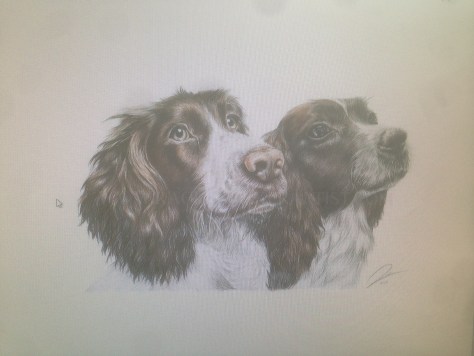
Dog Portrait Artist

Something a bit different?

Today I thought I would do a quick post to promote a lovely local artist – Rachel Baker.

I know that I am attempting to become capable of photographing dogs and of course I am indebted to my friend Kate Everall Photography for her support and talent.  But sometimes you want something more, well artistic.

Please go to Rachel’s website to see other examples of her lovely work.

TO ORDER:

Please contact Rachel Baker quoting Dentbros Dogs

Remember..

If you want to know more about me and my dogs, why not FOLLOW ME?  Then you will receive an email when there is a new post.  Please CONTACT ME if you have a problem you would like me to talk about?  And feel free to COMMENT if you want to tell me what you think.

When should you re-home your dog?

Question 19: Why would you give up your dog?

We love our dogs, don’t we?  They are part of the family and we will do anything to give them the best life possible.  Just like we do for our children.  Hell, let’s face it, our dogs ARE our children.  Our fur babies.  So why on earth would we give them up?

I’ve written previously about choosing between a rescue or breeder when getting a dog, but that is not the whole story.  The more time I spend thinking about dogs and talking to people about their experiences, the more I realise that there are many scenarios for getting a dog.  Who can judge which is the right one for you?  Only you can do that.

Why would a dog need a new home?

Here are some possible reasons:

  • Death of the owner.  Most people who have dogs want to continue owning a dog for their whole life and that’s fine, but sometimes that means the dog lasts longer than the owner.
  • Moving into accommodation that does not allow dogs.  Again, this could be due to old age or ill health in the owner, but it could also be that a rental property that allows dogs cannot be found.  I do have advice for that, having had to rent a house with three dogs, a cat and a snake!
  • Change of personal circumstances.  Often when a couple splits up, neither person is able or willing to take the dog with them.  They might be moving in with someone who cannot have their dog, due to allergy or the suitability of accommodation.
  • Having a baby.  It is really common for couples to have a dog, then decide to start a family.  The dog usually adapts fine to the baby, although not in all cases.  However, children bring their own challenges and sometimes this means there is no longer any room, or more likely time, for a dog.  A dog might then become jealous, or snappy.

Reasons involving the dog:

  • Bringing in a second (or subsequent) dog.   I have written about how many dogs you should have, but even though it is lovely to have more than one dog, they may simply not get on.  You are then faced with a life of managing the situation, or you can sort it out and move on.
  • Dog breed/type is not suitable for the life and environment provided.  Ideally, this problem should be sorted out before getting a dog, but when you don’t have a dog, it is sometimes really hard to imagine what life will be like with that dog.  (My What Dog? service can help you with this process)

When we have children, all we want is for them to be happy.  We give them everything we have to achieve this, providing them with the best possible home and loving them unconditionally.  Despite this, they grow up and leave home, never to return.  They find a partner, have children and live their own lives.  That is how it should be.

When we have dogs, we also want them to be happy.  We work hard to provide a great home for them and to love them unconditionally.  Despite this, they might need something we cannot provide.  Or they might be happier living somewhere else.

Do you see?  Just because we love someone, doesn’t make us the best person for them.  It might be heart-breaking for us, but not for them.

Ask me for Advice?

You are very welcome to contact me to ask for my advice.  I can help you with a variety of issues and problems around getting a dog and suggestions for tackling training issues.  Please let me know if you have found this post helpful?

If you want to know more, why not FOLLOW ME?  Then you will receive an email when there is a new post.  Please CONTACT ME if you have a problem you would like me to talk about?  And feel free to COMMENT if you want to tell me what you think – what is the right number of dogs to have?


Pack Walk!

What could be more fun?

Just me, three friends and 15 of our 19 dogs!  We had such a lovely time.

They were still under control, waiting for cyclists..

I wanted to get some ‘posed’ shots of each of us with our dogs.  Hmm, easier said than done. But when you have mostly collies, with a few spaniels and a Miniature American Shepherd, it’s not too difficult!  So great to have so many happy dogs.

Remember..

If you enjoy hearing about Ounce and want more, why not FOLLOW ME?  Then you will receive an email when there is a new post.  Please CONTACT ME if you would like me to write about a specific topic?  And feel free to COMMENT if you want to tell me what you think?