All posts by Dentbros

Week 7: Mystical Litter – health testing

Health testing fun and games

Honestly, health testing is the bane of my life as a dog breeder. It is my absolute desire to have the healthiest, happiest dogs possible. But that comes at a cost! I monitor the ongoing health of all the puppies I have bred and am proud of their health and temperament, on the whole. As I’ve already boasted, quite a few of the pups have gone on to become therapy dogs, supported by amazing charities like Canine Concern.

My first litter are now 11 years old, with one of these dying aged 8, from cancer. Luna is diabetic, but this has been well-managed (by me :p). In an ideal world, I would like ALL my dogs to live well into their teens, with very few illnesses and health issues.

Sadly, not everything can be prevented through responsible breeding and health testing. I have had one epileptic puppy, who was put to sleep at under two years of age. Despite a great deal of research, no test is available for this horrible condition, so we breeders can only check our lines and try to steer clear of it.

Required tests

The Kennel Club require certain health tests to be carried out as a minimum, before a litter can be registered as pedigree dogs. We are extremely fortunate that more and more DNA tests are becoming available, which can test for conditions likely to affect certain breeds.

The current requirement is for all parents of puppies to have the following tests:

  • hip score – an x-ray is carried out and analysed by a panel of veterinarians to determine the health of a dog’s hips and the likelihood of that dog developing hips dysplasia, or passing it on. The lower the score, the healthier the dog. The aim is for scores to go down with each generation.
  • eye test for CEA – an annual eye test is required to check the ongoing health of the eyes and identify any possible eye disease that may be hereditary.
  • eye test for glaucoma – a gonioscopy test is required to check for the possibility of developing glaucoma, A DNA test is now available for this, which both parents of this litter have had.

In addition to these tests for the parents, it is recommended that puppies are given an eye examination and a hearing test at the age of 6 weeks.

Specialist vets

Luckily for me, the wonderful Davies Veterinary Specialists are not far away. They are able to carry out these tests for my puppies. So on Tuesday I put the pups in the van and headed there. We arrived in good time and a team of staff arrived to take the pups away. Before the pandemic I was able to hold them during the examinations, but of course this is not currently possible.

I therefore had to wait for two hours in the car park while the tests were carried out. It was torture, being away from them for so long, although of course they were receiving exemplary care and plenty of cuddles. And of course their eyes and hearing were all fine!

I took Busy with me and met up with Gunna. He is the sire of the litter, who needed his annual check-up at the same time. Busy wasn’t very pleased to see him!

Why bother with health testing?

It is an awful lot of time and effort, not to mention the cost! So is it worth it? Well I’m really not certain about that. I hope it does give the new owners peace of mind. In addition to the minimum requirements, both Busy and Gunna have been DNA tested for other conditions. This includes MDR1, which relates to drug resistance. Dogs who carry this gene can develop reactions to drugs, including those found in common worming treatments.

The challenge is with all the bureaucracy involved! The Kennel Club should be able to cope with the volume of registrations they are presented with. They should be able to turn these around in good time, so that breeders like me would be a lot happier!

If owners knew more about what health tests should be done and why, that would also be better. This is a challenge though, as finding the information on the KC website is hard to do and the requirements keep changing!

KC registered

When a dog is ‘KC registered’, this does NOT mean it is a pedigree, or that it is health tested, or responsibly bred. Any old mongrel can get a KC registration certificate, for the ACTIVITY REGISTER. It’s just a piece of paper, but it fools some people.

What do you think? Please let me know?

Buy the Workbook

The Workbook – A Year With Your Puppy is available to buy. It was written and designed to be a hands-on, interactive book for you. It will help you survive the first year with your puppy, but also act as a memento of that time and the journey you have been on. You can write notes and stick in pictures of your puppy throughout the year. Lovely!

Remember..

Please CONTACT ME if you want to know more about me and my dogs?  And feel free to COMMENT if you want to tell me what you think. 

NO PUPPIES AVAILABLE

Week 6: Mystical Litter – first outings

First Outings for the puppies

I know that responsible owners worry about taking their puppy home. I therefore make sure that every litter has had their first outings whilst they are still with me. How will they transport them?

What is the best way to secure them in the car (a legal requirement)? I recommend having a crate in your car, if you can. It is a good safe space and you can have some vet bed down to make sure puppy is warm and comfortable, with no worries if they are sick or toilet. People like to buy a puppy from someone near to them, but these days that is rarely achievable.

I am fortunate now that I have a van to transport my dogs; highly recommended if you have more than a couple of dogs. The van is fitted with custom-made cages, which means I have plenty of secure, dog-friendly space to transport the puppies. Which is just as well, as they have a few journeys to make before they go off to their new homes!

School visit

The first trip the puppies made was to visit Heronsgate Junior School. I have been visiting this school for nearly six years (pandemic notwithstanding), volunteering with the charity Canine Concern. I take Busy and Luna in for a few hours each week to work with the children. Dogs need to be calm and gentle for this work – they need to enjoy having a fuss from children and not lick, or be too excited and jumpy (like Ounce!)

Children spending time around dogs has enormous benefits for them (both children and dogs!) It can give the children more confidence, boost self-esteem and improve learning behaviour such as asking questions, improving focus and listening skills. The children also learn about the dogs and how to behave well around them.

Since Busy has been going into school, we obviously talk to the children about the puppies and they learn all about how they grow and develop. So it is really lovely that the school are happy for me to take the pups in to show the children and staff.

Bundles of fun

It’s a bit hectic, having six puppies running around! But everyone loves it and I feel it is really good for the pups to have so much exposure to children. Many dogs are understandably scared of children, as they can be intimidating if they grab, or chase, or get into the dog’s faces. It’s really nice to teach the children how to be around young dogs and to help them understand the needs of a dog. We make lots of people very happy!

First outings for microchips

The other trip the puppies made this week was to the vet’s, to have their microchips inserted. This is also a legal requirement.

“All dog breeders are responsible for ensuring puppies are microchipped before selling them. Puppies cannot be sold until they are eight-weeks-old and must be microchipped at the point of sale. If you’re buying a puppy make sure it’s microchipped before taking them home.”

Unbelievably, people are often unaware of this law, which came into effect in April 2016. Sadly, puppies bought from puppy farmers are often not microchipped, because this costs time and money that commercial breeders cannot be bothered to spend.

Of course the law should be enforced, with vets telling owners that their puppy is required to be chipped and reporting breeders who have not done so. This requires time and commitment from veterinary practices, which they may not have. Vets are poorly regarded already, so why should they be the villains, telling owners of their cute, fluffy puppies that they have been bought from unscrupulous breeders?

Owners need to take responsibility for buying their puppies from good breeders. It’s not that hard to do. Please do your research before buying a puppy?

Lots more cuddles

I’m a terrible nag aren’t I? Being a responsible breeder is a burden, but fortunately for me I get to cuddle my cute, fluffy puppies for weeks on end. Not such a tough life!

At the end of the sixth week nearly all the owners visited together and we had a very happy time playing and chatting. It was magical for me.

Buy the Workbook

The Workbook – A Year With Your Puppy is available to buy. It was written and designed to be a hands-on, interactive book for you. It will help you survive the first year with your puppy, but also act as a memento of that time and the journey you have been on. You can write notes and stick in pictures of your puppy throughout the year. Lovely!

Remember..

Please CONTACT ME if you want to know more about me and my dogs?  And feel free to COMMENT if you want to tell me what you think. 

NO PUPPIES AVAILABLE

Week 5: Mystical Litter – family life

Fitting into family life

Just before they were four weeks old, the Mystical litter moved into the kitchen, so that they are able to get out of the run and start to explore the house, but in a safe (puppy-proof!) environment. It’s been lovely watching them in the run while we watch TV, but there is more space in our kitchen. They still have access to the outside run, which is also a bit bigger. Now they can start to enjoy family life!

Quick hide in the safe space

The puppies now start to be exposed to ‘normal household sounds’. This includes the vacuum cleaner obviously, but also all the other noises, such as the washing machine, dishwasher and the incredibly scary sound of the pepper mill! They all ran and hid when Chris was seasoning the potatoes!

A cosy crate

I have put a crate up in the run, mainly so that Busy can safely and easily jump in and out of the run when the gate is closed. She needs to access the run to feed the pups whenever she chooses, but she also needs to be able to escape! Otherwise they just feed and feed and feed and…

Helping out in the garden

Interestingly, when the crate is there, the puppies choose to sleep inside it, often piled up in a heap. Even more interestingly, they don’t toilet inside the crate – ever! They wee everywhere else in the run, including on the vet bed out there, but in the crate the vetbed stays clean and dry.

snoozing away

Lots of people think crates are cages and frown on their use. I see it as a cosy, safe space. You wouldn’t lie a baby in the middle of the floor to sleep would you? Puppies and dogs like a nice hole to sleep in, if they can get one. Busy loves sleeping under a table in a corner of the kitchen. Read more thoughts on crates/cages here.

Crying for attention

Around this age, puppies start to be aware of company and how to attract attention. My husband and I call this attractive trait ‘seagulling’ because they sound just like seagulls! It’s a horrible, screeching noise, which can be hard to deal with (especially at 5am).

sleeping anywhere

Despite being ‘home-bred’ puppies, my dogs are not given my undivided attention – that would be ridiculous! I am fortunate that I have worked from home for the last 25 years, so I am around most of the time, but that doesn’t mean I’m not busy. This week has been particularly full.

Lots of cuddles

I cuddle my puppies every day, making sure they are handled, cuddled, kissed and generally loved. Equally, I leave them to sleep and grow. As they get older, the balance shifts and they gradually spend more time around us. But at this age, they still need to sleep plenty of time. The seagulling can be when they are getting tired, but don’t want to go back to sleep – just like babies!

happy days

Family life with your other dogs

If you have another dog, as all the owners of this litter do, you need to think about how you are going to manage the puppy alongside your older dog. It is difficult to judge when is the best time to get a second dog and there is no right answer. I do know that the older dogs are unlikely to be thrilled when the puppy arrives!

One happy dad

Whatever happens, you need to make time for your older dog and ensure that they still get individual attention. I always train my puppy separately from the other dogs until they are at least 5 months old. It’s better for both dogs if you do this.

Buy the Workbook

The Workbook – A Year With Your Puppy is available to buy. It was written and designed to be a hands-on, interactive book for you. It will help you survive the first year with your puppy, but also act as a memento of that time and the journey you have been on. You can write notes and stick in pictures of your puppy throughout the year. Lovely!

Remember..

Please CONTACT ME if you want to know more about me and my dogs?  And feel free to COMMENT if you want to tell me what you think. 

NO PUPPIES AVAILABLE

Week 4: Mystical Litter – homing

Homing heartaches

I’ve thought long and hard about whether to write about homing the puppies and how difficult this can be. I do try to give an honest account on this website and am often praised for the way I write, so here goes…

Busy being brilliant

Homing puppies is the hardest part of breeding, by a mile! I’ve already said that this time I have been fortunate to have had people come back to me for a second time. That’s great, but even so, they still have to be checked as being a suitable home.

Homing – what can go wrong

First of all, when the litter arrived, I didn’t have the right number of boys and girls. So someone had to go elsewhere and I had to get in touch with people on my waiting list.

Then when I properly looked at the people I did have, one was not suitable, because she was a childminder, with a house full of various children (not used to dogs!)

Next, I had agreed to let someone have a puppy, who had a dog from Sunny’s second litter. A lot can happen in 9 years! Unfortunately, when they came to visit, I could see that the children were too young and did not know about dogs (they lost their last one over a year ago). I felt that the adults did not have enough time to train and manage the dog alongside the children and a busy working life.

Finally, to make life more complicated, I discovered that my beautiful, longed-for stud dog was no longer going to be able to go to stud. A series of unfortunate events and circumstances had conspired to make this no longer possible. He was jointly owned with someone else and lived nearby, but I realised he could no longer be half-owned by me. I was going to have to keep a boy myself!

Nothing is guaranteed

One of the disappointed people asked if I could commit to giving her what she wanted from the next litter. I couldn’t do that, because nothing is guaranteed. So many things can go wrong! This is what I say to potential owners:

  • Bitch may not be pregnant (has happened a few times to me)
  • They may not survive (has happened – litter 8)
  • She may only have a few puppies (sometimes there is only one or two)
  • She may have all one sex (I have had this)
  • She may not have a colour you would like (most people are not that fussy)
  • You may not like the puppies (unlikely, but it does happen)
  • I may decide you are not the best home for a puppy, or for the one you prefer (see above)

It’s a tough old game and not for the faint-hearted. I’ve had one pup come back to me at 13 months for being snappy with children. He’s now been assessed as a therapy dog, as he is in the right home. Such a lovely dog! So it’s made me even more circumspect about which puppy goes to which home. I have had pups from most of my litters go to:

  • first time dog owners
  • people with children of all ages, including a toddler
  • people who work full time
  • people with other dogs
  • people with cats

So I am not unreasonable, or particularly difficult to please. But if I think there might be a danger of a dog biting someone, I am not going to send that dog to that home. I’d be pretty irresponsible if I did, wouldn’t I?

Happy endings

Happily for me, I get plenty of absolutely lovely people wanting a puppy. People who have done their research, looked into what they want and ask all the right questions. Those people will be delighted with their puppy and welcome it into their family. That’s such a joy to me. They understand how to contact a breeder and that it might be necessary to wait for the right litter.

so pleased to meet you, mum

Puppies growing away

Despite all my angst, the puppies continued to be an absolute joy. I made their run bigger this week, but we carried on enjoying watching them alongside the TV in the evenings.

They can hear now and are getting much more active. I would love them to be outside but it’s still been mainly cold and wet.

Buy the Workbook

The Workbook – A Year With Your Puppy is available to buy. It was written and designed to be a hands-on, interactive book for you. It will help you survive the first year with your puppy, but also act as a memento of that time and the journey you have been on. You can write notes and stick in pictures of your puppy throughout the year. Lovely!

Remember..

Please CONTACT ME if you want to know more about me and my dogs?  And feel free to COMMENT if you want to tell me what you think. 

NO PUPPIES AVAILABLE

Week 3: Mystical Litter – eyes!

Eyes open, looking around

After just two weeks, puppies open their eyes! It’s lovely to see them and meet them properly for the first time. This time, I wanted to have a go at taking pictures of them individually, which I was able to do, as I have been working on my photography skills!

Arla, just peeping

It’s always interesting to see my puppies with their eyes open, as I have had quite a few with heterochromia iridum, where the irises are a different colour. This has been most notable for me in Busy, but she has two older brothers and a son with the same condition. These puppies all have matching eyes, although the blue and white girls look green and the chocolates will probably be amber in colour.

I can see you

Up on their feet

Two week old puppies are already starting to stand up, but they are still very wobbly. Initially, they get around by commando crawling on their bellies, although you would be surprised how far they can travel using this method!

Meeting her big sister

They start to move around more at this age, but are pretty unsteady and often roll over. The puppies navigate mainly by smell, but a couple of days after their eyes open they start to see where they are going. Then they can meet big sister Ounce!

They still fit

Trying out real food

Once they can see and are up on their feet, I start to think about giving them so food. This time I waited until just before they were three weeks old, because I knew Busy was doing a great job feeding them herself.

There’s food under there

They eat really well from day one, but they don’t really need it. Once I’ve started to introduce kibble, soaked in puppy milk, I try to give them some food several times per day. It becomes a bit of a game of tag with Busy, as we both feed them puppies at frequent intervals.

It’s delicious

Of course I still continue to feed her numerous big meals throughout the day, so I start to feel a bit of a feeding machine.

I can see my face now

More cuddles

We continue to have some visitors. People often wait until they are older, when they are running around and doing a bit more. I like it when people visit at this age, as I can sit and chat, rather than running around mopping up wees, changing the newspaper and making up feeds!

pink paws

Buy the Workbook

The Workbook – A Year With Your Puppy is available to buy. It was written and designed to be a hands-on, interactive book for you. It will help you survive the first year with your puppy, but also act as a memento of that time and the journey you have been on. You can write notes and stick in pictures of your puppy throughout the year. Lovely!

Remember..

Please CONTACT ME if you want to know more about me and my dogs?  And feel free to COMMENT if you want to tell me what you think. 

NO PUPPIES AVAILABLE

Week 2: Mystical Litter growing

Growing and sleeping puppies

Border Collie puppies don’t do much from 1-2 weeks of age. Except growing, constantly! They double their birth weight around days 8-9, which I find pretty impressive, especially when there are 6 of them!

Growing

Of course that weight comes from the milk provided by the mum, so you might think there is nothing for me to do, but actually, I work pretty hard caring for Busy. She gets fed a bigger meal than normal, up to six times per day! I feed her a good quality kibble, with some puppy milk and puppy food, I add in extra protein, such as tinned tuna, to keep her eating. Busy is not a particularly good eater- she is prone to being a bit fussy, so I have to tempt her a bit.

Gazing and cuddling

As always, I spend many hours every day gazing at my new puppies and enjoying the snuffly, squeaky noises they make. Well I enjoy them during the day, not so much at night! I keep them up in my bedroom for the at least the first week and usually nearly two weeks. I like them to be kept away from the bustle of the rest of the house and to have Busy where I can keep an eye on her.

Hiya

Out and about

Busy sleeps in her whelping box for the first week or so, feeding the puppies for much of the time. By the second week she has started to come out of the box more and having some ‘time out’, to recover.

Still pretty small

All my dogs go out for their normal, off lead, hour-long walk a couple of days after giving birth (see my thoughts on exercise). I think it’s really healthy for them to have time to run around with the other dogs and enjoy a bit of exercise and fresh air. There is little to no risk of carrying infection, because of course they are vaccinated against all common diseases.

sleeping anywhere

Moving downstairs

When I decide I’ve had enough sleepless nights I move the pups downstairs, into another quiet room. This time I set up a small run, with a bit of cardboard instead of the whelping box, as it didn’t fit in the setup I wanted. This worked well for a bit, as it kept the pups sleeping in a draught-free corner.

A new setup

Sorting out homes for growing puppies

I have been extremely fortunate to have had more of my lovely puppy owners come back to me for another one this time! Altogether I have had 9 people come back for more than one puppy, which makes me extremely proud as a breeder.

Which one will they choose?

I have also been really lucky to keep in touch with the majority of my puppies, so I am able to track their progress, support their owners and monitor their health and temperaments. Quite a few of my puppies have gone to friends or family and many of my owners have become good friends. Of course these people get to meet the puppies very early on!

Some of the people waiting for this litter knew what they wanted (blue and white girl for example) and were lucky enough to get that! If you want a particular sex of puppy and I don’t have enough, you might miss out. And sometimes the plans change.

Chief cuddler in action

It’s really tough as a breeder, deciding which puppy goes where. Of course I want to take people’s choices into account. But I have to evaluate homes and decide if the puppy is going to be best placed there, or with someone else.

Buy the Workbook

The Workbook – A Year With Your Puppy is available to buy. It was written and designed to be a hands-on, interactive book for you. It will help you survive the first year with your puppy, but also act as a memento of that time and the journey you have been on. You can write notes and stick in pictures of your puppy throughout the year. Lovely!

Remember..

Please CONTACT ME if you want to know more about me and my dogs?  And feel free to COMMENT if you want to tell me what you think. 

NO PUPPIES AVAILABLE

Week 1: Mystical Litter here

Here are the Mystical Litter!

Here we go! On Monday 19th April, Busy gave birth to 7 beautiful puppies. She had a restless night, without being ‘properly’ in labour. Then she finally got going around 8am and suddenly produced three puppies! We then waited around, with her being very calm and relaxed. She had been scanned for 6 puppies, so I knew we were not finished.

As we approached midday I decided she needed a bit of help along the way. We popped round to the vet’s for an oxytocin injection. Very straightforward, (although she didn’t like being away from me). The vet said there was nothing obvious in the birth canal.

However, after the five minute journey home we went upstairs and she had four more puppies within forty minutes! So the injection worked perfectly and the pups were all safely delivered.

One down..

The pup that caused the hold-up was a little lilac girl. I was thrilled to see her, as lilacs are so rare. Sadly, she was extremely small and under-developed. She was barely alive. I breathed on her and rubbed her, so she seemed to get going. But she was extremely weak, prone to getting cold and struggled to feed.

Just a murmur

On the second day, I tried feeding her milk myself, which she seemed to take. However, she wasn’t really there and within 48 hours she had slipped away. Busy did notice she had gone and looked for her, but then she got on with it, looking after the others so brilliantly.

Three pairs

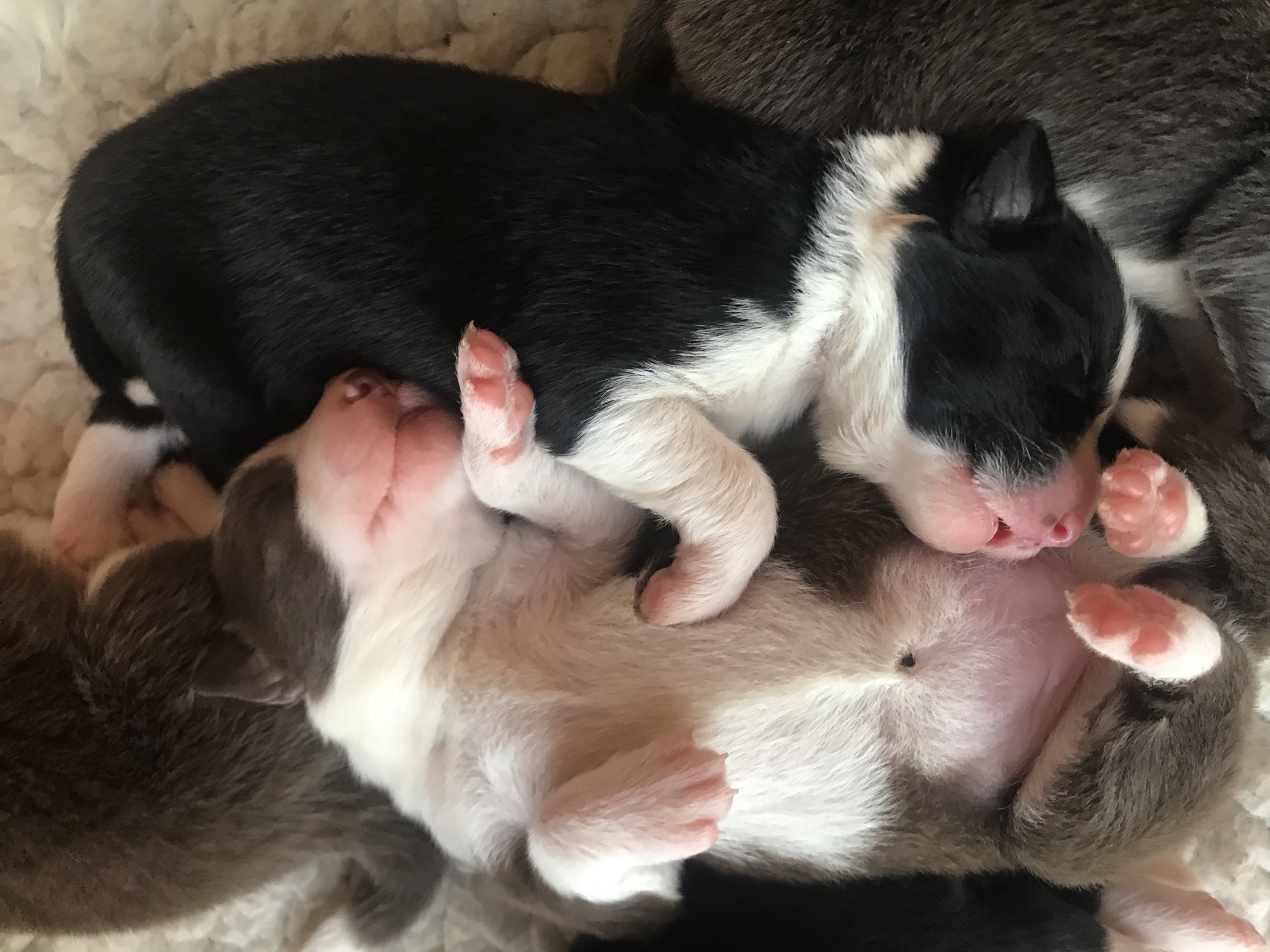
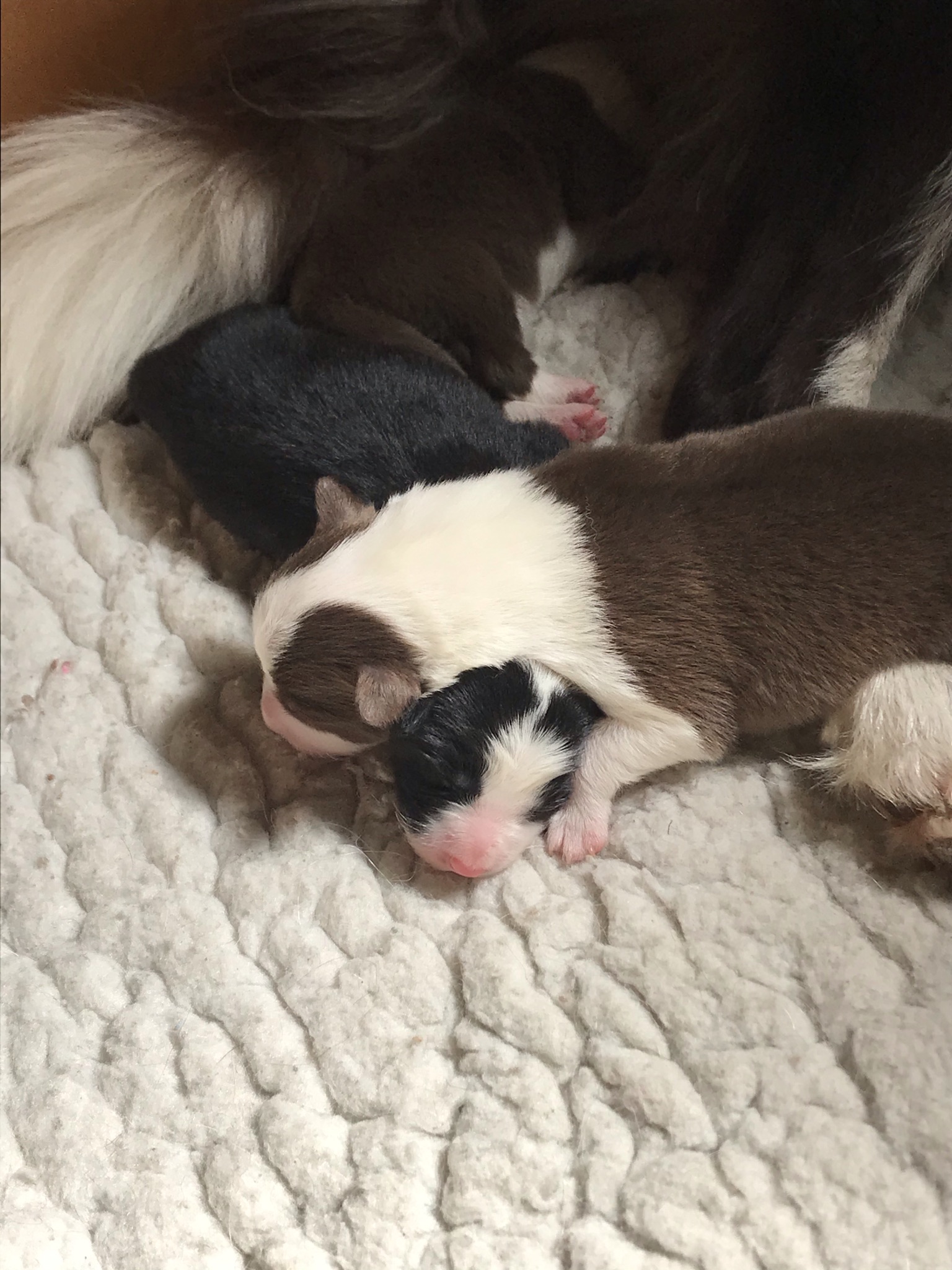
We have three pairs in this litter – a pair of black and whites, a pair of chocolate and whites and a pair of blue and whites! Both the blues are girls but we have a black and white boy and a chocolate boy. Lovely! They are all ‘classic collies’ with absolutely textbook markings. Busy is a fantastic mum, extremely attentive and thorough with her cleaning and feeding.

Two of each

The puppies weigh 250-350g at birth, but they soon start to gain weight! They feed almost constantly, so poor Busy gets very little rest.

Who’s the dad?

The sire of these puppies is Goytre Smokin’ Gun – Gunna. He is also the sire of the Sweetie Litter, so I knew exactly what these pups would be like. He is an amazing boy, with a super temperament. I am very fortunate that so many of my puppies are from the Goytre lines.

Gunna

NB: All have homes

I have been inundated with enquiries for puppies for the past 15 months – up to 5 PER DAY! during the first Lockdown. I still get an enquiry every day, but thankfully people do now realise they will have to wait a long time to have a puppy from a responsible breeder, such as a Kennel Club Assured Breeder.

pink noses, pink toes

I have had a waiting list of people, but in addition I have been extremely fortunate (and proud) that quite a few people who have had dogs from me before have come back for a puppy again. So I knew straight away that these puppies all have homes.

Buy the Workbook

The Workbook – A Year With Your Puppy is available to buy. It was written and designed to be a hands-on, interactive book for you. It will help you survive the first year with your puppy, but also act as a memento of that time and the journey you have been on. You can write notes and stick in pictures of your puppy throughout the year. Lovely!

Remember..

Please CONTACT ME if you want to know more about me and my dogs?  And feel free to COMMENT if you want to tell me what you think. 

NO PUPPIES AVAILABLE

6 Tips to Deal With Problem Puppy Behaviour

Damage Limitation: 6 ways to help you manage your problem puppy

This week I have been asked for advice from a few people having to deal with all the usual problem puppy issues. I thought it would be helpful to share some of my experiences and thoughts with you.

Puppies are so annoying and challenging! They just don’t do what we think they will. We imagine our life with a wonderful dog and it just doesn’t seem like that straight away. I have written about this a few times, including in the post about getting the perfect dog. One of the biggest problems is that we don’t ‘speak dog‘ and irritatingly, they don’t speak human! I saw a post about an app that claimed to help you speak dog (it was rubbish).

Gorgeous Rusty

Seriously though, there are ways of understanding our dogs and coping with their behaviours. Sometimes, it’s about managing that behaviour, rather than trying (and failing) to change it. Here are my top 6 annoying behaviours that you might find it easier to manage than to train away.

1. Barking at the doorbell

The doorbell rings, the dog barks. Fact. I was thinking this morning about how you might train this association out of your dog. You might be able to do this by sitting calmly with your dog, completely ignoring the doorbell. Acting as though nothing has happened.

Of course you can’t do that, because if the doorbell rings, you MUST answer it! So what happens when the bell rings? You react. You get up, you go out, you answer the door, you speak. In the past, someone would then enter the house. These are all actions that are exciting for your dog. So if you have to answer the door, your dog very quickly learns that they MUST bark!

Luna is better than any doorbell

Our natural instinct in this situation is to shout at the dog to be quiet. SHUT UP! What the dog hears now is you joining in with the barking. That’s a brilliant game! He barks, you bark. How exciting! Is that a problem puppy or just a dog?

ACTION: When the doorbell rings, calmly put the dog away in another room. Don’t speak to your dog, or touch it more than you have to. Shut the door and go and answer the front door. It’s not very exciting for the dog and nothing much happens. NB: You will NOT stop your dog barking. Don’t try. Just manage the situation.

2. Barking at squirrels, cats and birds from the window

This is almost exactly the same as the doorbell situation, with a pretty similar solution. Barking at squirrels, cats and birds is a dog’s job. It’s what they live for. So if you have a dog that can sit at a window and watch other animals in the garden, they will obviously bark at them. You should be saying “Good boy! Well done for barking and doing your dog job”. I’m guessing you don’t do that?

It’s a CAT!

ACTION: Don’t let your dog sit at the window and bark, unless you like him doing it. Don’t shout at him (joining in). Just move him away from the window. Move your furniture around if you have to. Block off part of the window with frosting. Best of all, put your dog in a part of the house with no access to a view of the garden.

Then spend time with your dog, just chillin’. Watch TV together, or sit and work, with your dog lying calmly at your feet. Then take him for a nice walk, off lead, where he can chase those pesky squirrels and bark at all the birds!

3. Coming when called

Recall of your dog is the subject of whole training courses. I have written several posts about recall on this website (search ‘recall‘). But it’s a massive issue for everyone and the one thing that causes endless hassle. Because if your dog doesn’t come when you call it, you can’t let it off the lead. You can’t open the front door without worrying he will run off. You’re always on tenterhooks in case he runs onto a road.

ACTION: Let’s get straight to it. The easiest way to get your dog to come back to you is TO PRACTISE! I don’t mean when you are out on a walk and you get to the end of it and want to put him back on the lead. I mean every 5 minutes!

Ounce is nearly 4 years old and I STILL practise recalling her a few times every day on our walks. ‘Ounce come!’ and then give her a treat.

Start in the house. Call your dog “Dog come!” Use their name, with the word come. Be clear and exciting, positive and purposeful. Wait for them to come and then give a reward. This can be a tasty treat, or a toy and a game, or a fuss and a pat, or just a bit of lovely praise. “Well done! What a good boy.”

When you dog comes to you around the house, they are more likely to come when you are out. If you are interesting and rewarding, why wouldn’t they want to be with you?

4. Problem puppy: Running up to other dogs

Following on from the challenge of recall, we have the problem of your dog running up to other dogs. This is often an unwanted behaviour, because the other dog may not be friendly. Again, I’m afraid the solution is PRACTISE RECALL! It really is that simple.

ACTION: You need to teach your dog to have good manners. Your dog needs to be able to say hello politely and to come away when needed. It takes time and patience, but it can be achieved.

Nice to meet you

I saw a lovely example of a young German Shepherd puppy, around four months old, doing exactly this. The owner engaged the pup with a toy before we were near. As we walked past, the owner had gone ahead, so the pup inevitably came jauntily up to my dogs. They weren’t impressed, but the pup was already learning that bouncing and jumping were not required. The owner then called the pup and off it went to its dad. Hurray! How lovely. Of course it will get worse before it’s perfect, as the dog hits adolescence, but hey, it’s a work in progress.

5. Barking at other dogs

Dogs bark at other dogs because they are either excited or scared. When dogs are off lead they rarely bark at other dogs, so that’s the easiest action to take. Again, a good recall is vital.

If your dog is on lead, you can start by deciding whether he is desperate to play with the other dogs, or worried that they might come near you. If they are worried, is that because you are worried?

What do you think dad?

ACTION: Ignore the other dog. It means nothing to you. It is of no interest. Your dog? Your dog is fantastic! You want to play with your dog! The more exciting, interesting and confident you are, the less your dog will take any notice of other dogs. Please DO NOT stand still, anxiously gripping your dog’s lead and worrying that the other dog might rush over to attack you and your dog? Honestly, most dogs have better things to do.

6. Dogs who live together mating (or trying to)

I’m including this last point, even though it’s not really a problem puppy issue because someone contacted me about this specific situation. I was really disappointed that a breeder had sold her brother and sister pups and not told her how to deal with this situation. I also felt the vet should have advised getting the male castrated at 6 months. Although we like to try and leave neutering a bit longer these days, some situations make it more important to get it done. We do NOT want accidental matings, particularly of brother and sister!

So can you train this behaviour out of your dogs? You could more easily hold back the sea. Of course you can keep them shut in different rooms, but you may well end up with howling, scratching dogs, off their food and generally being a complete wreck.

Sisters and brother together

ACTION: Send one of your dogs (usually the boy) to stay with family or friends. This is another case of ‘damage limitation’ and honestly, it is much better to have peace of mind than try and manage it.

The first week of a bitch’s season is usually not too bad. Once they stop bleeding as much, they are fertile and that’s when the fun starts. So be prepared and take the easy action to manage your problem puppies?

I hope you find this helpful. Good luck with your problem puppy!

Buy the Workbook

The Workbook – A Year With Your Puppy is available to buy. It was written and designed to be a hands-on, interactive book for you. It will help you survive the first year with your puppy, but also act as a memento of that time and the journey you have been on. You can write notes and stick in pictures of your puppy throughout the year. Lovely!

Remember..

Please CONTACT ME if you want to know more about me and my dogs?  And feel free to COMMENT if you want to tell me what you think. 

NO PUPPIES AVAILABLE

Enrichment Activities for your Dog – Guest Post by Karen Young

This post is taken from Karen Young’s website: Safe Hands Clinical Canine Massage

Is every day feeling like Groundhog Day?

Groundhog Day is an American custom held on the 2nd February every year. If the hibernating Groundhog comes out of its den to sunshine he will see his shadow. Legend states this will mean 6 more weeks of winter and so the Groundhog will return to his den and go back to sleep. If the day is cloudy with no shadows the Groundhog will stay out of his den and spring is just around the corner. I am definitely hoping for cloudy!

We know the 1993 film Groundhog Day better in the UK, where every day is literally the same day, over and over again. With Covid restrictions, home learning and working and limited entertainment options I have a much better understanding of how Bill Murray’s character would have felt.

Life can be boring for our dogs

An enrichment opportunity for our dogs

But perhaps, this year has also given us an amazing opportunity to relate better to our pets and particularly our dogs. Most dogs live in a permanent state of Groundhog day. They are completely reliant on us and we usually set their daily routine at least during the week.

I realise that our dogs are no longer wolves, but if you compare the variety involved in a wolf packs day – socialising, playing, sleeping, hunting, patrolling, arguing, exploring and investigating throughout the day – with the average UK dog you may begin to see what I mean.

We have all been at home more over the last year and our dogs will have got used to our presence and our new routines. But as the metaphorical spring – with the roll out of vaccinations – is around the corner our routines are likely to change once more. This could mean our dogs will once again be left for extended periods of time and the days become even more regimented once more. There are likely to be some behavioural issues associated with separation anxiety, boredom and general stress for many of our dogs as they try to cope.

There are many blogs out there on helping your dog with separation anxiety so I won’t go into any detail here. But there are simple things you can do to help your dog break out of the routine and enhance your dogs quality of life.

Enriching your dog’s life can help your dog relax and cope

There are many things you can do to enrich your dogs life experiences, here are just a few:

Learning & Training

Most dogs love to learn, but many will only experience ‘training’ as puppies whilst we teach them the things we expect from them – toilet training, sitting, recall, stay, lead walking and oddly, give paw.

Karen’s dog Eva learning to pick up her feet

But dogs, like us, love to learn throughout their lives. Teaching new skills can be extremely rewarding. Why not try to teach them to walk backwards, spin (both ways), shake on command, stretch, or take them to a fun agility class?

Your dogs ability to learn is often limited by your own imagination. You only need to watch dogs ‘dancing to music’ to see how much they can really do.
https://video.wixstatic.com/video/bad9ea_e81476f1e6c9491c9c42446b3c7deea1/720p/mp4/file.mp4

“Tidy Up” by Helen Greenley, Animal Behaviourist, Aberdeenshire

Feeding

For many dogs their dinners are the highlight of their day, but when the food is gone in seconds this highlight is very short-lived. Feeding using interactive feeders will mean your dog is using their body and brain. Eating is slowed down making the whole process far more rewarding and also more natural.

Your dogs’ ancestors would hunt, catch, kill and eat their prey. You can mimic their natural behaviours with scatter feeding, hiding food and feeding out of slow feeders such as Kong. Feeding raw bones, hairy ears and cartilage based food can also take your dog longer to eat. This will give them valuable nutrients. There are lots of excellent independent pet shops that will be able to advise you on thi. My personal favourite is McGrumpy and Snuffles, in Aylesbury.
https://video.wixstatic.com/video/bad9ea_59bd972ed5344f1894e2c7a49a02259a/480p/mp4/file.mp4

Little Mia, above, has some neck pain, so this fun food game is also really helpful for getting her to stretch her neck downwards.

Play and Exercise

Eva loves to get higher and walk on obstacles

All dogs need opportunities to express themselves and explore their world. This is one of the reasons dogs need to go out for walks. Why not look at ways you can enrich this experience for them.

You should take their favourite toys out on walks and hiding them for your dog to find can be super rewarding for your dog. If your dog is ball obsessed reconsider using a ball thrower? I have already produced a blog on why I don’t particularly like them. You can always use the ball as a reward for some impromptu training. Why not train a send away, reinforce the recall or a sit and stay?

Benji supervising my blog writing

Sniffing and exploring

Let your dog sniff and explore their area. I see too many dogs being marched around on walks with owners or dog walkers completely focussed on their phones. But walking the dog is a sociable activity for most dogs. If they were part of a dog pack they would often go off together to patrol or explore. They would communicate and interact with each other whilst on the move. If you are on your phone, you are missing an excellent opportunity to really bond with, and deepen your relationship with your dog.

Dogs are incredible, intelligent, loving and loyal and deserve the very best from us. I would love to hear what you will be doing differently to enrich your dogs life.

The things your dog can learn are limited by your imagination.
https://video.wixstatic.com/video/bad9ea_9d25413da37d48e98c2877f8c260a3d1/720p/mp4/file.mp4

Playing Dead

Buy the Workbook

The Workbook – A Year With Your Puppy is available to buy. It was written and designed to be a hands-on, interactive book for you. It will help you survive the first year with your puppy. The book will also act as a memento of that time and the journey you have been on. You can write notes and stick in pictures of your puppy throughout the year. Lovely!

Remember..

Please CONTACT ME if you want to know more about me and my dogs?  And feel free to COMMENT if you want to tell me what you think.  If you want to know more, why not FOLLOW ME?  Then you will receive an email when there is a new post.
Thank you to Karen for letting me share one of her excellent blog posts. There is a lot more information on her website: Safe Hands Clinical Canine Massage. If you would like me to share one of your blog posts, please get in touch?

YKC – Activities for Dogs and Kids

Young Kennel Club: fun for all the family!

Hollie is 19 years old and has two dogs, Blue who is a Harrier Hound mix aged 8 and Pixie, a 3 year-old Border Collie (and Dentbros pup!) Hollie says that mum Sarah originally started doing agility because she attended obedience classes at a group that also did agility.  It looked like fun and Blue needed something to tire his brain as well as body as he was quite an active dog that easily got bored.

Hollie went along to shows with Mum and started competing in junior classes 5 years ago, competing at Crufts with Blue for the last 3 years. She also competed with Pixie in 2020, making me a very proud breeder!

The best dog for the job?

Blue is a hound cross and this can make agility training a challenge, as he’s more interested in sniffing than agility.  However this can make any successes all the sweeter, especially if they compete at Crufts.

Hollie says “I was lucky to get my own dog nearly 4 years ago.  She was chosen specifically with agility in mind.  Collies are intelligent, fast and agile, the perfect combination for agility.  We were lucky to qualify for Crufts in the Young Kennel Club competitions when she was just 2 years old.” Pixie has already achieved a number of great results and looks set to go on to greater things, the pandemic notwithstanding!

Hollie says the beauty of agility is that pretty much any dog can have a go (even dachshunds).  This is an energetic sport and can put a strain on breathing, muscles and joints. Short-nosed dogs who have trouble breathing on vigorous exercise and heavy-set dogs, are not suitable.

Agility is fun

Agility is run in a similar way to show jumping. The fastest dog with the least faults that wins.  You get 5 faults for each jump the dog knocks down or refuses.  There are agility obstacles which have ‘contact points’ that the dog must touch while completing them. This includes the seesaw, the A-frame and the dog walk.  Faults are given if the dog misses these contact points (to stop them damaging their joints).  You get eliminated if you take any jumps in the wrong order.

There are a lot of competitions for all levels of competitors. You might be a beginner and want to have a go at a local club show. Or you’ are an agility professional aiming for the main ring at Crufts and representing your country in European and World championships.  It is an inclusive activity and lots of fun for you and your dog!

Why do you like it?

Hollie says “It’s a great way to have fun with your dog.  It’s so rewarding when the hard work you’ve put in training pays off in the competition ring.” Agility is a very social sport, people support each other, whether you’re having a great day or it’s all gone a bit pear-shaped. It encourages you to keep fit, so you can be as fast as you can around the competition courses.

However, Hollie says it is important to remember that dogs are not machines. It takes dedication to train a dog to compete in agility.  You need to be resilient. Because no matter how hard you train, it quite often doesn’t go the way you planned!

Hollie says she trains and competes in all weathers.  If you like being outdoors that’s great, but there can be a lot of waiting around at competitions.  If you start to get really involved, the cost of entering competitions can add up, along with entry fees. You may also need to book overnight accommodation if the competition is a distance away. 

Who’s in charge and what do you need?

The governing body is the The Kennel Club. Juniors can compete in Young Kennel Club competitions, competing in one of two age groups; up to 12 and over 12 years. There are also lots of agility clubs that run independent shows not governed by the kennel club.

Agility equipment takes up quite a lot of space. Most people train at an agility club where they have full sets of equipment and space for you and your dog to train safely. You need a pair of trainers, comfy clothes, your dog and plenty of tasty treats or a toy they love to reward you dog for their hard work.

If you decide to really get involved in the sport you can do some training with 1 or 2 jumps and some weaves in your garden.  Hollie and Sarah have also taken equipment to the local park, but she says you do get an audience 😊!

Getting started

Hollie trains in a class once a week for an hour.  She says that lots of people do more training, depending on what level they are at. You can really train anywhere, even while on your walks. Send your dog around obstacles, or practising a wait, which is really important.  Keeping your dog’s general level of fitness is key. Agility puts a lot of strain on a dogs joints and muscles and they can get injured.

Thank you so much Hollie for this invaluable insight. We wish you lots of luck on your journey with Pixie in agility!

Buy the Workbook

The Workbook – A Year With Your Puppy is available to buy. It was written and designed to be a hands-on, interactive book for you. It will help you survive the first year with your puppy, but also act as a memento of that time and the journey you have been on. You can write notes and stick in pictures of your puppy throughout the year. Lovely!

Remember..

Please CONTACT ME if you want to know more about me and my dogs?  And feel free to COMMENT if you want to tell me what you think.  If you want to know more, why not FOLLOW ME?  Then you will receive an email when there is a new post.